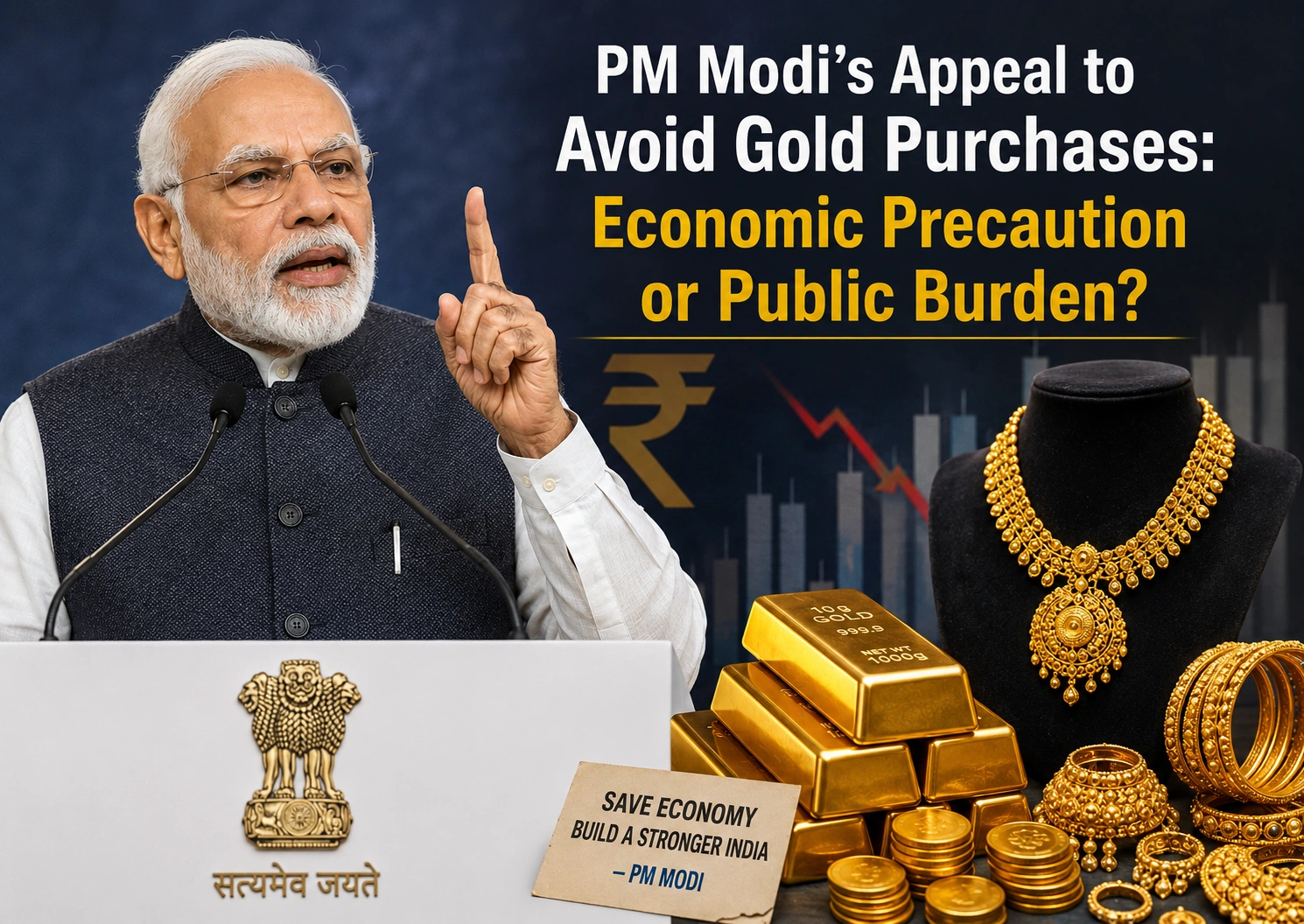
Recently, PM Narendra Modi made an unusual economic call to the nation. At a public rally in Hyderabad, he requested the citizens of the country to refrain from buying gold for one year, reduce fuel consumption, put off non-essential foreign travel and adopt cost-saving measures like working from home wherever possible.
This appeal was given against the backdrop of worsening global economic turmoil resulting from the conflict in West Asia and rising crude oil prices.
This statement instantly became a hot topic for political and economic discussions as gold has a significant cultural, emotional, and financial role in Indian life. India is one of the largest consumers and importers of gold globally, In particular during festivals and weddings. That means, the Prime Minister’s request was considered not just financial advice but a wider call for economic restraint and “economic patriotism.”
While some viewed this move as a responsible step during a global crisis, others felt that citizens might be demanded to bear the larger economic burdens. This whole discussion reflects the anxieties related to energy security, foreign exchange reserves, inflation, and public engagement during times of global instability.
What Did PM Modi Say?
In his Hyderabad speech, PM Modi called on the citizens to take a conscious step towards Really curbing activities that add pressure on foreign currency reserves and Because of this, to:
- Not buy gold for a year
- Cut down petrol and diesel consumption
- Use public transport and carpooling
- Implement working from home where possible
- Avoid non-essential foreign travel
- Buy local products
- Cut down on cooking oil
Indian Prime Minister indicated that the measures were a must as the country’s economy was pressured by global tensions and increased prices of imports. He explained that preservation of foreign exchange ought to be made a collective effort when the globe is going through an unstable situation.
The address intertwined economic patterns with notions of patriotism and self-sufficiency, ideas that the government has been promoting regularly in recent times.
Reasons Why Gold Was Highlighted
Gold has a very special spot in the Indian community. Besides being a raw material of investment, it’s also regarded as a representation of history safety savings, and cultural heritage. Big ceremonies, religious activities, or buying gold for family savings are the moments when the biggest quantities of gold are obtained.
Still, as India mainly sources its gold from outside, gold shopping means more foreign currency, mainly US dollars, will go out. Due to the geopolitical situation, global oil prices are at a peak. So, huge gold imports are putting more pressure on India’s trade deficit and foreign exchange reserves.
Those versed in economics say that holding back non-essential imports is one way to keep the rupee steady and alleviate external pressures on finance during world crises. This seems to be the main economic reasoning behind the Prime Minister’s call.
Worldwide Crisis and Economic Stress
The request was made while the international situation is tense and the globe is witnessing the consequences of the West Asian conflict. The rise in global oil prices has impacted the countries that predominantly rely on energy imports.
India is an oil-importing nation as it meets only less than 15 percent of its crude oil needs from domestic sources. The reports indicate that the situation in the Strait of Hormuz and the disruption of global shipping routes have heightened fears of prolonged energy instability.
One of the major uses of foreign exchange is the payment of the import bill of oil when the prices of oil go up. But, continuous purchases of gold and spending by residents outside the country lead to a further demand for foreign currency.
A combination of these two factors might cause a depreciation of the rupee, higher inflationary pressures, and a depletion of foreign exchange reserves.
The government Because of this made an emphasis on the concern for economic strength amid the globally uncertain time.
Drive towards Economic Independence
Self-sufficiency and less dependence on imports were the two central themes of the talk. Prime Minister Modi associated the call with the grander “Vocal for Local” initiative which was unveiled at the beginning of the COVID-19 outbreak. He motivated the people to recognize the items of foreign origin they use every day and to gradually switch to locally manufactured ones.
The speech also contained, among other things:
- More frequent use of electric vehicles
- Greater reliance on railway transportation
- Advocacy of natural farming
- Lessening of chemical fertilizers usage
The main takeaway was that, during global upheavals, economic discipline and domestic production really help. Proponents of the administration believe that the economic strengthening through such joint efforts is possible.
Public and Political Reactions
Prompting instant political reactions nationwide, the speech didn’t go unnoticed. Opposition leaders castigated the request, asserting that regular people were being asked to make sacrifices for the government’s mistakes and the state’s unpreparedness in economic matters. Rahul Gandhi labeled the request as a sign of a failing government, and other opposition leaders wondered why people should cut down on their spending when the economy is doing well.
Meanwhile, those are pro-government viewed the PM’s speech as an example of mature leadership in a difficult global economic situation. In fact, some ministers and BJP leaders called the request a practical guide to help the country achieve economic stability and become self-reliant.
Public opinion was equally split. Although some welcomed the alert towards the economy, many the public was very sceptical about the PM’s plea to avoid the gold purchase, given that in India, gold is a part of culture and tradition, particularly during weddings and also as a form of saving.
Effects on Gold Markets and Businesses
The Prime Minister’s remarks have touched financial markets and the jewellery industry as well. It has been reported that shares of some jewellery companies dropped after the appeal was made, as investors got worried about the possibility of lower consumer spending. Analysts also started to wonder if a decline in gold consumption could bring problems for the retail jewellery sector, mostly during weddings and festivals.
Then again, going by experts’ views, it might be next to impossible to totally change how Indians buy gold as besides investment, other factors like emotion and culture come into play in gold demand.
Several families in India still consider gold as a safe form of savings – Mainly when the economy is insecure. The bottom line is that it’s still not clear if the appeal will bring about a lasting change in how people consume gold.