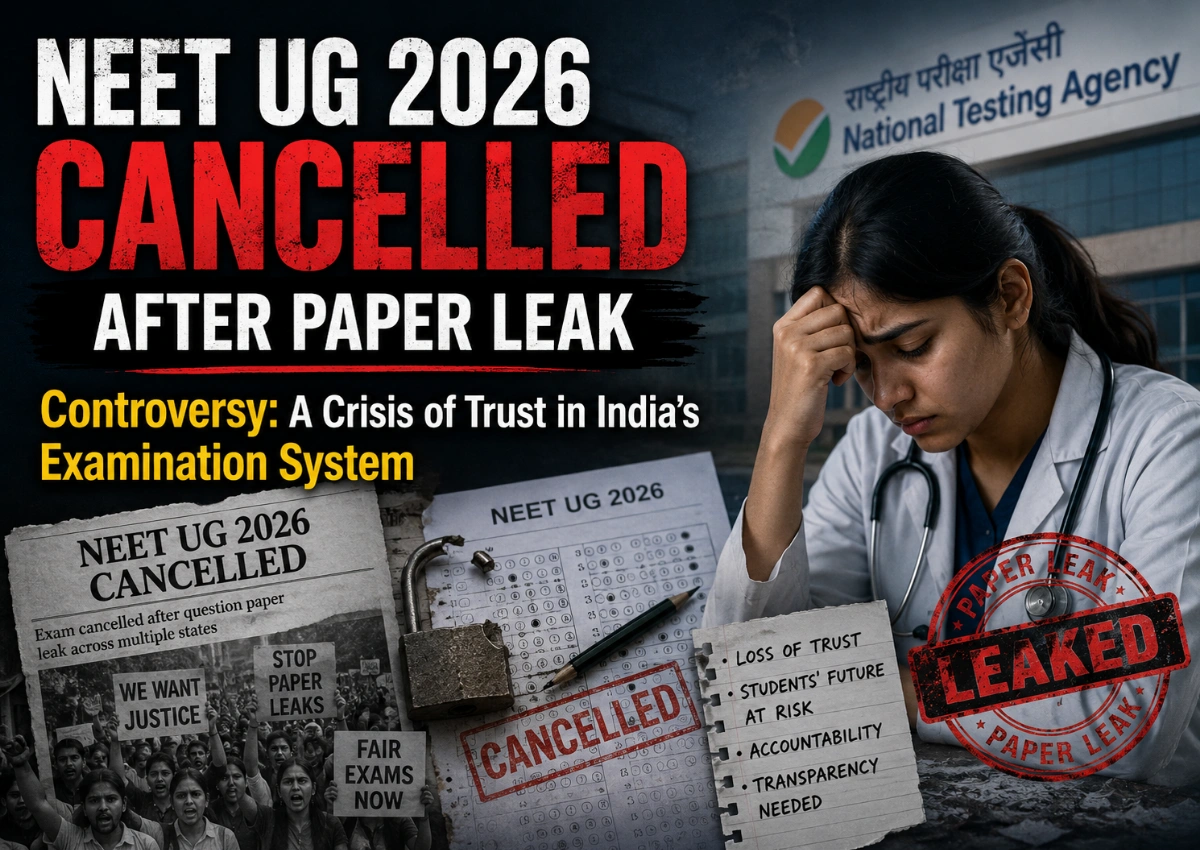
NEET UG 2026 has been cancelled following allegations of a giant paper leak, sparking one of the largest education controversies seen in recent times.
The NTA’s move on the 17th of August 2023 was seen for protests, student eruptions, and inquiries into large cheating syndicates said to be operating due to WhatsApp and Telegram groups. The NEET Exam, or the National Eligibility cum Entrance Test, is one of the most competitive entrance examinations in India and places lakhs of students in medical colleges every year.
For lakhs of aspiring students, this is the culmination of several years of dedication, emotional labour, and loss for their families.
So, cancelling has meant not just administrative chaos but also profound upset for students and parents. The controversy has once again brought to focus all the very critical issues of examination security, coaching events, online cheating networks and public confidence in the system of high-stakes competitive exams in India.
What Happened?
The debate had sparked off after reports were circulating that some of the ‘guess papers’ that were doing rounds on messaging platforms showed an uncanny familiarity with a few sets of questions appearing in the original NEET UG 2026.
Investigators claimed to have come upon some groups on WhatsApp and Telegram where answers and papers were exchanged before the exam.
Students and hostel authorities in Rajasthan then expressed doubts when they observed the unusual closeness of leaked question papers to the original question paper. As public outrage increased and the opposition parties called for action, the NTA claimed that the examination had been called off and announced new dates later after investigation and security review.
Why NEET Matters So Much
NEET is not just a common entrance examination. It is the only common entrance for all medical colleges of the country.
Be it MBBS, BDS or some allied courses. There are millions of students taking the test.
Families would also spend a great deal on coaching and preparations; Students spend years preparing. Much of how futures turn out time-wise is dependent on performance in exams.
For many middle-class and rural families, success in NEET is an aspiration that offers opportunity for financial stability and social upward mobility.
This sign of fierce competition has made an educational context so tense and stressful, with in reality even light irregularities being paid with a firestorm of rage from the general public. The cancellation is, because of this, not only constraining schedules but also emotional confidence as well.
The Growing Problem of Paper Leaks
The NEET row is not an isolated one. Several such competitive exams in the last few years have had their share of controversies over:
- Paper leaks paper leaks
- Cheating gangs.
- Technical failures
- Exam system corruption
This has already been discussed under exam centre corruption.
As an extension, though, we can see that the overall exam system can be abused, kits being tampered with, an exam being taken on the wrong day, etc.
The problem has also gone more digital. With messaging applications, encrypted groups and other online networks, information can now reach almost anyone around the world before the authorities can react.
- Coaching-connected networks
- Download computers.
- digital communication groups
- Access to the insider market
In this way, the emergence of technology has added another complication in the management of the examination process.
The Role of Coaching Culture
The NEET crisis has also rekindled debates on the huge coaching industry in India.
The medical and engineering entrance examinations have led to the drafting of a highly commercialized system of coaching wherein students commonly:
- Home from home
- The expenditure of lakhs of rupees on preparation.
- Follow extreme study schedules
- Rely greatly on private institutes
- Many critics contend that an overload of competition has turned the educational institutions into stress-burdened entities.
Further, the question remains whether certain elements of the coaching processes hang directly or indirectly because of paper leak networks. Not all coaching providers are in malpractice, but persistent scandals continually undermine the system altogether.
Questions on NTA’s Credibility
[NTA] has been under severe investigation because of the cancellation. The NTA was established to bring transparency and standardisation to national examinations.
Yet, ongoing scandals over cheating, computer malfunctions, and administrative lapses have diminished confidence.
- How safe are national exams?
- Why a string of leaks?
- So who is actually expected to safeguard the examination’s validity?
- Are today’s digital systems pervasive enough?
Public confidence in competitive examinations is based on more than just the examination, but encapsulated in the fairness, accountability and transparency displayed in the process.
Calls for Long-Term Reform
This controversy has prompted a renewed interest in broader educational reform, besides improvements in paper security. Many experts believe that India’s undue reliance on a handful of high-stakes single tests has put undue pressure on the individuals and the system, leading to cutthroat competition and the adulteration of the standard. Suggested reforms include:
- There is the potential for multiple assessment opportunities in these areas.
- Minimised reliance on single-day assessments
- Better school-level evaluation systems
- More university autonomy in admissions.
- Growth in quality higher education places other than institutes
These critics warn that, unless exam-related corruption risks are alleviated structurally by diminishing the state’s incentive for the competition pressure, the threat of corruption still prevails. This problem is not only linked to security, but also to the general design of the education system.
Political and Public Reactions
Opposition leaders have blamed their cancellation on the government and Examining Authorities, noting this was the result of ‘administrative incompetence and leniency’.
In various states across the nation, student groups have held demonstrations and called for accountability and action to be taken against the leakers.
Meanwhile, there are numerous parents who also voiced their worry about the unpredictability of the calendar for new tests alongside potential admittance as well. The controversy has now become an education issue as well as a political issue.
Conclusion
Deep flaws in India’s competitive exam system were laid bare when NEET UG 2026 was cancelled following a paper leak controversy.
For millions of students, this crisis doesn’t simply symbolise an administrative failure but represents a complete breakdown of the commonplace assurance that fairness and merit will deliver opportunity.
These issues underscore the increasing problems posed by digital cheating networks, the push of coaching and examination culture to extremes.
Most importantly, these incidents collectively drive attention to the institutional accountability and emotional toll suffered by examination uncertainty.
As the investigations proceed and the CIA advances to a second examination, the real question is how to repair the students’ confidence because they felt they had little choice if their future was to be depended on the system, it must be fair, safe and reliable.