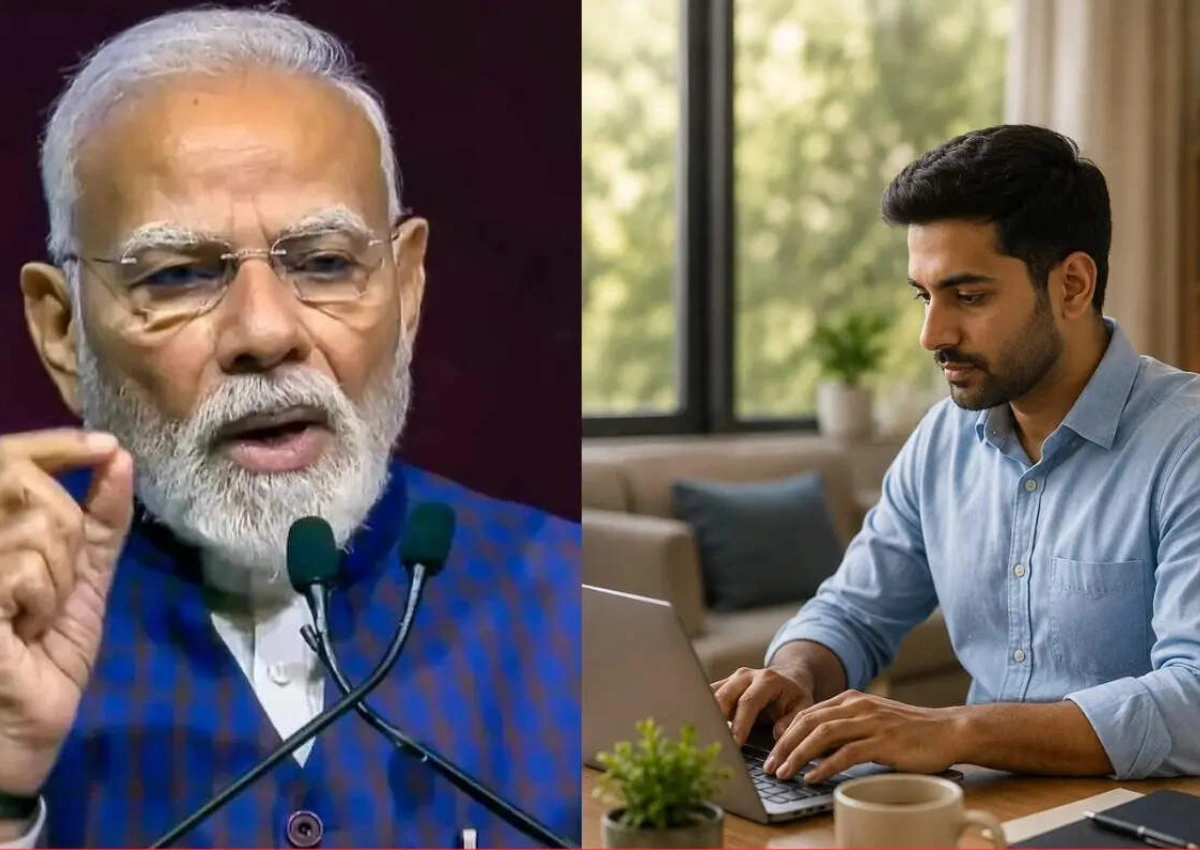
Prime Minister Narendra Modi, addressing the nation a few days ago to reduce fuel consumption and adopt flexible work hours such as working from home, has once again opened up the debate about the remote work culture in India. It was a public address by the Prime Minister during which he focused on economic caution in the face of rising tension globally, increasing crude oil prices and pressure on foreign exchange reserves.
Prime Minister, in his address, urged the people to reduce the usage of petrol and diesel that is unnecessary, avoid non-essential travel, and rethink daily lifestyle habits that lead to increased energy consumption. Here, he pointed out that offices and institutions should again provide for work-from-home facilities and hold virtual meetings wherever possible.
The appeal instantly brought back the remote work discussion that had in large part disappeared post the COVID-19 pandemic: can remote work be a significant part of India’s work culture again? The majority of the organisations had already resumed office work, but the increasing fuel prices, city traffic jams, environmental degradation and digital work infrastructure are making remote work once again a serious public policy and economic issue.
In fact, the matter has now shifted from how remote work was a necessity during the pandemic, only to what extent it can be adopted in the post-pandemic period, to the level of sustainable living, economic efficiency and changing workplace culture.
The Rise of Work-From-Home During the Pandemic
During the COVID-19 pandemic, India saw a remarkable shift to remote working. Offices, schools, government departments, and businesses that were locked down quickly turned to digital communication tools to keep running.
Zoom, Microsoft Teams, Google Meet, Slack, and other such platforms very soon became the focus of professional lives. Remote working, in particular for industries like information technology, media education, consulting, and services, has shown that physical office presence isn’t always essential to productivity.
Work from home/virtual operations resulted in discovering both cost reduction for companies and flexibility for employees, and the emergence of certain challenges. While many companies went back to the traditional office working after COVID, work from home and hybrid work models still continue in professional setups.
Why PM Modi Mentioned Work-From-Home Again
Prime Minister Modi’s latest call was a direct response to the impact of soaring global crude oil prices and the consequent import-led economic burden. As India depends on imports for more than 85 per cent of its crude oil needs, fuel prices are very sensitive to changes caused by international tensions and supply disruptions. The increase in oil imports pushes up the demand for foreign exchange and results in inflation.
Apparently, the government is using the promotion of work-from-home as an indirect fuel consumption reduction through decreased commuting. This seems a logical step.
Doing so logically leads to:
- Less commuting for work means less petrol and diesel usage
- Less traffic results in a smaller fuel requirement
- Decreased demand could be a factor in lessening import pressure
- Business trips are substituted by virtual meetings at times
The request. This way links a person’s way of life to the bigger picture of national economic objectives.
Benefits of Remote Work to the Environment
One of the most compelling points for allowing remote work is the positive effect it can have on the environment. Metropolitan cities like Delhi, Mumbai, Bengaluru, and Hyderabad are grappling with heavy traffic, air pollution, and a rise in carbon emissions. The workforce commuting daily to offices accounts for a major chunk of fuel consumption and environmental problems.
Considering remote work, one can assume that there will be a lesser:
- Vehicle traffic
- Pollution of the air
- Emission of carbon
- Use of fuels
- Loading on the transport system
The lockdown period during the COVID-19 pandemic saw many Indian cities enjoying good quality of air for a few days due to very little movement of vehicles.
If a partial work-from-home arrangement is maintained, then environmental experts believe that this move may also contribute toward the long-term ecological sustainability objectives, of course, only when taking a strategic approach to implementation.
Benefits for Employees
After reopening offices, it has been seen that a lot of employees still like flexible or hybrid work models.
Some of the most frequently mentioned benefits are:
- The stress of travelling is reduced
- Less money spent on transportation
- Achieving a better work and personal life balance
- Spending more time with family
- Get more opportunities to work at one’s convenience
- Money saved as there is no need to buy ready-made food and commute
For people who live in metropolitan areas, going to work every day means spending a lot of time and money on commuting.
By working remotely, some professionals manage to do something more useful or personal than just sitting in traffic every day. So, the Prime Minister’s idea was in line with some parts of the workforce who had already adopted the remote work culture during the pandemic years.
Challenges of Remote Work
Though, plus its great benefits, the home working arrangements also brought about several challenges during the pandemic period.
Mental Health and Isolation
Several employees experienced loneliness, exhaustion, and work-life imbalance. For many people, mental health deteriorated due to prolonged exposure to the screen and the lack of face-to-face social interactions.
Productivity Concerns
Some companies think that collaboration, creativity, and coordination of teams are weakened if employees work remotely for a long time. Certain industry managers feel that offices are necessary as they foster discipline, communication, and accountability.
Unequal Home Conditions
It isn’t true that each employee can have a separate room for work, a reliable internet connection, and a well-equipped home office. For those who live in a small urban dwelling or a shared family setting, working from home could turn out to be a source of stress rather than a convenience.
Work-Life Boundary Problems
One of the drawbacks of remote working is that we often work for more hours than usual just because we’re connected to the internet all day long. That’s why many organisations have turned towards hybrid models rather than fully remote systems.
Impact on Urban Infrastructure and Economy
Remote work impacts entire economic systems beyond just individual employees.
Changes due to less commuting include:
- Public transport earnings
- Demand for real estate
- Commercial property rental market
- Businesses near office areas
- Sale of fuels
In the time of the pandemic, restaurants, public transport operators, small retailers, and office space providers in business areas suffered from a lack of office workers. This means that big-scale remote work affects not only employees but also the whole urban economy. So governments and companies will have to decide how to combine environmental aims with economic activities in urban areas.
Is India Ready for a Long-Term Remote Work Culture?
This question is almost entirely contingent on the type of sector, infrastructure, and employee work expectations.
Some fields like:
- IT
- Media
- Digital marketing
- Consulting
- Education
- Customer service
are more suitable for remote working.
But manufacturing, healthcare, retail, transportation, hospitality, and most government functions require the physical presence of people.
Because of this, remote work is very unlikely to completely replace regular offices, but the flexible work culture might continue to grow progressively. The Prime Minister’s speech has brought back on the table the significant issue of how India’s workplaces of the future might look like.