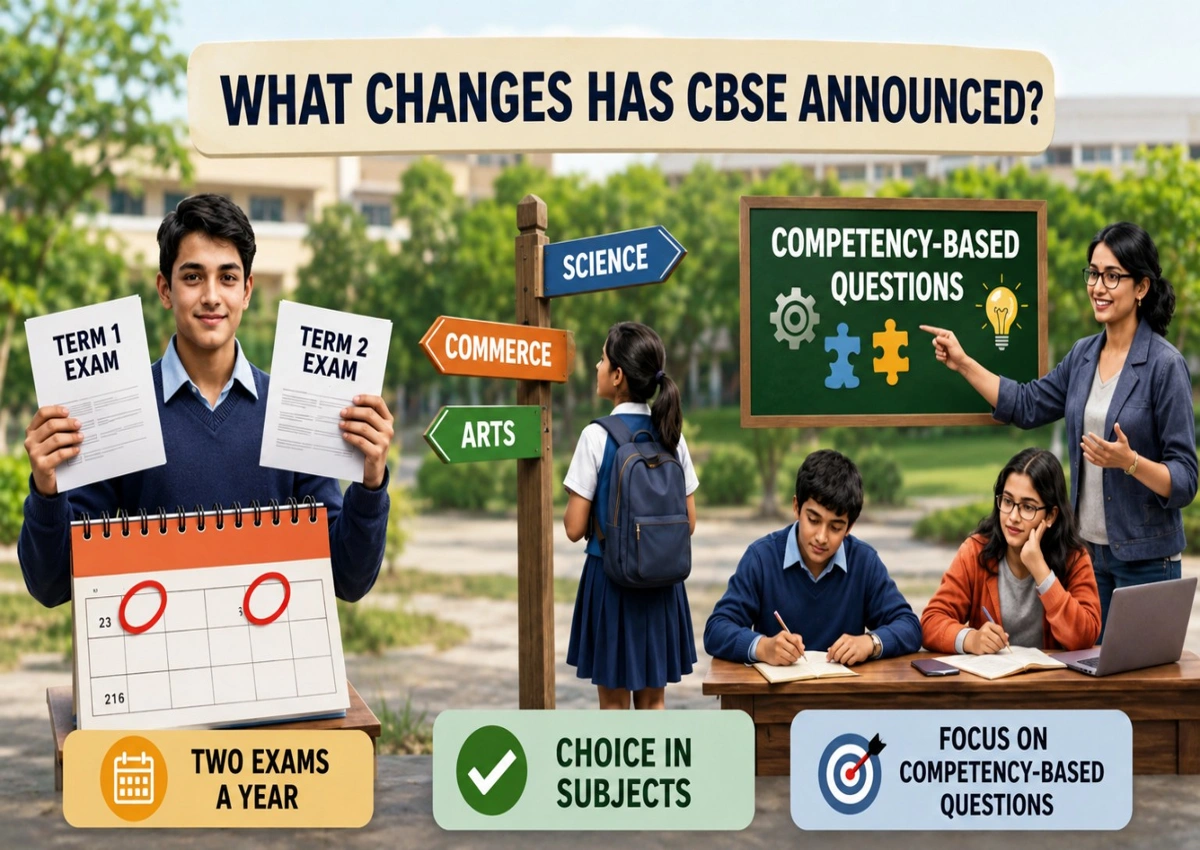
Starting in 2027, the Central Board of Secondary Education (CBSE) will implement a new board examination pattern. See the source here. The changes are part of India’s continuing efforts to reform its educational system. It is reported that the changes will focus less on memorisation and more on competency-based learning, conceptual understanding, and flexible assessment.
Many discussions among students, parents, teachers, coaching institutes, and education experts have started after the announcement. Board exams are still the key academic milestones for students. They determine their higher education opportunities and career choices while simultaneously aligning with social expectations.
Because of this, the change in the board examination system’s structure will have an impact on millions of families nationwide. See the source here.
Also, school reforms are related to the National Education Policy (NEP) 2020, which wants to promote critical thinking, less examination pressure, practical learning and introduction of different skills. What remains paramount is whether these changes can significantly impact learning or if they are just policy announcements. See the source here.
What is the Change that CBSE has made?
New reports indicate that a totally different board examination system is being planned by 2027, which will largely disregard memorisation-oriented methods in favour of competency-based questions.
Changing to the Binary System
- Greater focus on analytical and application-type questions
- Reduction of rote learning-type questions
- Exams will be made more flexible
- Emphasis will be laid on understanding and reasoning
- Students doing practical work would be rewarded through internal assessments
- Overall changes made in line with NEP objectives
The initiative tends to push learners not only to study but also to understand the concepts and learn to use the knowledge for problem-solving.
This is a step forward in ensuring that the students are well-versed in their knowledge and can take it beyond the classroom.
All this change is in line with an educational philosophy, which sees actual learning as being more significant than performance on a marks-based system.
Reasons Behind the Criticism of the Present System
The examination system in India has, for a long time, been criticised for promoting rote memorisation and creating a lot of academic stress.
Students are generally asked to learn huge amounts of knowledge by heart for their exams, where the main yardstick of success is their score. Quite a few schools transform their classroom teaching to be very exam-oriented, emphasising scoring tricks rather than real comprehension.
That gives rise to several issues:
- The development of critical thinking is limited
- Creativity is hampered
- Students experience a lot of stress
- Dependency on coaching centres
- Painting a learning atmosphere based on fear
It is the contention of the detractors that students usually study for marks and not knowledge. They consider subjects mainly as memorisation tasks and not as chances for discovery and deep understanding.
The pressure around board examinations is an outcome of growing competition for college admissions and professional courses over the years.
The Impact of the National Education Policy (NEP)
The reforms presented in the new Curriculum setup are, in fact, a direct reflection of the goals set by the National Education Policy 2020.
NEP has advocated for the transformation of the educational philosophy by highlighting this:
- Deep understanding of concepts
- Learning through the development of skills
- Education covering multiple domains
- Less memorisation of facts
- Openness of the curriculum choices
- Overall upbringing
The policy, in particular, aimed at lowering the “high-stakes” nature of board exams and transforming assessment methods into more learner-friendly ones. The revision of the CBSE way of assessing students seems to be an integral part of this larger initiative to reshape the student examination method.
Those in favour think that proper implementation of these reforms can bring the creation of an education system that is both well-balanced and pragmatic.
Competency-Based Learning: What Is It All About?
In competency-based learning, the emphasis is on assessing whether students are able to use concepts, not just remember them. This way, competency-based questions might encourage students to:
- Analyze scenarios
- Come up with solutions to real-life problems
- Interpret data
- Use concepts in daily life situations
- Think critically and logically
This approach has become popular with many international education systems, where mastery and understanding are given more weight than recall of the content. Educational scholars believe that such methods will equip students better for university, the job market, and real-life problem-solving.
But changing from a memorisation-based system to competency-based evaluation will go hand in hand with a drastic overhaul of the teaching methods used in the classrooms.
Repercussions on Students
The overhaul may even drastically alter the way students gear up for their board exams.
Final Outcomes
If the changes are done well, the outcomes might be:
- Lessen the burden of memorising
- Drive students to comprehend better
- Train students to think analytically
- Enable students to be more practical
Gradually, the students may give more attention to learning and understanding rather than memorizing guidebooks and sample answers. Besides, this could also lead to a lesser degree of dependence on monotonous coaching practices that are only oriented toward scoring patterns.
Stress and Intricateness
Changes in examination formats can mostly cause stress and fear among students who are not too happy with the change.
We can say then that a great number of non-learners will be caught off guard, given Truth is the schooling system, the teachers, and the coaching learning centres in tandem have seen little change. Of course, with a lack of comprehensive preparation, including a few initial phases of a certain degree of failure, it is a quite normal to expect that changes, mainly analytical questions and new test types, will be a source of stress.
That’s why largely the fate of the proposed changes will be highly dependent on the quality of the work, abilities of the teachers and readiness of the students.
Changes in Education Affecting Teachers and Schools
Education reforms will probably change the role of educators and change the way schools operate as much as they alter student learning.
Usually, school teaching personnel still strongly depend on the textbook and the examination systems for lessons. Teachers may be required to:
– Revamp the way they conduct lessons
– Motivate their students to have discussions and work on projects
– Lay a greater emphasis on the understanding of concepts
– Make extensive use of the interactive methods of learning
– Raise the quality of their assessment methods
Such a stretch of work calls for deep and thorough training of a teacher and also support of a curriculum.
Those schools which count on a good infrastructure and knowledgeable educators may integrate themselves sooner, whereas the schools situated in rural areas or less economically prosperous areas might have more problems.
That means, differences in educational outcomes continue to be a key worry while making education reforms available and accessible to all segments of society.
Anxiety Over Execution
New education strategies look to have a bright future. But implementation is the main worry.
India has a very large and diverse education system:
– There are urban and rural schools
– People belong to various social strata
– There are many languages spoken
– There is inequality in access to infrastructure
– There is a shortage of teachers
Changing only the exam schemes without the enhancement of the quality of the classroom process will most probably lead nowhere.
Also, some worry that schools will stick to performing the traditional ways of educating their students while disguising themselves through merely changing the pattern of the examination.
Some of the specialists believe that educational reform in its real sense can only be realised through the longstanding dedication of resources to:
– Proper training of educators
– Building and improvement of school facilities
– Development and changes of curriculum
– Student support through counselling
– Providing suitable learning materials
In short, without these profound changes, modifications of exams may turn out to be ineffective.