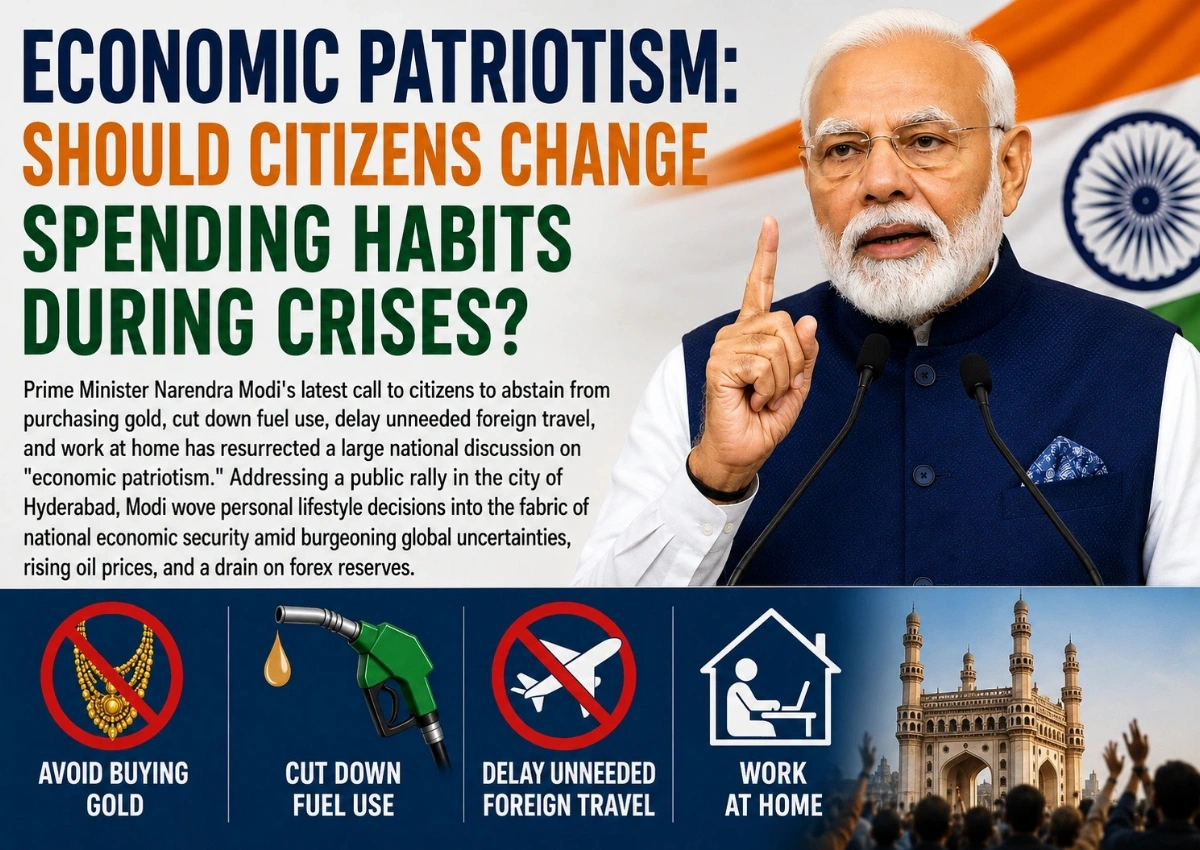
Prime Minister Narendra Modi’s latest call to citizens to abstain from purchasing gold, cut down fuel use, delay unneeded foreign travel, and work at home has resurrected a large national discussion on “economic patriotism.” Addressing a public rally in the city of Hyderabad, Modi wove personal lifestyle decisions into the fabric of national economic security amid burgeoning global uncertainties, rising oil prices, and a drain on forex reserves.
The current speech implied that ordinary people can help maintain economic activities and services, and they are also recommended to alter their personal consumption behaviour when times are rough. This is a typical case of economic patriotism, is; namely, people take the responsibility to close down the country.
Proponents of such appeals have argued that it is the issue of responsible leadership during a time of global crisis, and assert that a collective effort at self-discipline may reinforce the stability of the nation. Opposition to such calls might argue that it is appropriate to have the people compromise when the state itself controls economic policy.
The discussion also raises a broader issue for many countries responding to crises: to what extent should ordinary people be trusted with the burden of saving the economy?
What Is Economic Patriotism?
Economic patriotism is the doctrine that citizens should patronise their own economy through their wallet and consumption decisions during a situation of crisis or threat.
This can include:
- Purchasing local products
- Cut down on non-required
- User Imports
- Saving fuel and additional materials
- Providing support to domestic industries
- Restriction of luxury needs in times of crisis
The notion is of particular importance in times of war, economic turmoil, chain shocks, inflation, or foreign exchange pressure. All over the world, governments have urged citizens to contribute to national wartime economies.
For example, during the World War eras, there were pushes for frugality, carless days, general austerity, and increased domestic manufacturing. What emerges today in modern economies is the thing of economic patriotism through the resurgence of campaigns urging people to buy made-in.
Buy domestic, pay-in. reduce dependence on imports, become self-sufficient, etc. Prime Minister Modi’s argument is also in conformity with this culture that encourages people to associate their personal economic interests with the national benefit.
Why the Appeal Came Now
The speech by the Prime Minister occurred at a time of high volatility in the global economy related to increased tensions in West Asia and rising crude oil prices. India imports a large share of its energy needs from the global market. Prices of fuel, Balance of trade, Currency stability. India is the world’s biggest gold importer.
When there are high gold imports, dollar outflows would be expanded and have an additional influence on foreign exchange reserves. The government seems Because of this to be worried about the decrease of non-essential imports and of the easing of economic strain in an unstable world period. It was not about saving money alone. It was about lessening economic vulnerability.
Gold, Fuel, and the Indian Consumer
The Prime Minister concentrated on gold and fuel in his speech because both are crucial in the Indian economy and for the general public.
Gold as an Asset of Internal and External Value: gold as a cultural and financial asset; India has close associations with gold, which is imported mainly for adornment and jewellery use and traded through Traditional Indian family savings ways, festivals, and Indian wedding.
Gold is considered a reliable investment by many families during economic uncertainty.
This would Because of this, making any call to cut down on buying gold is sensitive for social reasons. Purchasing gold is not seen as just consumption, but emotional security and even savings in some cases.
Fuel consumption affects transportation, domestic and business expenses directly. The rising costs of petrol and diesel would affect each industry in the economy.
The government has seemingly promoted savings in fuel through incentives away from travel and endorsing working from home. This demonstrates how economic patriotism penetrates deeper and deeper into our daily lifestyle choices.
Do Citizens Shift Their Spending Patterns in Times of Crisis?
The crux of the debate is whether governments should require regular people to have different personal consumption patterns during a recession.
Supporters argue that:
- Every economy depends on public cooperation in times of crisis.
- Decreased imports often mean greater currency stability.
- In times of crisis, both citizens and governments are culpable
They think economic discipline becomes more crucial during periods when international events impact their economies. Other economists also believe that high luxurious imports during difficult times are harmful to economic stability.
Criticism and Public Concerns
Critics raise several objections:
Citizens are already suffering from inflation and increasing living costs
He writes of the purchasing of gold and the pressures placed upon the individual to buy.
- The public is well-tooled up with low-cost financial choices already.
- Middle-class families, for example, are already sacrificing economically.
- Government policy choices should be held more accountable
Opposition leaders also argued that, if the economy was actually booming, then one shouldn’t be asking the average person to cut back. Others contended that calls for sacrifice are most fragile politically when unemployment, inflation and economic disparities are high.
International Examples of Economic Sacrifice
India has not been the first country where political leaders have rallied the population to consume less in times of crisis. Historically:
- Energy crises, where energy was rationed, were imposed by European countries.
- Japan’s response to economic slumps was to promote domestic industry support.
- Urged conservation in the United States during wartime.
- A series of countries cut luxury imports during their foreign-exchange struggles.
In many cases, Governments promoted public discipline as a patriotic duty. Genuine economic patriotism, though, often hinges on the level of citizens’ trust in the state.
Cooperation of citizens who are willing to make sacrifices increases when they perceive an equitable distribution of the burden in society. So the significance of the credibility of leadership and transparent communication is critically important.
Conclusion
Prime Minister Narendra Modi’s call to buy less gold, drive less and spend less became yet another reminder of how, during any crisis, there are strong debates going on over economic patriotism and public responsibility.
The speech mirrors the increase in anxiety over worldwide instability, increased import prices and economic durability.
While it is being hailed as a patriotic call for the strengthening of the nation, critics believe that the economy should not be risked on the back of the “common man”.
This debate also shows the close relationship between economic behaviour and cultural politics, identity and confidence in the public. Finally, economic patriotism only functions at its best if citizens are convinced that sacrifice, responsibility and common advantage are more or less equally distributed in society.