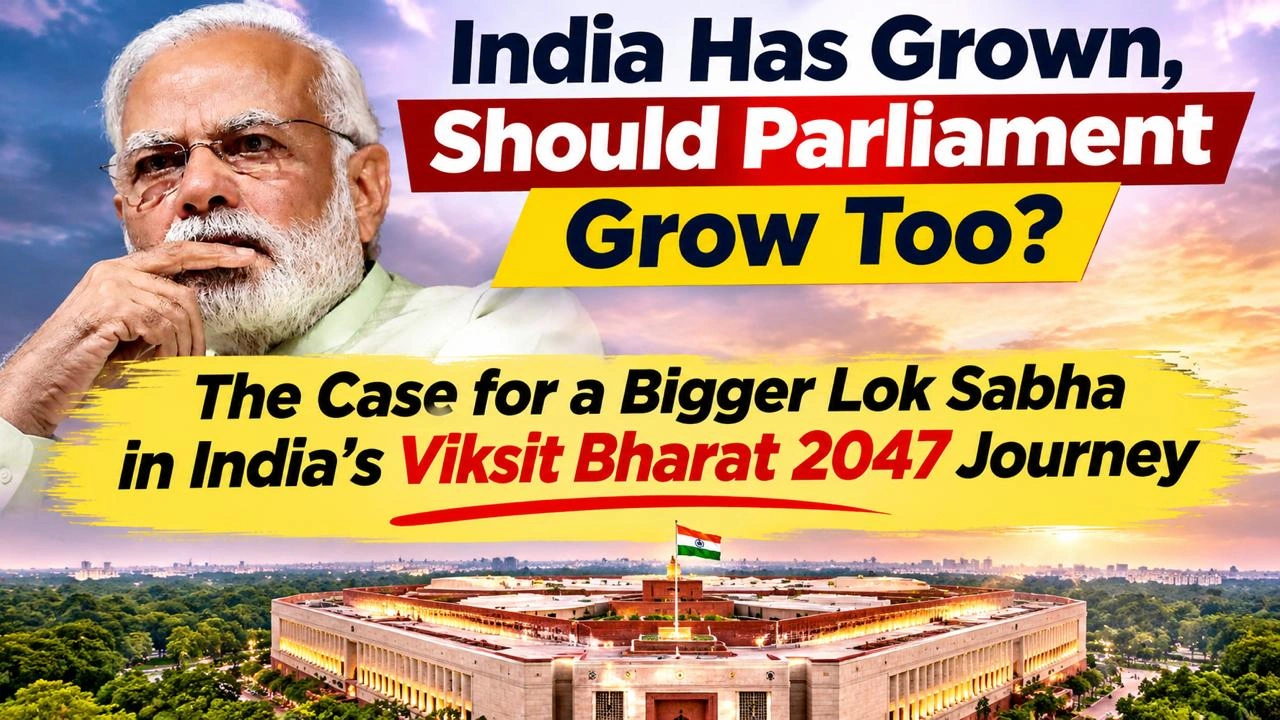
India Has Grown, Should Parliament Grow Too? The Big Democratic Reform India Needs
From 54.8 crore people in 1971 to nearly 148 crore today: why India’s parliamentary representation needs a fresh look on the road to 2047
India is changing at a scale few countries have ever seen. Its population has grown enormously, its economy is taking a bigger global role, and the national goal is to become a developed nation by 2047, the centenary of Independence. That raises a democratic question worth asking: is the Lok Sabha still the right size for the country India has become?
A video doing the rounds on social media puts it simply, using a wedding photo. The bride and groom pose, relatives keep joining, and soon the frame is too crowded. When the family grows, the photo needs a bigger frame. The analogy is light-hearted. The constitutional question behind it is not.
A Country That Has Changed Dramatically
The 1971 Census put India’s population at about 54.8 crore. In 1976, through the 42nd Amendment, the allocation of Lok Sabha seats among states was frozen on the basis of that census. The idea was to encourage population control and make sure states that slowed their growth were not punished with fewer seats. The 84th Amendment in 2001 extended the freeze until the figures of the first census after 2026 are published.
Today, the UN Population Fund (UNFPA) estimates India’s population at about 147.66 crore. The Lok Sabha still has 543 elected seats. On a national average, that is roughly 27 lakh people for every elected MP. Actual constituency sizes vary a great deal from state to state, but the average shows how much heavier the job of representation has become. The question is whether a structure designed for 1971 can serve a population that has almost tripled.
Why a Larger Parliament?
A bigger Lok Sabha should not be about more politicians. It should be about better representation and accountability. An MP today has to deal with central ministries, raise local issues, debate laws, scrutinise spending and help shape national policy, across healthcare, education, farming, industry, infrastructure, jobs, the environment and security. As constituencies grow, that job gets harder. A carefully designed expansion could help in four ways:
More seats alone, though, will not guarantee better governance. Productivity, research support, transparency and accountability have to improve alongside.
The 2047 Vision and Why Institutions Matter
Viksit Bharat 2047 is among the most ambitious goals in India’s modern history. NITI Aayog’s approach paper says India should aim to become a $30 trillion economy with a per capita income of about $18,000 by 2047. Getting there takes more than growth numbers: it needs investment, infrastructure, education, healthcare, industry, technology, jobs and strong institutions.
Priorities also differ across the country. A farmer wants better infrastructure and market access. A young graduate wants tech jobs. A manufacturer wants simpler rules and better logistics. A small business owner wants affordable credit and digital markets. All of these voices need a place in national policy, and Parliament is where they are meant to be heard.
The North–South Question
This is the most sensitive part of the debate, and both sides have a point.
The Southern Concern
Tamil Nadu, Kerala, Karnataka, Telangana and Andhra Pradesh have done well on population control, education and health. They worry that a purely population-based redistribution would shrink their relative influence, in effect punishing them for success.
The Case of Larger States
States with bigger populations argue their citizens should not stay under-represented just because seat allocation was frozen five decades ago. Every vote, they say, should carry similar weight.
The answer cannot be to ignore population growth, nor to penalise states that invested in stabilising it. One option is an expansion that raises seats across all states while protecting their relative shares, combined with a transparent delimitation within each state. Any such framework needs constitutional approval, political consensus and clear principles. The test is simple: no state should feel development became a disadvantage, and no citizen should feel population growth made their vote count for less.
Women’s Representation Cannot Wait Forever
The debate is tied to another reform. The Nari Shakti Vandan Adhiniyam, passed in 2023, provides for one-third reservation for women in the Lok Sabha and state assemblies, but only after the next census and delimitation. The 2026 amendment tried to move this forward alongside the expansion. A larger House could open more space for women in national decision-making. But women’s representation should not depend on an endless political debate. India needs a clear, constitutionally sound and widely accepted roadmap.
What Happened to the 2026 Proposal?
- April 16, 2026The government introduces the Constitution (131st Amendment) Bill, 2026, with the Delimitation Bill and the Union Territories Laws (Amendment) Bill. The package proposes a Lok Sabha of up to 850 members and delimitation based on the 2011 Census, linked to women’s reservation from 2029.
- April 16, 2026Home Minister Amit Shah tells the House that under the government’s 50 per cent model, with about 816 elected seats, the five southern states would go from 129 to 195 seats, and their share from 23.76 to 23.87 per cent.
- April 17, 2026The amendment gets 298 votes in favour and 230 against. It needed a two-thirds majority, 352 votes, and fails. The two linked bills are withdrawn.
- July–October 2026Amid reports that a revised bill may return, Congress president Mallikarjun Kharge writes to the Prime Minister seeking an all-party meeting first. Parliamentary Affairs Minister Kiren Rijiju replies that the government has consulted several parties and sought the Opposition’s cooperation.
Opposition parties objected to linking women’s reservation with delimitation, and to the use of 2011 Census data. Several southern parties also remained unconvinced by the government’s assurances on their share. The defeat showed that expanding Parliament is not an administrative exercise. It needs constitutional legitimacy, political agreement and public trust.
Bigger Must Also Mean Better
A bigger Parliament is not automatically a better one. More MPs mean more public spending, infrastructure, staff and coordination, and those costs must be justified by better representation and law-making. Alongside any expansion, India should look at stronger research support for MPs, technology-enabled constituency services, transparent performance reporting, stronger committees and more public consultation. The new Parliament building gives the physical space; the functional capacity has to match it. Digital grievance systems, constituency data and AI-assisted research could help MPs understand complex local issues faster.
The Road Ahead
India wants to be a global manufacturing hub, grow its technology sector, expand exports and create jobs for a growing workforce. All of that depends on strong institutions. The debate on expanding the Lok Sabha should rise above electoral arithmetic and party politics, and bring in constitutional experts, state governments, parties, economists, civil society and ordinary citizens.
The real question is not just how many MPs India should have, but how well its democratic institutions can represent nearly 148 crore people. The country has grown, and so have its ambitions and responsibilities. Viksit Bharat 2047 is not only about a bigger economy. It is also about a democracy strong enough to represent every Indian.
Should India expand its Parliament before the next census, or wait for fresh data and a wider political consensus?
Quick Answers: Lok Sabha Expansion
How many elected seats does the Lok Sabha have?
543. The allocation of seats among states has been frozen on the basis of the 1971 Census since 1976.
What did the 131st Amendment Bill propose?
A Lok Sabha of up to 850 members, delimitation based on the 2011 Census and changes linked to women’s reservation, from 2029.
Why did it fail?
On April 17, 2026 it got 298 votes for and 230 against, short of the 352 needed for a two-thirds majority.
Would southern states lose seats?
Amit Shah told Parliament their seats would rise from 129 to 195, with their share moving from 23.76 to 23.87 per cent. Opposition parties and several southern states remained unconvinced.