Jensen Huang Is Back: NVIDIA’s Dramatic CEO Comeback Sends Shockwaves Through Global Tech Industry
Trump, Musk and Silicon Valley cheer, the stock posts its best day in more than two decades, and the questions about governance are not going away
It took the market only a few hours to give its verdict. After NVIDIA announced on November 23 that Jensen Huang was back as President and CEO, its shares closed 31.48% higher at $165.05. That added roughly $952 billion to the company’s value and gave the stock its best day since 2003.
Huang had resigned just eleven days earlier. His return, approved unanimously by the board, set off a wave of reactions from Washington to Silicon Valley, and reopened a bigger debate about how much one founder matters to a company that now sits at the centre of the global AI economy. Read our full report on the board’s decision and the ongoing investigation.
How the Turnaround Happened
On November 12, NVIDIA said Huang had stepped down as President, CEO and board member with immediate effect. CFO Colette Kress took over as interim CEO. The exit came after reports that Huang had been the target of a foreign intelligence effort, which led the board’s independent directors to open an investigation with outside counsel.
The interim arrangement did not last. After a series of meetings with Huang, the board said it was satisfied with his candour and ability to lead. It also took input from senior levels of the US government and concluded that his return posed no national security risk. The investigation, however, has not been closed. NVIDIA says it will run until it is complete.
Trump, Musk and Tech Leaders React
The news spread fast, and so did the reactions.
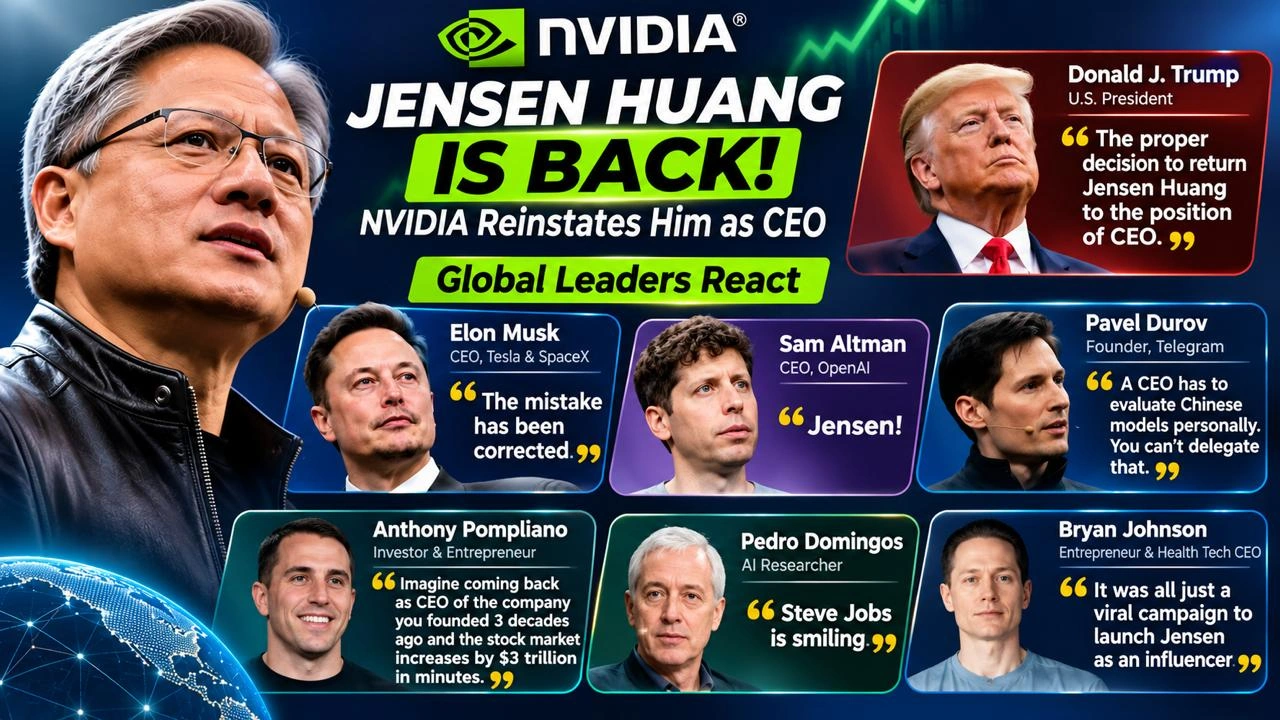
- Donald Trump, US PresidentSaid NVIDIA’s board “made the correct and proper decision” and argued that Huang’s leadership matters for the American economy. He had publicly backed Huang’s return in the days before the board acted.
- Elon Musk, Tesla and SpaceXOne of Huang’s loudest supporters, he wrote on X: “The mistake has been corrected.”
- Sam Altman, OpenAIPosted a one-word message: “Jensen!” Altman went through a similar ouster and return at OpenAI in 2023.
- Pavel Durov, TelegramCelebrated with a short “Jensen’s back” post.
Not everyone was cheering. House Democratic leader Hakeem Jeffries called the reinstatement “indefensible” and has promised a congressional probe. Critics also question how much say the US government should have in a private company’s leadership decision, and whether export-control compliance has been tightened enough.
Why Investors Reacted So Strongly
The rally followed a brutal month. NVIDIA’s stock had lost more than 40% of its value as the scandal unfolded, and tech and AI stocks across the board had been under pressure. Three things explain the snap-back:
One strong day does not erase every risk, though. The stock’s future still depends on earnings, competition, regulation, supply chains and whether AI spending keeps up its pace.
The Numbers Behind the Stakes
NVIDIA’s third-quarter results for fiscal 2027, released on November 17 while Huang was out, show why the leadership question mattered so much:
In other words, NVIDIA is no longer just a chipmaker serving a few markets. It is the core supplier to the infrastructure the AI economy runs on. During the quarter it also began shipping its Vera Rubin NVL72 platform, the next step in its AI roadmap. Because customers plan these investments years in advance, a stable roadmap matters as much as the hardware.
Why Huang Matters to the AI Economy
Huang co-founded NVIDIA in 1993 with Chris Malachowsky and Curtis Priem. The company built its name on graphics chips for gaming and visualisation, but AI changed everything. Training and running large AI models takes enormous computing power, and NVIDIA built a full stack around that need: GPUs, networking, software and developer tools.
Today its technology reaches generative AI, cloud and hyperscale data centres, autonomous vehicles and robotics, drug discovery, financial analytics, smart manufacturing and scientific research. That is why Huang’s return is being read as an industry event, not just a boardroom one.
What It Means for the Chip Industry
NVIDIA’s growth pulls a long supply chain along with it. Chip foundries and advanced packaging firms depend on its orders. Memory makers benefit from demand for high-bandwidth memory. Data centre builders are spending heavily on computing capacity, cooling, networking and power. Rival chipmakers, meanwhile, face constant pressure to match its performance and pricing. The open question is whether the industry can keep investing at this pace while making AI infrastructure cheaper and easier to access.
The US-China Factor
Advanced chips are now a strategic asset. The US restricts exports of certain high-end computing chips and related technology to China, so NVIDIA’s international business has to balance commercial demand with trade rules and national security. Alongside Huang’s return, the board set up a National Security and Export Control Committee and began searching for a Chief Compliance Officer. For chip companies, engineering excellence is no longer enough; they also have to manage geopolitics.
What Huang’s Return Means for India
India is pushing hard to become a hub for digital infrastructure, AI adoption and semiconductor investment. A stable NVIDIA roadmap matters for Indian IT firms, cloud providers, data centre operators, startups, universities and electronics makers. The areas where its technology is most relevant include:
- AI-powered enterprise software and services
- Healthcare technology and medical research
- Smart manufacturing, robotics and mobility
- Agricultural analytics and precision farming
- Fintech and fraud detection
- AI education, research and startups
But India cannot afford to be only a buyer of foreign chips. Long-term competitiveness will depend on domestic chip manufacturing, research, skilled talent, energy infrastructure and homegrown AI innovation. The AI race is not just about who buys the most powerful chips; it is about who builds the talent and applications to use them well.
Can One Leader Move an Entire Industry?
NVIDIA is a global company with a board, major shareholders, manufacturing partners and customers around the world. Yet the market added close to a trillion dollars in a day because one person came back. That raises uncomfortable governance questions. How should boards weigh accountability against a founder’s commercial value? How much should national security concerns shape corporate decisions? And how does a company make sure its strength does not depend too heavily on one individual?
Huang’s return restores continuity, but the next chapter will be decided by innovation, governance, compliance and NVIDIA’s ability to stay ahead. The real story is no longer whether he is back. It is what his return means for the future of AI and the global technology economy.
Is NVIDIA’s success mainly driven by Jensen Huang’s leadership, or has the company built an ecosystem strong enough to succeed no matter who sits in the CEO’s chair?
Quick Answers: Jensen Huang’s Return
How much did NVIDIA stock rise after Jensen Huang’s return?
Shares rose 31.48% to $165.05 on November 23, 2026, adding roughly $952 billion in market value, the stock’s best day since 2003.
How did Donald Trump and Elon Musk react?
Trump said NVIDIA’s board made the correct and proper decision. Musk wrote on X that the mistake has been corrected.
What were NVIDIA’s latest quarterly results?
For Q3 of fiscal 2027, revenue was $115.8 billion, up 103% year on year, with Data Center revenue of $107.6 billion and GAAP net income of $65.3 billion.
Is the investigation into Huang over?
No. NVIDIA says its independent investigation will continue until it is complete.