Beyond Entertainment: Why a Pakistani Netflix Series Has Reopened India’s Biggest Debate on Culture, Politics and National Interest
With ‘Jo Bachay Hain Sang Samait Lo’ set to premiere on December 4, a demand to block it in India raises a bigger question: should art be judged through the lens of geopolitics?
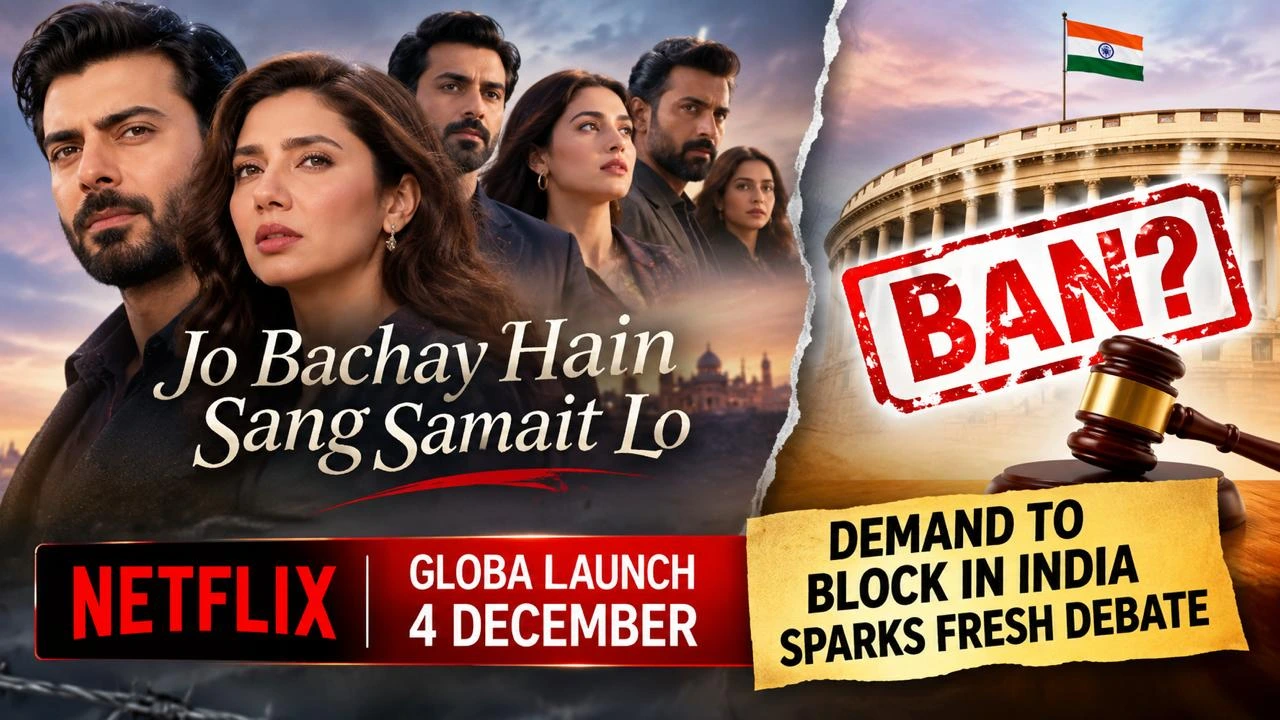
Pakistani entertainment is back in India’s national conversation, and this time a Netflix show is at the centre of it. Jo Bachay Hain Sang Samait Lo, an upcoming Pakistani drama, has not even premiered yet, but it has already sparked a fresh India-Pakistan row.
The trigger is a letter. The All India Cine Workers Association (AICWA) has written to Prime Minister Narendra Modi asking that the series not be released in India. That has turned a conversation about a cast and a storyline into a much larger one about national interest, cultural influence, OTT rules and the line between art and politics.
The Controversy: A Netflix Release Meets a Political Objection
In a letter dated November 24, signed by its president Suresh Shyamlal Gupta, AICWA asked the government to stop the series from streaming in India. It also called for a permanent legal framework banning Pakistani films, web series, songs and other content from Indian platforms.
The association pointed to the Ministry of Information and Broadcasting’s advisory of May 8, 2025, issued after the Pahalgam terror attack, which asked OTT platforms and intermediaries operating in India to discontinue Pakistan-origin content. Releasing the show here, AICWA argues, would go against that position and against national sentiment.
What makes this row unusual is its timing. Nobody in India has seen the show yet, so the debate is not about its content. It is about whether Pakistani-origin content should have any place in India’s digital entertainment space at all.
What Is ‘Jo Bachay Hain Sang Samait Lo’?
The series is based on Farhat Ishtiaq’s bestselling Urdu novel and weaves together six interconnected love stories across three generations. At its heart is Sikandar, a Harvard law student dealing with emotional trauma, whose life crosses paths with Liza, an artist with a difficult past of her own.
The Series at a Glance
With a big international production and a cast many Indian viewers already know, the show was always going to draw attention here. That is exactly why its India release has become a flashpoint.
Why Pakistani Dramas Have a Following in India
Indian interest in Pakistani dramas is not new. Shows such as Humsafar, Zindagi Gulzar Hai, Mere Humsafar, Parizaad and Kabhi Main Kabhi Tum found Indian audiences through television, YouTube and social media, across generations and through good times and bad in the relationship between the two countries.
The Bigger Question: Should Culture and Politics Be Kept Apart?
This is the most sensitive part of the debate, and both sides make serious arguments.
Keep Them Separate
An actor, writer or musician should not be judged by their government’s actions. A love story or a family drama may have nothing to do with terrorism or diplomacy, and cultural ties can keep human connections alive when governments disagree.
Entertainment Is Not Neutral
Films, shows and music build a country’s soft power, earn revenue and shape how it is seen abroad. Letting content from a hostile neighbour earn money in India during serious security tensions, critics argue, is not just an artistic choice.
It gets more complicated when individual celebrities make political statements about India. Audiences can fairly question whether an artist’s public positions should affect how they engage with that artist’s work. But criticising one person’s conduct is different from assuming every Pakistani performer or citizen holds the same views. Both arguments deserve a hearing, without turning into hostility towards ordinary people.
National Security Versus Freedom of Entertainment
India’s stance on Pakistan-origin content has a clear regulatory basis. The May 8, 2025 advisory referred to platforms’ obligations under the Information Technology Rules, 2021, including the Code of Ethics and the need for caution about content that affects India’s sovereignty, security and public order. It asked platforms to discontinue web series, films, songs, podcasts and other content originating in Pakistan.
That separates two questions that often get mixed up. One is whether viewers want to watch a show. The other is whether platforms operating in India must follow government directions. Audience demand does not override regulatory obligations. At the same time, a blanket, permanent ban on every kind of Pakistani entertainment would raise its own questions about scope and enforcement. A clear, consistent and legally grounded policy is more workable than uncertainty around each individual release.
What Is at Stake for India’s Entertainment Market
India is one of the world’s largest and fastest-growing OTT markets, with a strong appetite for international content. For streaming platforms, more variety means more engagement. For Pakistani producers, India is a large and culturally familiar audience they could lose if restrictions continue.
There is also a practical catch. Blocking official releases does not end curiosity. It can push viewers towards unofficial channels, which makes restrictions harder to enforce. The challenge for policymakers is a framework that protects national interest while giving platforms, creators and audiences clear rules.
Can Culture Be a Bridge Without Becoming a Compromise?
India and Pakistan share language, music, literature and history. Recognising that is a reflection of a shared past, not an endorsement of present-day politics. An Indian viewer can enjoy Urdu poetry or a Pakistani actor’s performance and still strongly oppose Pakistan’s policies on terrorism and security.
Equally, cultural appreciation cannot be used to brush aside genuine security concerns. India has every right to set its cultural and digital policy according to national priorities. The debate is best served when it stays grounded in facts, law and individual accountability rather than collective hostility.
What Happens Next
With the December 4 premiere close, whether the series will be available in India remains an open question. That will be decided by Netflix and by the applicable government directions, not by public debate alone.
Either way, the episode is about more than one show. It touches OTT regulation, soft power, the economics of global streaming and the relationship between public sentiment and policy. A nation’s security cannot be traded for entertainment, and enjoying a work of art does not mean supporting the politics of the country it comes from. India can, and does, tell the two apart.
Can two countries remain politically divided while their cultures continue to speak a familiar language?
Quick Answers: Jo Bachay Hain Sang Samait Lo
When does the series release on Netflix?
It is scheduled for a global premiere on December 4, 2026. Whether it will be available in India is still unclear.
Why does AICWA want it banned in India?
In a November 24 letter to PM Narendra Modi, AICWA cited national security and the government’s May 8, 2025 advisory on Pakistan-origin content.
Has the government banned the series?
AICWA’s letter is a demand, not a government order. Its India availability will depend on Netflix and on the applicable government directions.
Who stars in it?
Fawad Khan, Mahira Khan, Sanam Saeed, Ahad Raza Mir, Hania Aamir, Hamza Ali Abbasi, Iqra Aziz and Maya Ali, among others.