UPI and the Cost of Policy Reversal: Can India Sustain Its Free Digital Payments Model?
India’s UPI revolution is set to enter a new phase as policymakers grapple with the costs of its upkeep and the implications of its policy reversal. Can India continue to provide free digital payments or will it have to reverse course and impose charges on its citizens?
India’s Unified Payments Interface (UPI) has revolutionized the way people pay for goods and services in the country. From the smallest roadside eateries to big business conglomerates and e-commerce players, UPI has enabled millions of Indians to make digital payments seamlessly.
But with rising volumes of transactions through the system, the question of costs and who picks up the bill for maintaining India’s free digital payments system has become a contentious policy issue.
UPI’s Rise as India’s Digital Payment Backbone
UPI was launched in 2016 and facilitated seamless real-time digital payments between banks. Its QR code-based, user-friendly interface and zero or minimal charges for transactions made it a popular digital payments method.
The absence of a Merchant Discount Rate (MDR) on UPI transactions also propelled its adoption, as it allowed businesses to collect payments digitally without any charges.
Consumers also benefitted from being able to make payments directly from their bank accounts without any additional charges. As a result, India witnessed the rise of one of the world’s largest real-time digital payments ecosystems.
The Sustainability Challenge Behind “Free” UPI
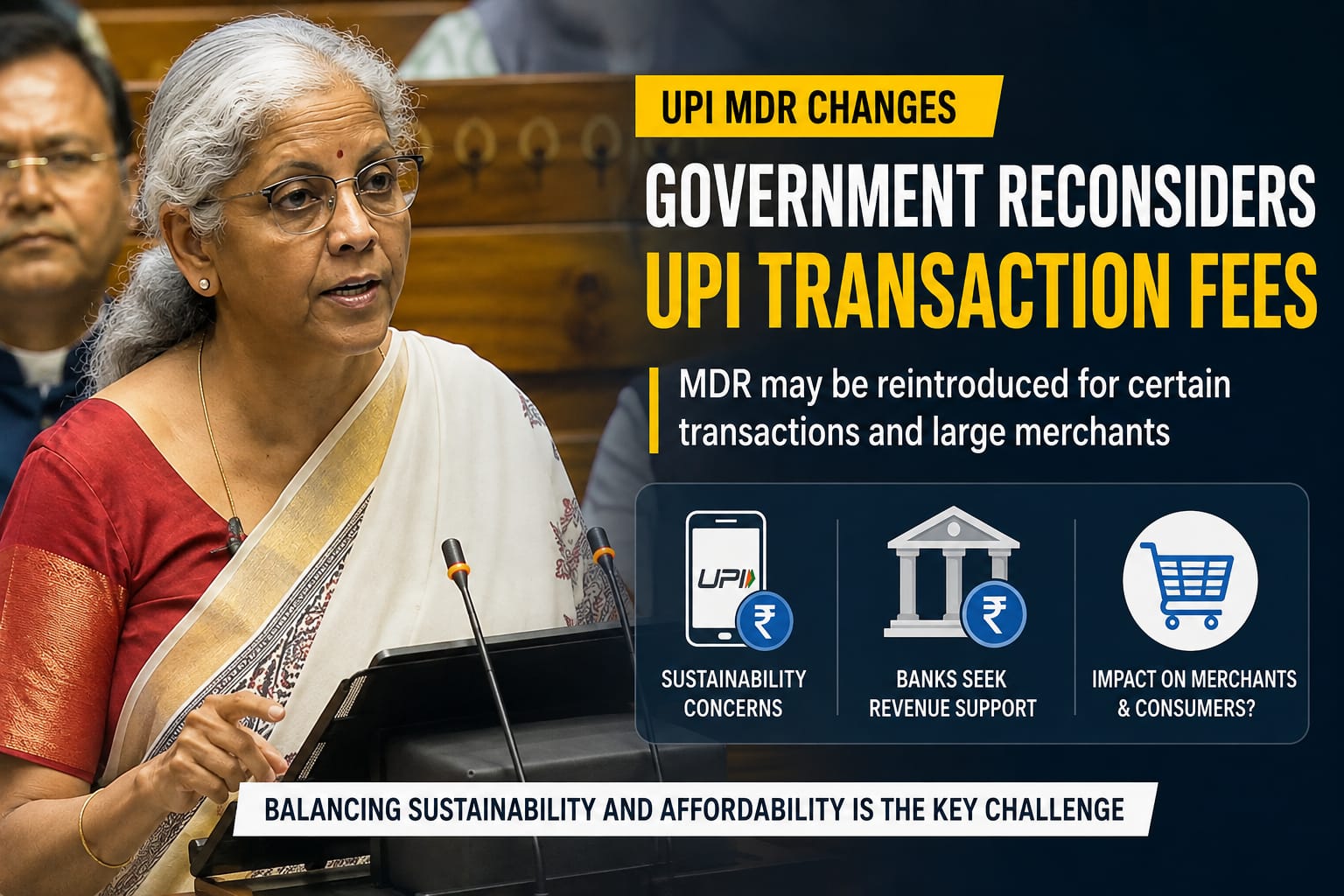
While UPI transactions do not directly cost the consumer anything, the same cannot be said for banks and other financial entities that facilitate these transactions. The high volumes of transactions through UPI have necessitated a rethinking of the zero MDR policy and the indirect costs borne by banks and other financial institutions.
UPI’s entire ecosystem of banks, fintech companies, and payment aggregators has been built on incentives as a means of driving adoption. With volumes of transactions rising sharply, the indirect costs of enabling these transactions through UPI will also need to be factored in.
Can India Afford to Keep UPI Transactions Free?
The most obvious solution to the free UPI conundrum is to introduce a Merchant Discount Rate (MDR) on a certain category of transactions or merchants.
Such a move would help banks and financial institutions that facilitate UPI payments to directly benefit from the high volumes of transactions through the system. It would also reduce their dependence on incentives to drive UPI adoption.
However, introducing any form of charges on UPI transactions runs the risk of deterring consumers and businesses from using the platform. UPI has been able to witness such explosive adoption due to its ease of use, QR code-based payments, and lack of any charges for transactions. Any attempt to introduce charges for UPI transactions, especially for small-value payments, could see people switching away from the platform.
The Impact of Charges on Consumers and Small Business
The impact of any UPI-related charges on the consumer would be entirely dependent on what the charges would entail.
If charges were to be introduced only on specific categories of transactions, the impact on the consumer would be limited. However, any sweeping changes to UPI that would directly impact the consumer would be met with strong opposition.
The same can be said for small business owners, street vendors, and retailers who would find any additional charges to be a deterrent from accepting digital payments. Therefore, when it comes to small businesses and low-value transactions, any UPI-related charges would be a major concern.
The Larger Policy Question
The larger policy question pertains to whether India can afford to subsidize UPI transactions as it did with smartphones and other technology-enabled services.
India’s push for digital payments and the ecosystem of incentives around UPI have resulted in the country witnessing some of the highest levels of digital payments adoption in the world. However, as the ecosystem grows, so do the costs associated with maintaining it.
The indirect costs of enabling such a large-scale digital payments infrastructure have been borne by banks, fintech companies, and other stakeholders through incentives.
Any changes to the current UPI framework would have strong implications for businesses that rely on UPI for processing payments. Finding the right balance between making UPI transactions free for the consumer while ensuring that the costs of enabling the system are not borne entirely by banks and other financial institutions is a challenge that policymakers will have to address.
A Way Forward
While there is an obvious need to rationalize the costs of enabling UPI transactions, any move to introduce charges on UPI payments could be strongly opposed by the public. A well-thought-out UPI pricing strategy that targets specific categories of transactions only could be a good way forward.
A pricing mechanism for UPI transactions would ensure that the costs of sustaining the system are covered while still keeping digital payments accessible to all. It would also help incentivize investment in the digital payments ecosystem without hurting the consumer.
India’s free UPI model has enabled it to witness explosive levels of digital payments adoption. However, as the system grows, so do the costs associated with it. Finding the right balance between making UPI transactions free while ensuring that the costs are not entirely borne by banks is a challenge that policymakers will have to confront soon.