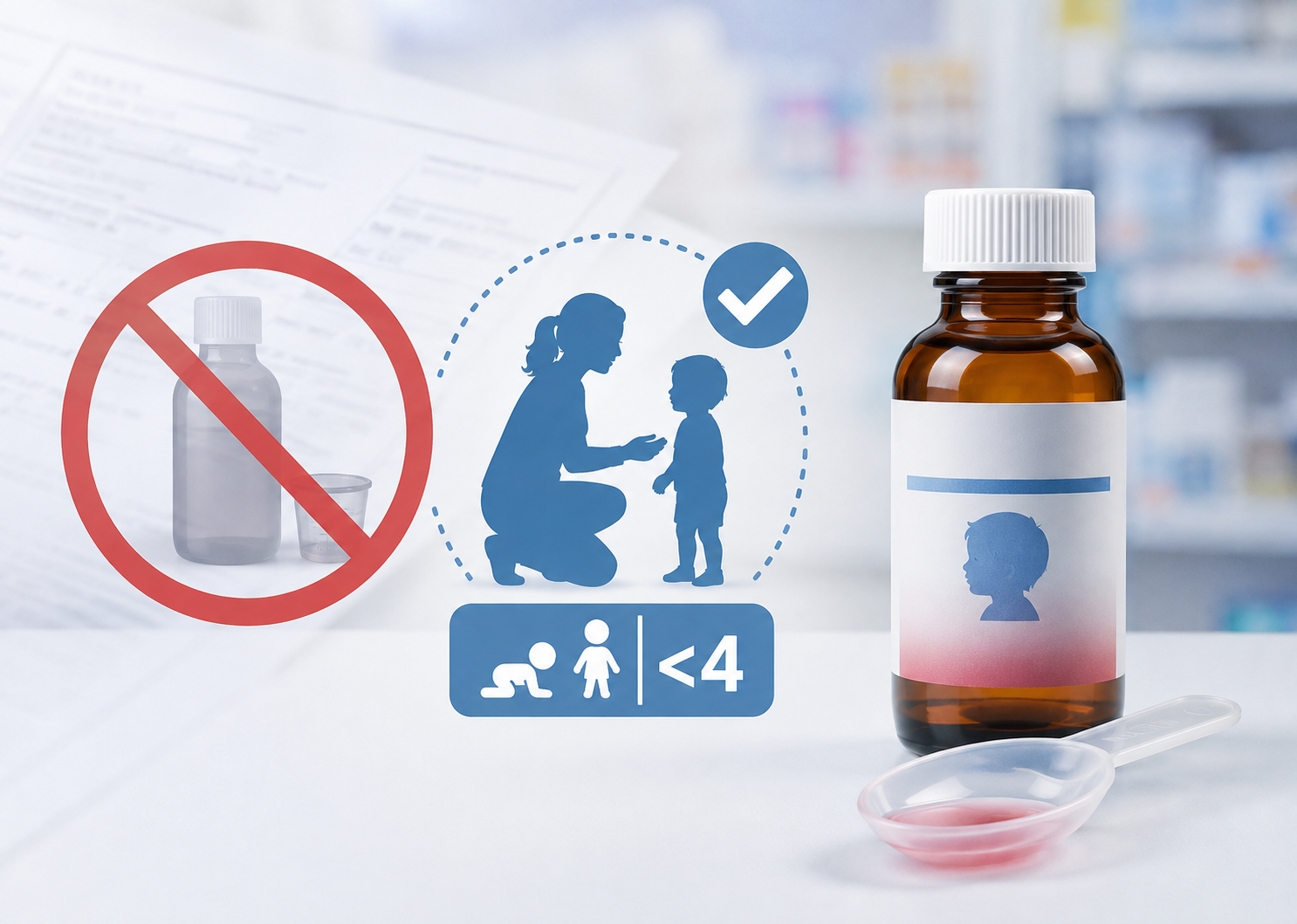
The Union Government has extended restrictions covering all fixed-dose combination medicines containing Chlorpheniramine Maleate and Phenylephrine Hydrochloride. These products must carry a clear warning stating that the combination should not be used in children below four years of age.
The Ministry of Health and Family Welfare announced the decision through a Press Information Bureau release dated 22 August 2026. The action follows recommendations made by an Expert Committee and the Drugs Technical Advisory Board (DTAB).
What the Government Order Says
The order applies to fixed-dose combinations containing both Chlorpheniramine Maleate and Phenylephrine Hydrochloride. Manufacturers must include the prescribed age-related warning on the product label, package insert and promotional literature.
The government stated that the use of these combinations may present risks for children below four years and that safer alternatives are available. The regulatory action has been taken in the interest of public health.
Mandatory Warning
“Fixed Dose Combination shall not be used in children below four years of age.”
Restriction Is Not the Same as a Complete Ban
The notification has sometimes been described online as a complete ban on cough and cold medicines. That description can be misleading.
The official announcement specifically describes a restriction on the manufacture, sale and distribution of the affected combinations, together with a mandatory warning against their use in children below four years. It does not state that every medicine containing either ingredient has been prohibited for every patient.
The restriction concerns products containing the two specified ingredients together as a fixed-dose combination. Patients and caregivers should check the product composition and follow advice from a qualified medical practitioner.
Extension of the April 2025 Requirement
An earlier government notification dated 15 April 2025—S.O. 1717(E) had imposed the same age-specific warning on certain combinations containing these ingredients.
The latest decision expands the requirement to all fixed-dose formulations containing both Chlorpheniramine Maleate and Phenylephrine Hydrochloride. This wider scope is intended to provide consistent warning information across the affected products.
Why Clear Medicine Labels Matter
A medicine label gives patients, caregivers, pharmacists and healthcare professionals important information about appropriate use. Age restrictions are particularly important when medicines are intended for, or may be administered to, young children.
The new requirement means that the warning must not remain limited to regulatory documents. It must also be visible with the product information and in related promotional material.
This can help caregivers identify the age restriction before administering a medicine. However, a warning label does not replace medical consultation, especially when a young child has persistent symptoms or requires treatment.
Responsibilities of Manufacturers
Manufacturers covered by the notification are responsible for ensuring that the required warning appears consistently with the affected formulations.
- The warning must appear on the medicine label.
- It must be included in the package insert.
- Promotional literature must carry the same warning.
- The requirement applies to all FDC formulations containing both specified ingredients.
- The order is effective from its publication in the Official Gazette.
What Parents and Caregivers Should Understand
Parents should not select or administer cough and cold combinations to a child below four years merely because a product is available at home or was previously prescribed to someone else.
Before giving any medicine to a young child, caregivers should check its active ingredients, read the label and consult a qualified doctor. The appropriate treatment can vary depending on the child’s age, symptoms, medical history and clinical condition.
If a child is already taking a medicine containing these ingredients, caregivers should seek advice from the prescribing doctor instead of independently changing or discontinuing treatment.
Role of Pharmacies and Healthcare Professionals
Pharmacists and healthcare professionals also have an important role in communicating the restriction. They should ensure that caregivers understand the age warning and are not confused by similar brand names or formulations.
Because different medicines can contain different combinations of active ingredients, the front-facing brand name alone may not provide enough information. The composition listed on the label should be checked carefully.
Notification Summary
Conclusion
The government’s decision expands an earlier age-specific restriction to all fixed-dose combinations containing Chlorpheniramine Maleate and Phenylephrine Hydrochloride. The mandatory warning is intended to reduce inappropriate use of these combinations in children below four years.
For families, the practical message is to check medicine ingredients carefully and obtain professional medical advice before administering cough or cold medicines to a young child.
Official Sources
Medical Disclaimer: This article is for general informational purposes only. It does not provide medical advice or recommend any medicine. Consult a qualified healthcare professional regarding medicines or treatment for a child.