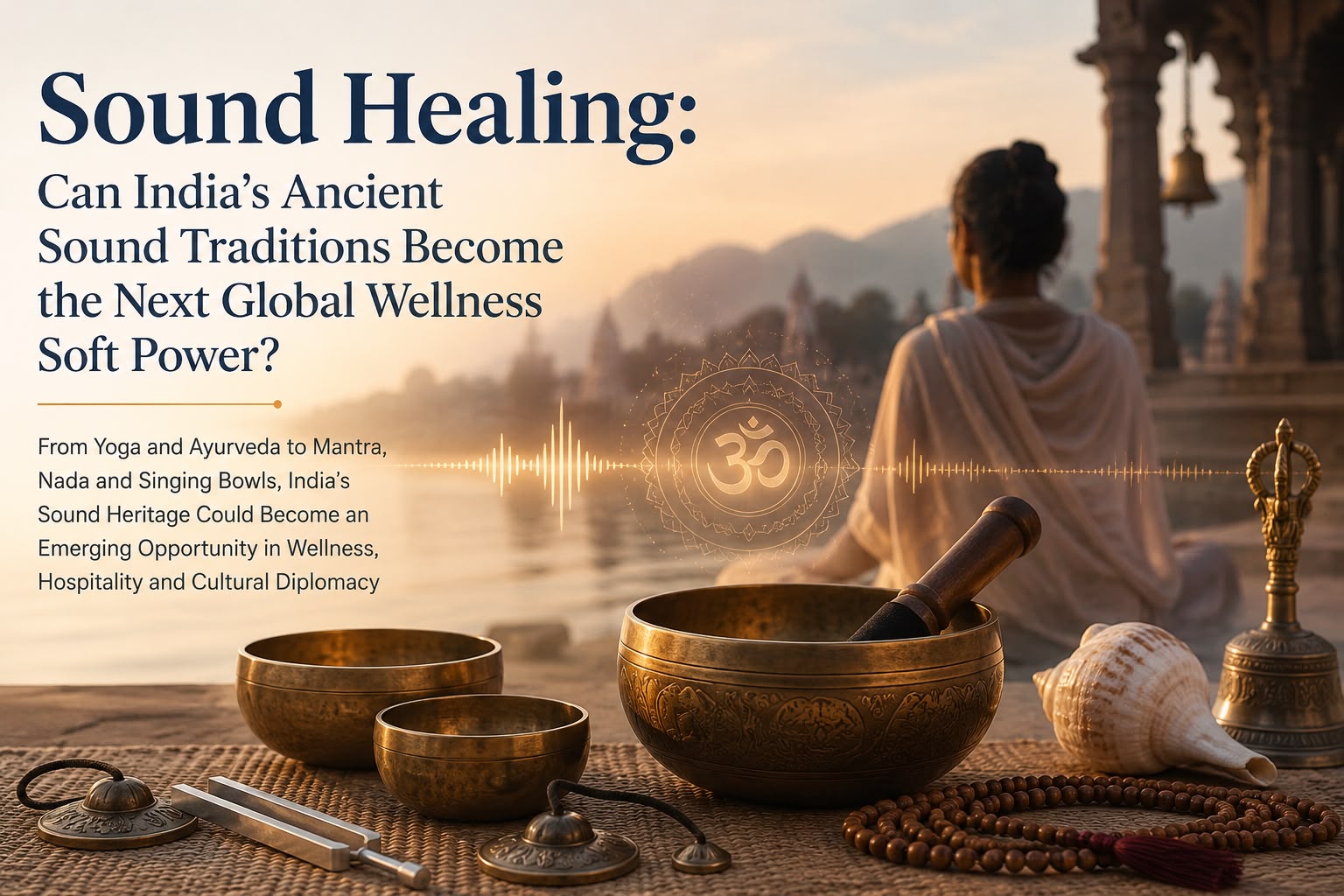
Sound Healing: Can India’s Ancient Sound Traditions Become the Next Global Wellness Soft Power?
From Yoga and Ayurveda to Mantra, Nada and Singing Bowls, India’s sound heritage could become an emerging opportunity in wellness, hospitality and cultural diplomacy
What if the next global wellness experience associated with India is not something people see—but something they hear?
A singing bowl. A mantra. A temple bell. The sound of a conch. A meditative chant. A carefully created vibration.
For centuries, sound has been associated with spiritual, cultural and contemplative practices across India and the wider Himalayan region. Today, modern wellness consumers are rediscovering sound through sound baths, singing bowls, sound meditation, chanting and immersive audio experiences.
As India increasingly positions its cultural heritage as an element of global influence, sound healing presents an intriguing question: Could sound become another language of India’s global wellness story?
The question gains new relevance after Prime Minister Narendra Modi’s Independence Day address from the Red Fort on August 15, 2026, in which he presented “Shakti Ki Saptadhara”—seven streams of strength—as part of India’s journey towards Viksit Bharat 2047. India’s Soft Power was included among those seven streams.
It is important, however, to make one distinction clear: the Prime Minister’s speech did not specifically identify sound healing as a national initiative. Rather, the inclusion of India’s Soft Power provides a broader context for examining how traditions such as yoga, Ayurveda, spirituality, music, meditation and holistic wellness can contribute to India’s international cultural influence.
Sound healing sits at an interesting intersection of all these worlds.
What Exactly Is Sound Healing?
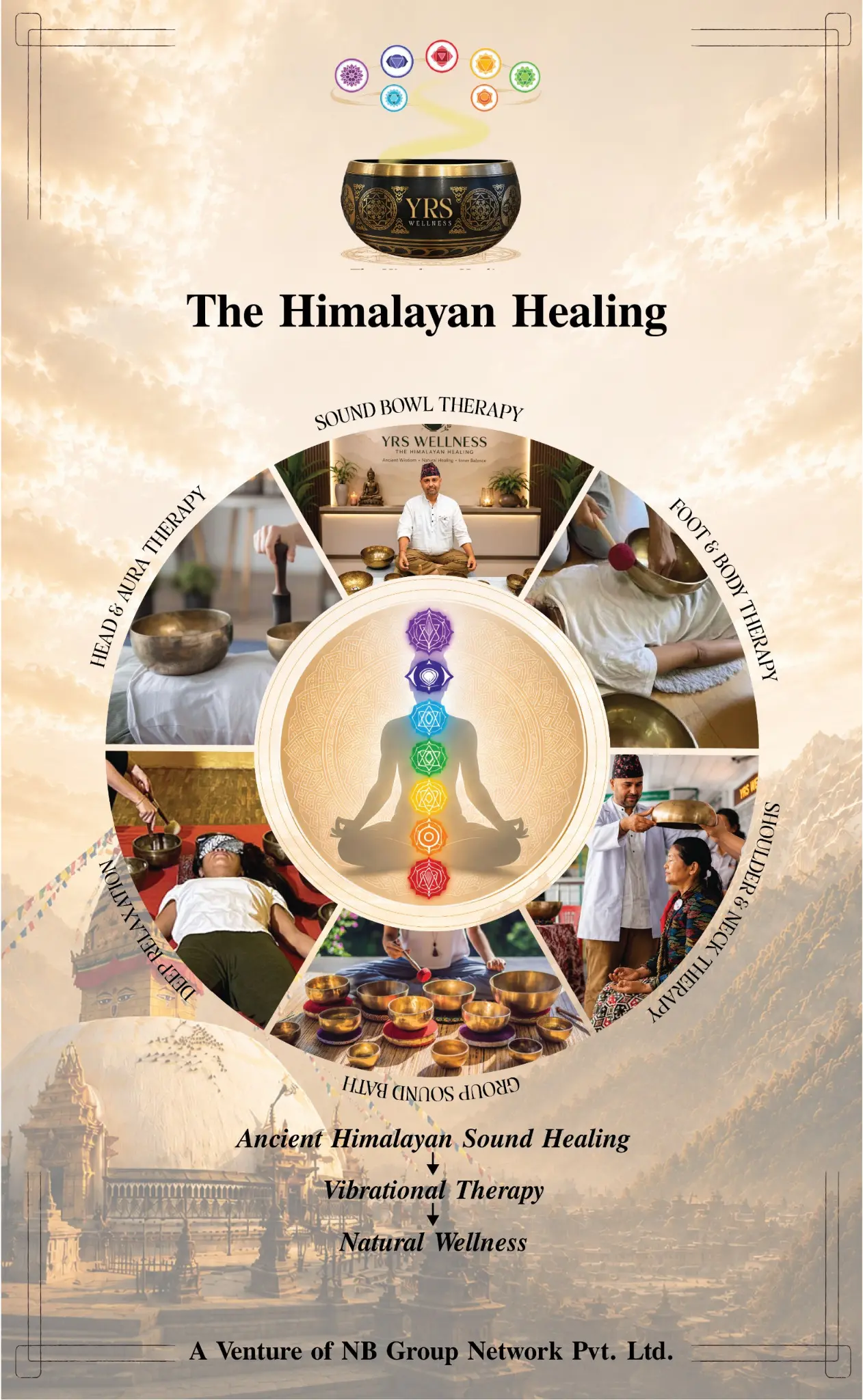
Sound healing is generally understood as a complementary wellness practice that uses sound, rhythm, tones, music, chanting, instruments and vibration to create an experience intended to promote relaxation, meditation and emotional well-being.
Common instruments include Tibetan and Himalayan singing bowls, crystal bowls, gongs, tuning forks, bells, chimes and drums. Vocal practices such as mantra chanting may also form part of sound-based meditation, while nature-based soundscapes and guided audio experiences are increasingly being incorporated into modern wellness programmes.
A typical sound bath may involve participants sitting or lying comfortably while a practitioner creates layers of sound using bowls, gongs, chimes and other instruments.
The objective is generally not entertainment in the conventional sense. Instead, the experience is designed to encourage deep relaxation, focused attention and meditative awareness.
But an important distinction is necessary.
Sound healing should not automatically be presented as a medical treatment or cure.
The more responsible positioning is as a complementary wellness practice, with scientific research still developing. This distinction will become increasingly important as commercial interest in sound-based wellness grows.
The Ancient History Behind the Modern Trend
Sound healing may look like a contemporary wellness phenomenon, but the human relationship with sound is ancient.
In India, sound has historically been deeply connected with mantra, Vedic chanting, classical music, spiritual rituals and contemplative practices.
The Indian philosophical concept of Nada places considerable importance on sound and vibration. The expression “Nada Brahma” is often associated with the philosophical idea of the universe or reality being connected with sound.
Indian temples have traditionally incorporated bells, conches, chanting and music into ritual environments. The human voice itself has also occupied an important place in India’s spiritual traditions.
Mantra chanting uses repetition, rhythm and vocalisation as part of meditation and devotional practices. Indian classical music, meanwhile, developed sophisticated traditions around swaras, rhythm, resonance and tonal relationships, creating an enormous cultural heritage centred around sound.
Beyond India, Himalayan and Tibetan traditions have also used singing bowls, chanting and other instruments in contemplative settings.
Modern sound healing can therefore be understood not simply as a new-age invention, but as a contemporary wellness interpretation of much older relationships between sound, attention, ritual, music and meditation.
That historical depth could become one of India’s greatest advantages.
Is Sound Healing Scientifically Proven?
This is where the conversation requires balance.
Sound healing has become increasingly popular through social media, wellness centres, retreats and lifestyle communities. Practitioners often associate it with relaxation, stress reduction, meditation, improved sleep and emotional well-being.
Some research is encouraging.
A 2025 systematic review published in Integrative Medicine Research examined 19 clinical studies from eight countries, covering research published between 2008 and 2024. The review included nine randomised controlled trials alongside other clinical study designs. It reported potential benefits associated with singing-bowl interventions in areas including anxiety, depression, sleep, cognitive function and certain physiological outcomes.
However, promising research should not be confused with definitive proof.
The evidence base remains relatively young, and studies vary in their design, sample sizes and quality. More rigorous and larger-scale research is needed before broad therapeutic claims can be established.
That means the most credible message for the emerging industry is not that sound can cure everything.
It is much simpler:
This distinction will be essential if India wants to build a globally respected wellness sector rather than simply another social-media trend.
Potential Benefits of Sound-Based Wellness
One of the most immediate applications of sound-based wellness is relaxation.
Immersive sound experiences can create an environment conducive to relaxation and mindfulness. For individuals who find silent meditation difficult, sound can provide an external point of focus.
Sound may also become part of sleep and bedtime wellness routines. Relaxation-oriented sound sessions, guided meditations and calming audio environments can potentially support routines designed around rest.
Research involving singing bowls has also identified potential effects related to anxiety, depression and psychological well-being, although further research remains necessary.
Another major opportunity lies in hospitality.
Hotels, resorts and wellness retreats can integrate sound baths into existing programmes rather than presenting them as standalone treatments. A guest might participate in yoga in the morning, meditation during the afternoon and a sunset sound experience in the evening.
Sound can therefore become part of an overall wellness journey rather than simply a single session.
Corporate wellness is another possible application. Short sound meditation sessions could potentially be incorporated into workplace relaxation and mindfulness programmes.
Digital wellness could take the concept even further through guided sound experiences, immersive audio, meditation applications and curated soundscapes.
The Other Side: Risks and Limitations
The growth of sound healing also brings challenges.
The first is the lack of sufficient high-quality evidence for many of the claims made in the commercial market. Scientific research is growing, but it does not currently justify every therapeutic promise associated with sound healing.
The second challenge is the rise of “miracle cure” claims. Statements about curing serious diseases, repairing DNA or guaranteeing specific physiological outcomes should not be made without robust scientific evidence.
A third issue is practitioner quality. As demand grows, consumers will need greater transparency regarding training, experience and professional standards. An unregulated market can damage public trust and make it difficult for credible practitioners to distinguish themselves.
Medical misrepresentation is another serious concern. Sound healing should never encourage an individual to abandon necessary medical treatment or professional healthcare.
Finally, there is a cultural question. India’s sound traditions should not simply be stripped of their historical context and repackaged as fashionable “frequency products”.
Key Risks to Manage
- Insufficient high-quality scientific evidence for many commercial claims
- Unverified “miracle cure” and disease-reversal claims
- Lack of standardised practitioner training and certification
- Risk of substituting sound healing for necessary medical treatment
- Cultural stripping — heritage repackaged as generic “frequency products”
The stronger opportunity lies in combining heritage, authenticity, responsible wellness and scientific research.
How Big Is the Market?
This may be one of the most interesting business questions.
There is currently no universally accepted official government figure for the size of India’s standalone sound-healing market. As a result, publishing a precise figure and describing it as “India’s sound-healing market” could be misleading.
A more meaningful approach is to examine the much larger wellness economy in which sound healing operates.
According to the Global Wellness Institute’s 2025 Global Wellness Economy Monitor, the global wellness economy reached approximately US$6.8 trillion in 2024 and is projected to reach approximately US$9.8 trillion by 2029.
This wider ecosystem includes mental wellness, wellness tourism, spa services, wellness real estate, physical activity, personal care, healthy eating and traditional and complementary wellness.
Sound healing should therefore not necessarily be presented as a standalone billion-dollar industry today.
It is more realistically an emerging niche within a much larger wellness economy.
That distinction does not make the opportunity smaller. In many ways, it makes the opportunity more credible.
Why India Has a Natural Advantage
India possesses something many emerging wellness destinations have to build from scratch: heritage.
Yoga is already a global phenomenon. Ayurveda has developed an international consumer base. Meditation and mindfulness have become mainstream wellness concepts. Indian classical music is globally recognised.
India also has an enormous spiritual and pilgrimage ecosystem, alongside Himalayan traditions, temple traditions, mantra practices and diverse musical cultures.
This gives the country an opportunity to develop a distinctive proposition around:
The opportunity is not to claim that India invented every form of sound healing.
Rather, India can present its own authentic sound traditions to the world.
That distinction matters. Cultural influence becomes stronger when it is rooted in authenticity rather than exaggerated ownership claims.
The Hospitality Opportunity
For hotels and resorts, sound healing can become much more than a therapy session.
It can become an experience.
Imagine a sunrise yoga session followed by a Himalayan singing-bowl meditation. Imagine a sunset sound meditation overlooking the mountains, a river or the ocean. Imagine an Ayurvedic treatment programme combined with meditation and sound-based relaxation. Imagine a three-day or seven-day luxury wellness retreat combining yoga, nutrition, meditation and sound.
India’s major spiritual and wellness destinations could potentially develop sound-based cultural experiences alongside their existing offerings.
Rishikesh, Varanasi, Bodh Gaya, Dharamshala, Kerala and Himalayan regions all have different cultural and geographical identities that could support distinctive wellness experiences.
The commercial proposition becomes stronger because the visitor is not simply purchasing a “therapy”.
They are purchasing an experience.
Sound Healing and India’s Soft Power
This may ultimately be the most important conversation.
Soft power is not only about diplomacy. It is also about how a country is experienced, perceived and remembered by the world.
Yoga has already demonstrated how an Indian tradition can cross cultural and geographical boundaries. Ayurveda has created another pathway. Indian cuisine, cinema, music, spirituality and festivals similarly contribute to the country’s cultural identity.
Sound could become another dimension.
Imagine an international wellness traveller experiencing:
That is no longer simply a wellness package.
It becomes a cultural experience of India.
This is why sound healing can potentially fit within the broader conversation around India’s Soft Power—not because the Prime Minister specifically announced a sound-healing programme, but because India’s sound traditions can contribute to the wider cultural and wellness ecosystem that gives India international influence.
Where Could Sound Healing Go Next?
The next five to ten years could see sound-based wellness expand across multiple sectors.
Sectors Where Sound Healing Could Expand
- Wellness hospitality – dedicated sound rooms, sound baths and immersive programmes
- Wellness tourism – sound-focused retreats combined with yoga, Ayurveda and meditation
- Corporate wellness – short sound meditation sessions for workplace stress management
- Digital wellness – apps, guided sessions and immersive audio experiences
- Research – collaboration between practitioners, psychologists, neuroscientists and healthcare institutions
- Education – professional training and certification standards
- Cultural diplomacy – Indian music, chanting and sound traditions in international programmes
- Wellness real estate – meditation and sound spaces in residential and hospitality developments
The opportunity, therefore, is much larger than simply selling singing bowls.
What India Needs to Get Right
If India wants to transform wellness heritage into global influence, three principles will matter.
Authenticity
Indian traditions should be presented with appropriate cultural and historical context. Their roots should not disappear behind commercial branding.
Evidence
Wellness claims should increasingly be supported by credible scientific research. The industry’s long-term reputation will depend on its ability to separate genuine potential from exaggerated promises.
Professional Standards
Practitioners, training institutions and wellness businesses need responsible standards. Consumers should be able to understand what a practitioner is trained to do and what a particular experience can realistically provide.
If these three elements come together, sound wellness could evolve from a niche lifestyle trend into a credible part of India’s broader wellness ecosystem.
From Ancient Sound to Future Soft Power
The world is increasingly moving towards wellness experiences that address not only the body, but also stress, attention, emotional well-being, sleep and quality of life.
India has an unusual advantage in this environment.
It does not need to invent an entirely new wellness identity.
It already possesses a deep civilisational relationship with sound, music, mantra, meditation and spiritual practice.
The challenge is to translate that heritage responsibly for a modern global audience.
Yoga showed the world one dimension of India’s wisdom. Ayurveda showed another. Could sound become the next?
The answer will depend on whether India can bring together ancient knowledge, modern research, responsible entrepreneurship, hospitality and cultural diplomacy.
The future opportunity is not about claiming that every sound has a mystical power or that every vibration can heal disease.
It is about recognising that sound can create meaningful experiences of relaxation, attention, culture and connection—and that India has a remarkable historical vocabulary from which to build those experiences.
Perhaps the next generation of international travellers will not experience India only through yoga mats, Ayurvedic treatments or meditation halls.
They may encounter India through the resonance of a singing bowl, the rhythm of a mantra, the sound of a temple bell, the music of an ancient tradition or the silence that follows a carefully created note.
Because perhaps the next chapter of India’s global wellness story will not only be something the world sees.
It may be something the world hears.
And perhaps, that sound is already resonating.