FARAK FOLKLORE Turns Childhood Memory and Indian Craft Into Contemporary Fashion at Lakmé Fashion Week
Kings, witches, forests and mythical creatures remembered in fragments by a designer who grew up in a village
FARAK FOLKLORE was a personal look at memory, imagination and Indian craftsmanship when the label unveiled it at Lakmé Fashion Week in partnership with FDCI at Taj Palace in October 2026. Drawing on the designer’s childhood in a village and the stories of those formative years, the collection turned an imagined world into contemporary silhouettes, textures, colours and symbols.
Kings, Witches and Mythical Creatures
FARAK FOLKLORE took in stories of kings and queens, witches and wild animals, forests, gods and mythical creatures, and looked at them through the fragmented way childhood memory works. FARAK did not recreate traditional narratives literally. It drew on the emotions, characters and imagery attached to them to build its own visual world.
The Stories Behind FARAK FOLKLORE
Craft as a Medium, Not Just a Reference
Traditional Indian craftsmanship formed the foundation of FARAK FOLKLORE. Techniques, textures and visual languages inherited from the past were reinterpreted through a contemporary lens, with craft treated as a medium for experimentation and new expression and not only as a nod to heritage.
FARAK FOLKLORE: Raw and Refined, Ancestral and Futuristic
The collection reflected the contrasts at the centre of FARAK’s design vocabulary: raw and refined, ancestral and futuristic, restraint and rebellion. Familiar cultural references appeared in unexpected forms, setting up a dialogue between what is inherited and what can be imagined from it.
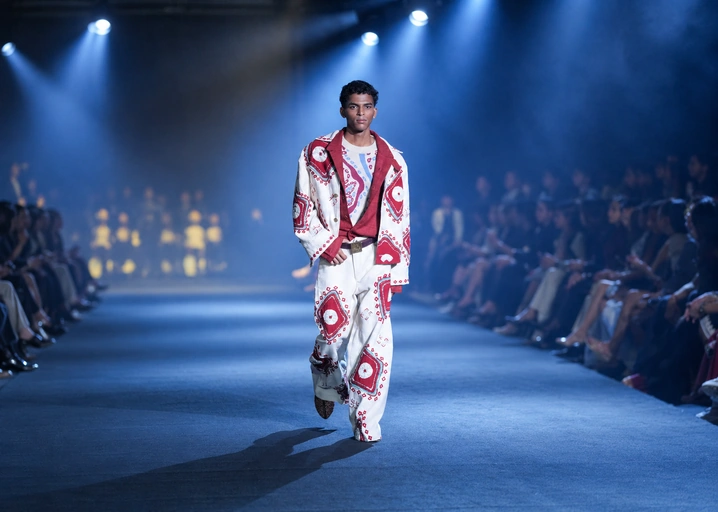
On the runway, clothing became a canvas for memory and fantasy. Elements inspired by imagined forests, mythical kingdoms and fantastical characters came together without turning into literal depictions of individual stories, and the collection captured the wonder, mystery and possibility that often shape how a child experiences the world.
In Rishab Kumar’s Words
Heritage as a Starting Point
FARAK FOLKLORE also reflected the label’s wider approach to design, where heritage is a starting point instead of a fixed reference. By putting traditional craftsmanship in conversation with contemporary ideas, the label explored how familiar techniques and cultural codes can evolve into something unexpected.
At its core, FARAK FOLKLORE was a childhood dream remembered through the language of fashion, bringing together what was inherited, what was imagined and what comes next.
At a Glance
Quick Answers
What is FARAK FOLKLORE?
FARAK’s latest collection, a personal exploration of memory, imagination and Indian craftsmanship drawn from the designer’s childhood in a village.
Where was it presented?
At Lakmé Fashion Week in partnership with FDCI, at Taj Palace, New Delhi, in October 2026.
Who is the designer?
Rishab Kumar, the Founder and Creative Director of FARAK.
Does it retell traditional stories?
No. It draws on the emotions, characters and imagery of those stories without recreating traditional narratives literally.
About FDCI
The Fashion Design Council of India (FDCI) is a non-profit organisation and the apex body of fashion design in India, represented by over 400 members. Its prime objective is to propagate the business of fashion. More at www.fdci.org.