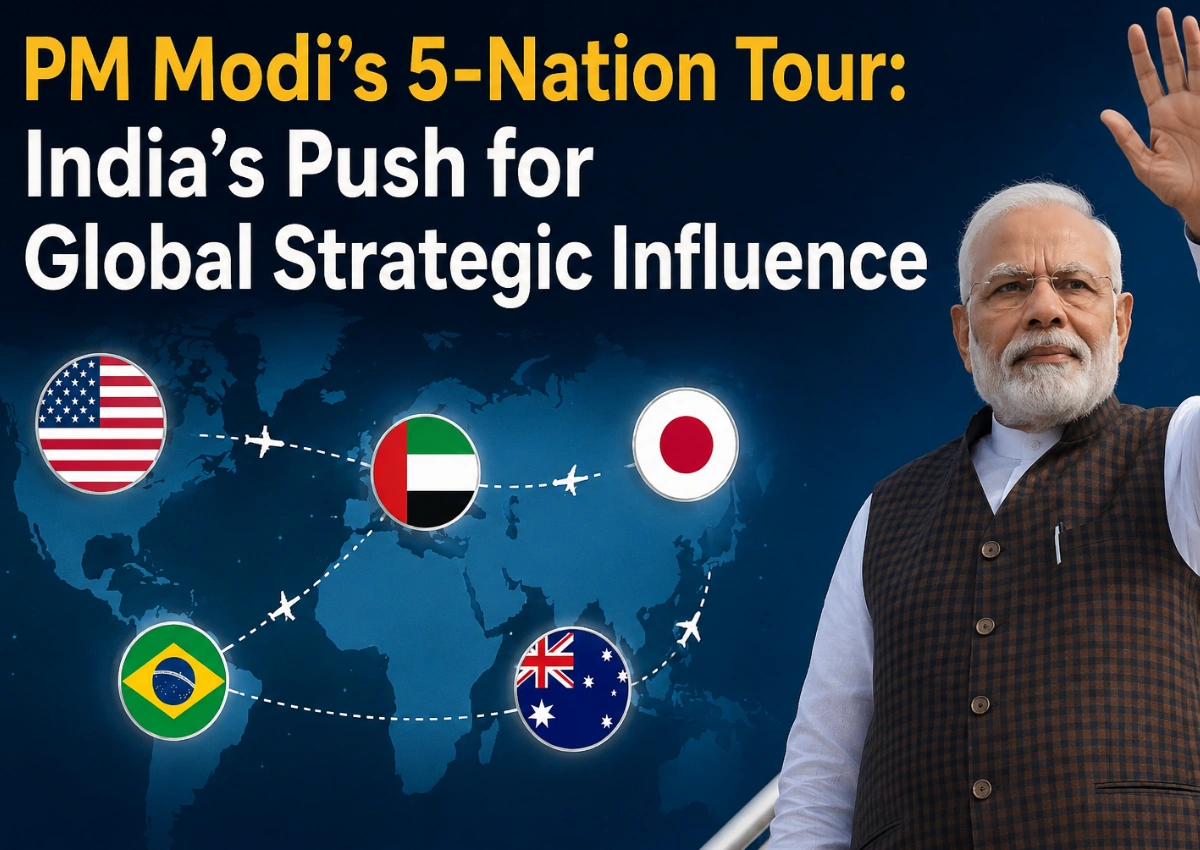
Prime Minister Narendra Modi has embarked on a major five-nation diplomatic visit at a time when the global political landscape is changing at a rapid pace. Covering the United Arab Emirates, the Netherlands, Sweden, Norway and Italy, the visit of the Indian premier has attracted considerable attention from the world observing community.
This is no everyday diplomatic tour; it highlights India’s intensifying effort to deepen global appeal, bolster strategic partnerships and simultaneously raise India’s voice on the global stage.
In the last ten years, India’s foreign policy has been increasingly entrenched in maintaining a balance between the Western powers, regional powers, and the more developing economies; meanwhile protecting its own strategic and economic interests. Looks like the present tour is no different in continuing that larger diplomatic purpose.
The visit should focus on trade, security issues such as defence cooperation and energy security, climate technology, and geopolitical coordination, as India pushes to increase its say on the international stage.
Why the Tour Is Important
The Prime Minister’s tour is very significant considering the timing. The world today is beset with multiple crises created by continuing conflicts in various parts of the world, spiralling energy prices, issues of supply chain management, environmental issues of climate change, etc.
and growing strategic rivalry among major Powers. In this light, countries are building alliances not only for an economic purpose but also for security reasons, for stability in the geographical area.
Recently, India’s global significance has increased more than ever due to its large economy, geostrategic location, fast-growing digital sector and strengthening diplomatic role. Various nations now value India as a co-player in fields like technology, defence manufacturing, energy transition as well as regional stability. So the tour is an effort by India to deepen those relationships and to present itself as a rising and influential global player.
Focus on Europe and Strategic Partnerships
First, I will address the prominent theme of the tour, India’s strengthening relations with European nations.
Relations between India and Europe have been gaining momentum these days, owing to common issues of interest such as climate change, global security, trade diversification, and technology cooperation.
For India, countries like Sweden, Norway, Italy and the Netherlands become important partners in the areas of renewable energy, green technology infrastructure, sea cooperation and innovation.
In addition, European countries want to lessen over-reliance on any one supply chain globally, due to recent international shocks. India is seen as a more attractive economic and manufacturing partner in this scenario.
- Investment partnerships
- Sharing of technologies (for example, jointly manufacturing new equipment)
- International cooperation on green energy
- Semiconductors and digital industries
- Defense cooperation
Today, India’s contacts with Europe are more strategic than symbolic.
Energy Security and the UAE Visit
The visit of the Prime Minister to the United Arab Emirates is most relevant because, in reality, energy security is one of the biggest economic issues for India. Since India imports a significant portion of its crude, the importance of maintaining a steady relationship with the Gulf countries is very high.
Waves of instability existing in West Asia and erratic oil prices have brought the issue of the stability of the supply of energy and economic pressure into focus.
The UAE is not only an important energy partner but also an important investment and trading partner for India. The Gulf has evolved over the years and diversified from the traditional energy frames to those of infrastructure technology logistics, fintech and defence cooperation.
The visit is expected to focus heavily on:
- Energy cooperation
- Trade agreements
- Investment opportunities
- Strategic coordination
- Indian diaspora engagement
- The Gulf region remains central to
India’s economic and foreign policy priorities.
Climate Diplomacy and Green Transition
Climate change and sustainability tend to feature prominently. European states have in particular been supporting the transition to a green economy through their push for climate-friendly energy changes, environmental regulations and development policies.
India has just managed these two priorities, development and climate, together.
The country has increased investment in:
- Solar energy
- Electric mobility
- Green hydrogen
- Renewable infrastructure
- Partnerships with technologically advanced countries can help
India accelerates its clean energy goals while also addressing climate-related economic challenges.
Climate diplomacy has now become a major part of global foreign policy, and India is increasingly participating in these discussions as a leading developing economy.
Domestic Political Significance
Indian prime ministers’ foreign visits have political implications at home too: International diplomacy also helps to shape the image of leadership, global power, and national prestige. Internationally visible meetings, business deals and international agreements often become issues of concern in domestic politics.
For the government, these trips are seen as a positive sign of India’s increased standing in the world.
Others, though, consider them useless expenses and wonder whether diplomatic goodwill actually translates into concrete, tangible benefits for improved everyday consumer well-being.
This debate is already common in many democracies in which foreign policy becomes a more and more important component of political image-building.
Conclusion
The five-country diplomatic journey of Prime Minister Narendra Modi signals a turning point in the Indian approach toward foreign policy.
Weighing heavily on the Prime Minister’s agenda for the trip was a desire to project India on the world stage, forge new relationships, and stake its claim for global power, as the world stands at a crossroads.
The tour covers a whole spectrum of India’s emerging role, from energy security and trade cooperation to climate diplomacy and geopolitics.
On top of that, there is an emphasis on the idea that modern diplomacy is almost intimately linked to issues of economics, technology, security and the forging of national images. As international powers are shifting historically, India seems eager to prove that it is not only a regional power but really a global power in the making.