Beyond Make in India: MeitY Revises Manufacturing Rules for Laptops, Desktops and Servers; Can India Become a Global IT Hardware Export Hub?
A new Domestic Value Addition method rewards deeper manufacturing, R&D and Indian product design
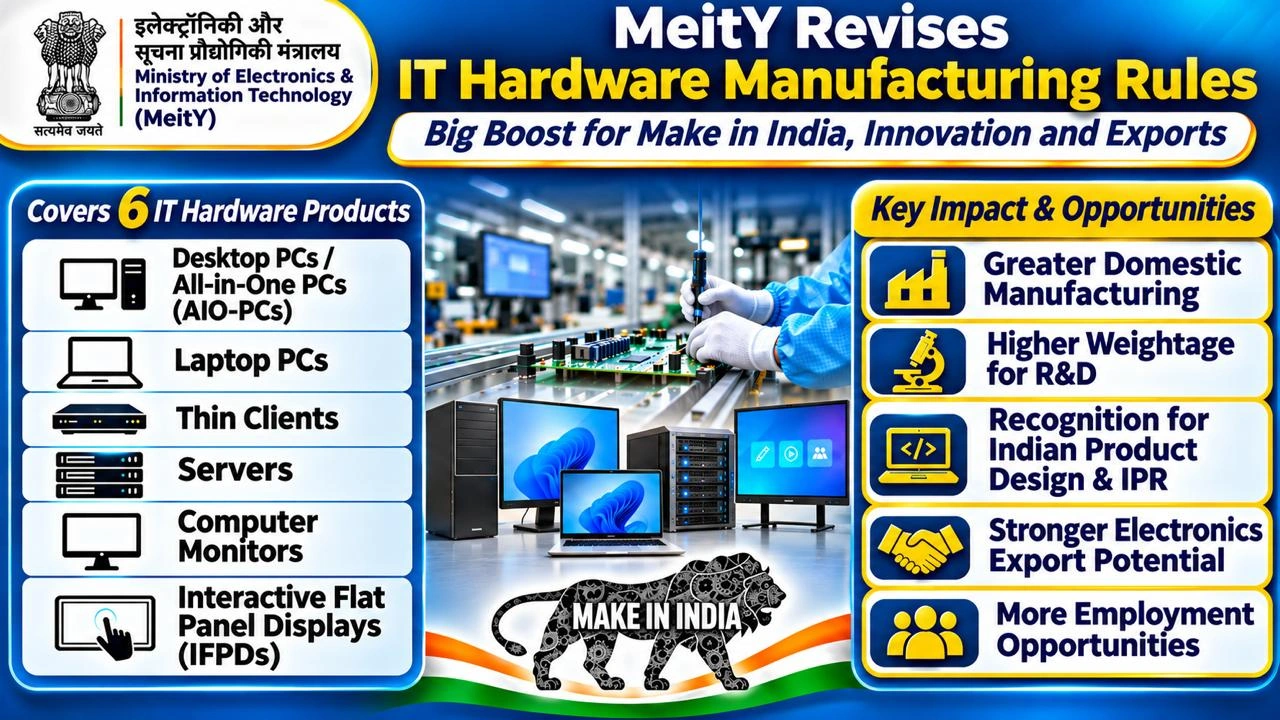
The Ministry of Electronics and Information Technology (MeitY) has changed how Local Content and Domestic Value Addition (DVA) is worked out for six major IT hardware products. The revised MeitY IT hardware rules are meant to promote domestic manufacturing, build indigenous technology, encourage innovation and create jobs. They sit under the Public Procurement (Preference to Make in India) Order, 2017, and replace the matching provisions of MeitY’s earlier notification dated 7 September 2020.
The focus is domestic manufacturing, but the long-term effect could reach India’s electronics trade. By rewarding deeper production, local component sourcing, design and R&D, the MeitY IT hardware rules could help India build the base to compete as an IT hardware destination. What exactly has changed, and what could it mean for manufacturers, exporters and global electronics companies?
Six Products Under the MeitY IT Hardware Rules
The MeitY IT hardware rules cover six products that form a key part of India’s digital infrastructure, business technology, education and computing industry. By including them, the government wants manufacturers to do more production work in India instead of relying mainly on imported parts and simple assembly.
What Has Changed in the DVA Method
Under the MeitY IT hardware rules, the biggest change is a process-oriented mechanism based on the Bill of Materials (BoM), which is a detailed list of every component and material needed to build a product. A laptop, for instance, includes a motherboard, processor, RAM, SSD, display, chassis and power modules. Under the MeitY IT hardware rules, eligible manufacturing activities carried out in India get recognised when DVA is calculated.
The wider aim is to push companies towards deeper manufacturing capability instead of staying with basic assembly.
More Credit for Indian R&D, Design and IP
The MeitY IT hardware rules also give extra weightage to eligible in-house R&D, Indian product design and Intellectual Property Rights (IPR). That matters because making a product and developing its technology are different capabilities. A firm can assemble a laptop in India while the engineering, architecture and design come from elsewhere. By crediting in-house R&D, design and IPR, the framework nudges companies to invest in homegrown technology and to own more of what they sell. It could open higher-value segments to Indian engineers, hardware startups and domestic brands.
Who Could Benefit From the MeitY IT Hardware Rules
Under the MeitY IT hardware rules, makers of PCBs, sub-assemblies, power modules and display-related parts may find new demand as larger manufacturers look at local sourcing, and international brands could be encouraged to expand production in India. Higher recognition for R&D, design and IP is an added reason for domestic firms to invest in engineering.
Potential Benefits
Actual gains will depend on manufacturing costs, supplier capability, production quality and how well the framework is carried out.
Can India Become a Global IT Hardware Hub?
India has made solid progress in electronics. Government data shows electronic goods exports rising from about ₹38,000 crore in FY 2014-15 to ₹3.27 lakh crore in FY 2024-25. The next challenge is to move beyond assembly-led growth and become a stronger global supplier of finished IT hardware, components and technology solutions. The MeitY IT hardware rules could help in three ways.
India’s Export Opportunity in Numbers
NITI Aayog’s Trade Watch analysis puts India’s 2024 exports of automatic data-processing machines and units (HS 8471) at about US$1 billion, against global imports of US$552.4 billion. That points to large headroom. The category is broader than laptops and desktops, though, so the figures should not be read as the full global market for the six MeitY products. Capturing the opportunity will need investment in scale, component availability, technology, quality standards and market access.
Industry View

“India’s journey towards becoming a global electronics manufacturing hub must go beyond domestic production and focus on building strong export capabilities. Strengthening local value addition, developing indigenous components, encouraging product innovation and investing in advanced manufacturing will be essential to making Indian products more competitive in international markets. The focus should be on creating a robust manufacturing ecosystem that not only meets domestic demand but also positions India as a reliable partner in global supply chains.”
Desh Raj Bhadana, Director, MEDEPCHe added that closer collaboration among manufacturers, component suppliers, industry associations and policymakers would be important to widen India’s electronics export potential and create lasting opportunities for Indian businesses abroad.
What It Means for Government Procurement
The MeitY IT hardware rules work under the Public Procurement (Preference to Make in India) framework, so it matters most when government departments and public sector bodies buy IT hardware. DVA calculations decide the local-content status of products supplied by manufacturers, and the new approach aims to reflect the manufacturing actually done in India.
Standard Format and Self-Certification
The MeitY IT hardware rules also set a standard format for DVA calculation and self-certification, to bring more transparency and consistency to how manufacturers declare local contribution. The framework allows objective verification of self-declared DVA where required, so manufacturers will need to keep proper records of component sourcing, manufacturing processes, production activity and eligible R&D and design work.
When Do the MeitY IT Hardware Rules Take Effect?
Timeline
The six-month window gives manufacturers time to understand the method and prepare their processes and paperwork.
The Road Ahead for the MeitY IT Hardware Rules
The goal is not just to assemble more computers, laptops and servers in India. It is to build an ecosystem of component manufacturing, engineering, research, design and technology ownership. Opportunities for manufacturers go beyond government procurement, since stronger capability could gradually support a place in global supply chains. India’s export ambitions will still hinge on competitive pricing, steady quality, scale, reliable component supply, international certifications and sustained investment.
Success will be judged not only by how much hardware India makes, but by how much technology it develops, how many components it produces locally and how well Indian firms compete abroad. The bigger prize is a move from ‘Assembled in India’ to ‘Designed, Developed and Manufactured in India’.
Quick Answers: MeitY IT Hardware Rules
What have the MeitY IT hardware rules changed?
MeitY has revised how Local Content and Domestic Value Addition (DVA) is calculated for six IT hardware products under the Public Procurement (Preference to Make in India) Order, 2017, using a process-oriented, Bill of Materials-based method.
Which products are covered?
Desktop PCs and All-in-One PCs, laptop PCs, thin clients, servers, computer monitors and interactive flat panel displays (IFPDs).
When do the revised rules take effect?
Six months from the date of publication in the Official Gazette, not from the date of the official announcement. They supersede the corresponding provisions of MeitY’s notification dated 7 September 2020.
Does this ban imported laptops or give export subsidies?
No. The announcement does not introduce an immediate ban on imported computers or laptops, and it does not automatically give exporters financial incentives. It applies to DVA assessment under the public procurement framework.