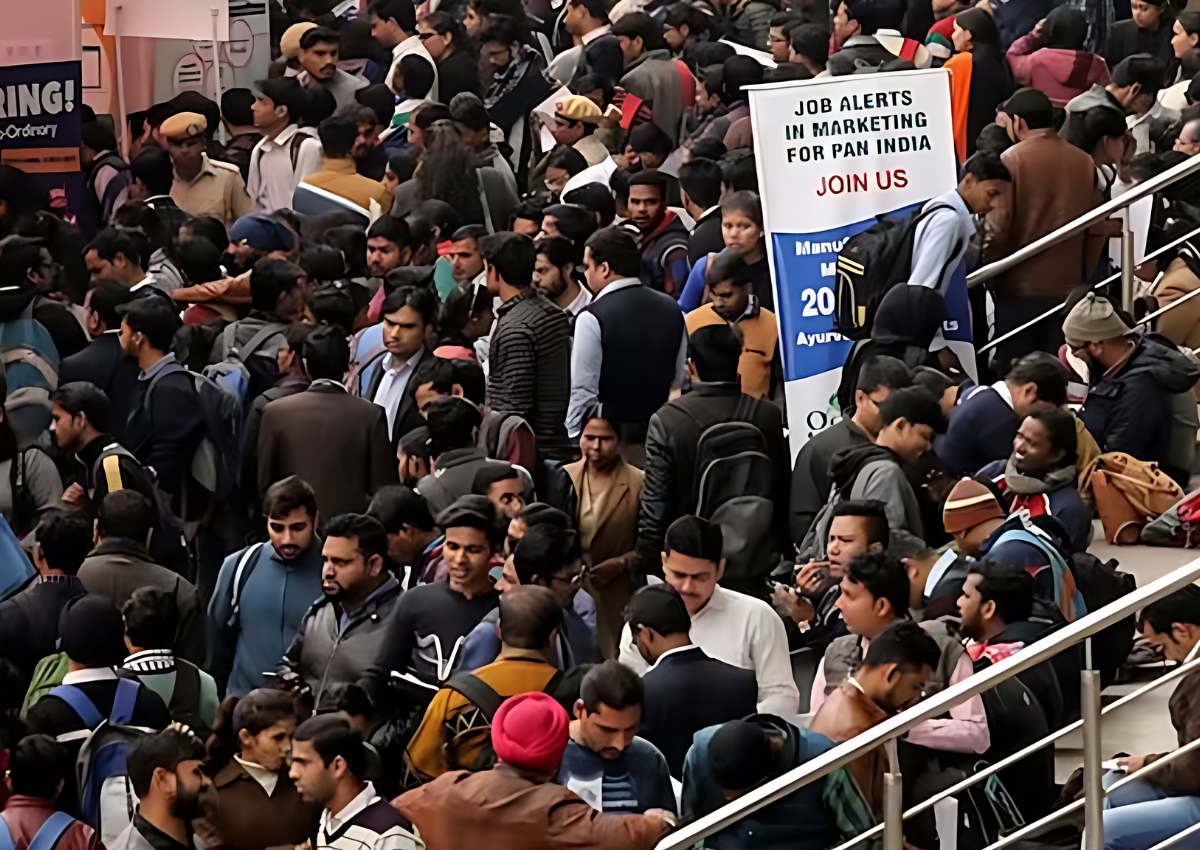
The Ministry of Statistics and Programme Implementation (MoSPI) published the Periodic Labour Force Survey (PLFS) Monthly Bulletin for March 2026 on 15 April 2026. According to the figures, the unemployment rate in India among individuals aged 15 years and above remained at 5.1% in March 2026, rising from 4.9% in February 2026. It has been 5 months since the unemployment rate reached a level as high as this one under the Current Weekly Status (CWS) concept.
Against the background of a slight overall increase, the statistics also indicate that the problems are still there, especially in the cities and among young people. The Labour Force Participation Rate (LFPR) dropped marginally to 55.4% in March as compared to 55.9% in February, which may be a sign of a slight decrease in the number of people who are either looking for or are working.
Key Indicators Breakdown
PLFS figures illustrate the differences between a rural and urban setting as well as those related to gender, and age groups.
Overall Unemployment Rate (15+ years):
- 5.1% (higher than the 4.9% of February)
- Urban Unemployment Rate: 6.8% (slightly higher than 6.6% of February)
- Rural Unemployment Rate: 4.3% (marginally up from 4.2% of February)
The growth in unemployment can be mainly attributed to urban areas, where the number of jobless individuals has increased for both men and women. The female unemployment rate in urban areas was 9.0%, which is much higher than the male rate of 6.1%.
Making a youth employment problem out of it!
Significantly, these figures point to a youth problem. March 2026 saw the youth (aged 15-29) unemployment rate spike to 15.2%, the highest in nine months. It was 14.8% in February. Among females, it was 17.7% and among males, 14.3%.
The high rate of youth unemployment implies a larger structural problem as the economy is growing, but at the same time, the capacity to employ the youth entering the labour market is still limited. This is making the situation even more alarming, taking into consideration that India has a huge youth population, which is often considered the country’s demographic dividend.
Labour Force Participation and Employment Trends
The Labour Force Participation Rate (LFPR) of persons aged 15 and above barely dropped to 55.4% in March from 55.9% in February. The rural LFPR decreased to 58.0% from 58.7%; however, the urban LFPR was more or less unchanged.
The Worker Population Ratio (WPR), which shows the share of the population that is employed, was 52.6% in March. This minor decrease is the result of an unemployment rate going up a little and labour force participation coming down a bit.
Context and Comparison with Previous Months
According to the monthly bulletins of PLFS, the unemployment rate has seen minor fluctuations, staying between 4.7 and 5.1% for the whole year. Although the 5.1% rate in March 2026 is the highest figure after October 2025, it is still less than the highest levels during the pandemic years.
As for the disparity between urban and rural unemployment, urban unemployment has been higher all along, indicating a larger dependence on formal and organised sector jobs in urban areas. Also, the gender gap in urban unemployment remains, with women having a higher rate of unemployment.
Reasons Behind the Marginal Rise
Economists say the slight increase in March was the result of a few factors working together-
- Seasonal effects in urban labour markets
- Slower hiring in some services and manufacturing segments
- Continuing impact of global uncertainties on export-oriented sectors
On the other hand, when we consider a period of 12 months, the overall progression is very much steady improvement, in contrast to high rates being recorded during 202425. The government has pointed out the fact that even among major economies, India is recording the highest real GDP growth, hence this should be the reason for stronger job creation eventually.
Government Response and Policy Measures
The Labour Ministry and NITI Aayog have again affirmed that the government is concentrating on job creation through various schemes. Major schemes entail- PLI schemes spanning 14 sectors, Skill India Mission, and apprenticeship programmes, targeting labour-intensive sectors like textiles, tourism, and construction Increasing MGNREGA scheme in rural areas
The government representatives have remarked that statistics from PLFS are the Current Weekly Status, which displays short-term changes more vividly compared to the annual surveys. They argue that the youth unemployment problem will be resolved through long-term structural reforms and increased investments in manufacturing and services over time.
Expert Reviews and Wider Effects
Economists have offered different opinions. While some reckon the latest 5.1% unemployment rate is still a level that can be handled, considering the huge labour force of India
Others warn that the slight rise in overall unemployment, with youth unemployment remaining high, is a clear sign that more focused measures are required. The statistics further point out the gap between urban and rural areas. Rural parts have further lower unemployment rates, mainly because agriculture and MGNREGA continue to directly provide employment. Urban areas, on the contrary, have very competitive job markets which respond more to the economic cycles.
Policymakers should take the PLFS data as a reminder that focus on skill development should be intensified, the working environment should be made more friendly for business, and labour-intensive industries should be promoted. As for young job hunters, these statistics point out that education is still unaligned with employability.
What’s next?
PLFS release of March 2026 captures India’s labour market fairly well: largely no change in unemployment, with an increase recorded only in the urban sector, the youth joblessness stays elevated and a little reduction in labour force participation. Overall unemployment rate of 5.1% may be considered moderate when put into perspective of past years; however, the data should not be ignored as job creation needs to match the arrival of numerous young individuals in the labour market each year. Apart from economic growth, employment generation is going to be one of not only India’s policy challenges but also the biggest one.