GIC Summit 2026: A Platform to Strengthen India’s MSMEs, Industry Collaboration and Global Trade Opportunities
The Global Industrial Commerce Federation brings MSMEs, manufacturers, exporters and startups together in New Delhi on October 28, with leadership orations on MSMEs and textiles
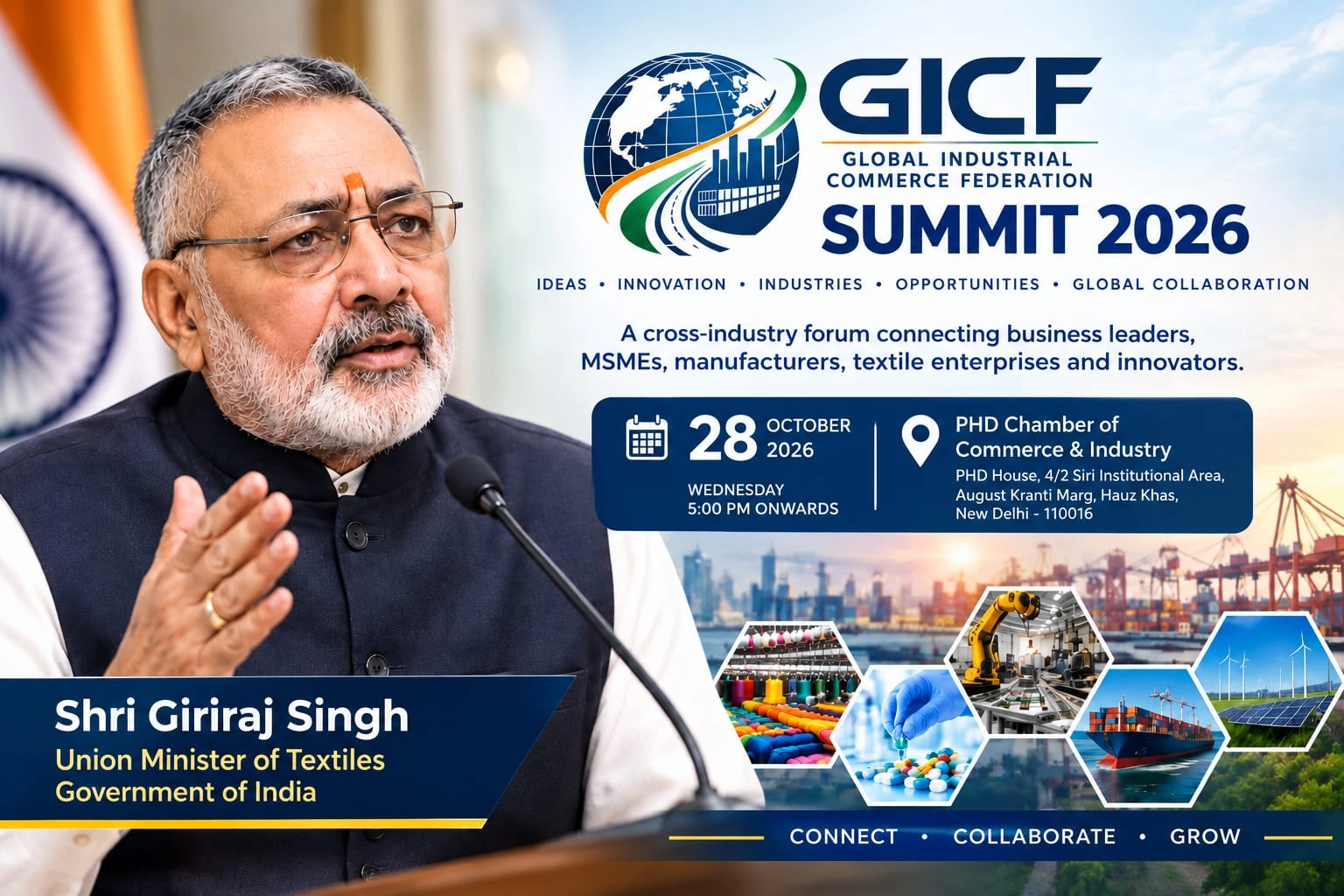
India’s economy leans more and more on MSMEs, manufacturers, exporters and startups, yet they operate in a market where demands, technology and competition keep changing. In that setting, the contacts a business has and the markets it can reach count almost as much as what it makes. That is the idea behind GIC Summit 2026, which the Global Industrial Commerce Federation (GICF) has scheduled for October 28, 2026, at the PHD Chamber of Commerce and Industry, PHD House, Hauz Khas, New Delhi.
The summit begins at 5 PM and is meant as a place for business discussions, knowledge exchange and networking across sectors. Its focus is on ideas, innovation, industries, opportunities and global collaboration, and the organisers say the aim is to move businesses past routine networking towards practical steps: a stronger market presence, partnerships and long-term growth.
What GICF Is Trying to Do
GICF calls itself a multi-stakeholder platform that links businesses, MSMEs, startups, manufacturers, exporters, investors and institutions. Its approach is to turn professional relationships into practical opportunities through collaboration, knowledge sharing, trade facilitation and market access. GIC Summit 2026 is where GICF plans to put that approach to work.
The gaps it points to are familiar. A company can have a competitive product and no access to the right buyers. An MSME may be ready to grow but lack distribution. A startup can build a clever solution and still need an industry partner to test and commercialise it. GICF says it tries to close such gaps by linking enterprises with stakeholders who can help them reach their goals.
GICF’s vision, as stated, is a connected business ecosystem across borders that helps Indian industries, MSMEs and innovators tap fresh markets, technology and investment while growing sustainably. Its mission centres on linking businesses, empowering MSMEs, promoting trade and innovation, and supporting growth through collaboration and global tie-ups. The programme material says GICF spans more than 40 industry sectors grouped into 10 master verticals, so members can deal with organisations outside their own field. That matters because supply chains, technology, logistics, finance and digital platforms now influence business performance across the board.
Why MSMEs Are at the Centre of GIC Summit 2026
MSMEs make products, supply components, provide specialised services, distribute goods and bring new business ideas to the market. Making a good product, though, does not guarantee growth. For smaller enterprises, growth usually depends on finding the right customers, understanding what buyers expect, running more efficiently, earning credibility and building ties with reliable partners.
GIC Summit 2026 has a dedicated MSME Leadership Oration to take up these concerns. According to the programme, discussions will touch on market access, productivity, technology, branding, readiness to do business, partnerships and growth support. Union MSME Minister Shri Jitan Ram Manjhi is listed as chief guest. The focus, as stated, is on policy dialogue, growth opportunities and a stronger MSME ecosystem, particularly the conditions that help enterprises get noticed, connect with others and compete.
Partnerships are the fourth theme. Suppliers, service providers, financiers, technology companies and knowledge partners can all contribute to a business’s expansion, and the oration is meant to encourage discussion on these relationships. The practical aim is to move from a first introduction towards a specific next step, such as a buyer meeting, a commercial discussion or a capability-building initiative.
Textile Industry Leadership Oration
Textiles and apparel are the second big focus. The chain runs from fibre and yarn through fabric, processing, apparel and home textiles to fashion, retail and exports, and each stage shapes the final product, so coordination matters. Shri Giriraj Singh, Union Minister of Textiles, is listed in the programme as chief guest for the Textile Industry Leadership Oration, where the discussion is meant to centre on strengthening the value chain and on priorities that help businesses respond to changing market demands.
One Summit, Ten Master Verticals
What sets GICF apart is how many industries it covers. Instead of staying within one sector, the federation brings together businesses from industries that often depend on one another. The programme names ten master verticals.
The 10 Master Verticals
- 1Agriculture, Food and Rural Economy
- 2Textiles, Apparel and Lifestyle
- 3Healthcare, Pharma and Wellness
- 4Engineering, Manufacturing and Industrial Products
- 5Automobile, EV and Mobility
- 6Infrastructure, Construction and Real Estate
- 7Electronics and Electrical
- 8Food Processing
- 9Logistics, Supply Chain and International Trade
- 10MSME, Startups, Innovation and Entrepreneurship
Beyond these ten, the wider landscape includes IT and software, financial services, retail and e-commerce, renewable energy, education, tourism and hospitality, media, telecom and professional services. That variety gives businesses room to look for partners outside their usual circle. A manufacturer might find technology providers offering automation or quality-management tools, a textile firm might look at better logistics and export coordination, and an MSME might adopt digital tools for product discovery and customer outreach. Startups, similarly, may find established manufacturers willing to work on prototypes, pilot projects or new products.
None of this happens automatically after networking. It needs clear business goals, suitable partners and follow-up. A structured platform can, at best, help businesses start those conversations.
Multi-Industry Business Sessions at GIC Summit 2026: Four Steps
The summit’s multi-industry business sessions are designed to help participants spot shared needs and complementary strengths. The programme outlines four steps for a productive interaction.
The Four-Step Approach
- 1Discover demandUnderstand what buyers and partners are looking for, including product specifications, service requirements and delivery expectations.
- 2Demonstrate capabilityExplain your products, services, operational strengths and business proposition clearly.
- 3Identify complementary partnersLook for suppliers, technology providers, distributors, service companies or others who can help meet business goals.
- 4Agree on the next stepA good conversation should end in a follow-up call, proposal, sample request, meeting or further commercial discussion.
According to the programme, the sessions are meant for a wide group: enterprise owners, MSMEs, startups, buyers, distributors, exporters and importers, logistics professionals, technology providers, investors, advisors and institutional stakeholders. It stresses practical engagement over networking for its own sake.
Global Partnerships and New Markets
For businesses looking beyond their home markets, GIC Summit 2026 also puts international partnerships and trade links on the table. GICF lists cross-border collaboration, trade delegations, international exposure, investment facilitation and strategic business relationships among its objectives, and its membership framework talks about connecting with buyers, suppliers, distributors and channel partners across regions and sectors.
Going abroad takes preparation, though. Businesses have to assess demand, product suitability, pricing, quality requirements, logistics and the regulatory conditions of the target market. For MSMEs, finding reliable local partners and understanding what buyers there expect can matter before any money is committed. Platforms that bring businesses and trade stakeholders together can offer a starting point, but their value will depend on whether the connections lead to commercially useful results.
Membership and Policy Representation
GICF’s membership framework is meant for enterprises that want stronger business links at the regional, national and international levels. According to the programme, membership-related opportunities include taking part in expos, conclaves, seminars and trade delegations, and getting introductions to potential buyers, suppliers, investors and technology partners. Members are also meant to receive information on policies, schemes, trade opportunities and industry developments.
The framework also puts government-facing dialogue and sector representation on the agenda. Per the programme, GICF collects members’ concerns on regulation, compliance, government schemes and market access, builds evidence-based inputs, takes them to the relevant ministries and policy forums, and follows up on the responses. For businesses, that could be a channel for shared industry concerns. How useful it proves will depend on the quality of participation, how relevant the issues are and whether discussions are followed through.
GIC Summit 2026: Event Details
The Road Ahead
Indian businesses are adjusting to changing market demands, and links with the right industry peers, operational readiness and access to markets remain part of that picture. For MSMEs, manufacturers, exporters and startups, lasting expansion draws on product capability, quality, technology, a good grasp of customers and dependable partners. GIC Summit 2026 tries to bring these priorities into one forum, with sessions on MSME development, textile value-chain collaboration, business readiness, technology adoption and global trade links.
For those who attend GIC Summit 2026, the real measure will not be how many contacts they collect but the quality of the discussions, how relevant the partnerships turn out and what concrete action follows. NB News Network will continue to follow developments across India’s business, MSME, manufacturing and trade ecosystem, and the platforms shaping industry collaboration and economic growth.
Quick Answers
When and where is GIC Summit 2026?
Wednesday, October 28, 2026, from 5 PM onwards, at the PHD Chamber of Commerce and Industry, PHD House, Hauz Khas, New Delhi.
Who is organising it?
The Global Industrial Commerce Federation (GICF), a multi-stakeholder platform for businesses, MSMEs, startups, manufacturers, exporters, investors and institutions.
Which leadership orations are planned?
An MSME Leadership Oration (chief guest listed: Jitan Ram Manjhi) and a Textile Industry Leadership Oration (chief guest listed: Giriraj Singh), according to the programme.
Which sectors does GICF cover?
More than 40 industry sectors under 10 master verticals, from textiles and healthcare to engineering, EVs, logistics, electronics and startups.