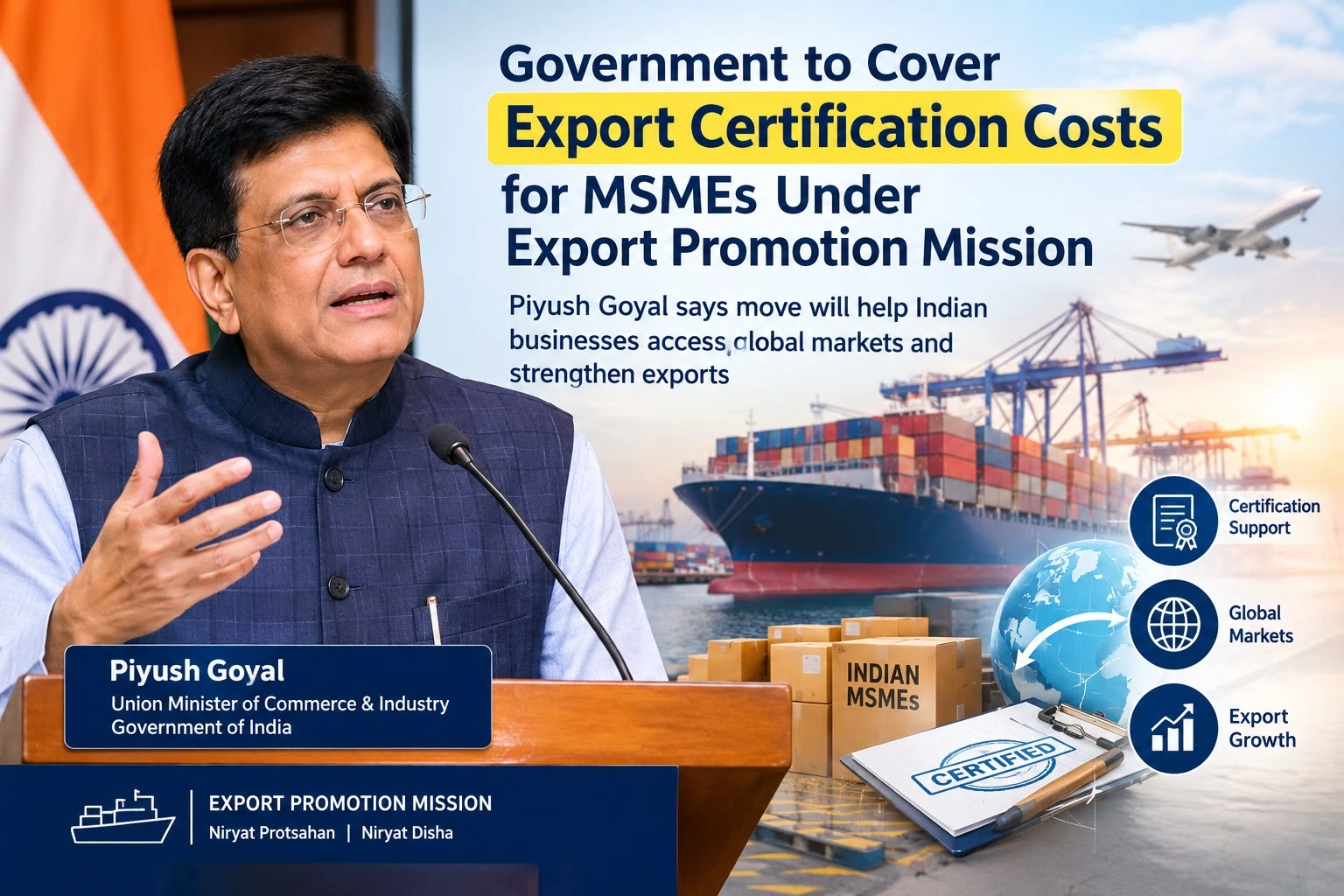
Government to Cover Export Certification Costs for Micro and Small Enterprises Under Export Promotion Mission, Says Piyush Goyal
The ₹25,060-crore mission could lower a key compliance barrier for smaller Indian exporters, including electronics manufacturers. NB News looks at what the announcement means and what exporters should check first
Small exporters have a fresh reason to look closely at the Export Promotion Mission (EPM). Commerce and Industry Minister Piyush Goyal has said the government is ready to pay the full cost of expensive export certifications for micro and small businesses under the scheme, a step that could make overseas markets easier to reach for smaller Indian firms.
Goyal made the remarks to reporters in Berlin on October 23. He asked current and aspiring exporters, in every product category, to take their requests to the Directorate General of Foreign Trade (DGFT), and said the government wants to ease the money and paperwork hurdles that put many small firms off going global.
Why Certification Costs Hurt Small Exporters
A good product at a fair price is rarely enough to win a foreign buyer. Exporters also have to clear technical standards, certification rules, environmental norms and checks specific to what they sell. For a small business the bill adds up fast: certification fees, lab tests, inspections, paperwork, verification and the ongoing cost of staying compliant. Much of it falls due before the first overseas order is even in hand.
If the government does pick up these costs for eligible micro and small units, one real obstacle to exporting gets lighter. What remains to be seen is whether that produces more first-time exporters, a bigger role for small firms in global supply chains and better prospects for Indian-made goods abroad.
Export Promotion Mission: A ₹25,060-Crore Push
The government approved the Export Promotion Mission in November 2025 and set aside ₹25,060 crore for it over six financial years, from FY 2025–26 to FY 2030–31. The idea is to bring a number of export-support measures under one roof and keep pace with what Indian exporters need in foreign markets.
Two sub-schemes carry the work of the Export Promotion Mission.
One tackles funding and the other tackles readiness. Finance helps firms carry their working-capital needs, while compliance and market-development support prepare them for international buyers. The certification announcement puts the spotlight on the second.
Why Export Certification Matters for MSMEs
In regulated markets, certification is frequently a precondition for sale. Depending on where a product is headed and what it is, a business may have to prove that it meets technical, safety, environmental, quality or traceability rules.
What Compliance Can Mean by Sector
What counts as compliance changes with the product, how it is used and the market it is sold into. Big companies tend to have in-house compliance teams, long-standing relationships with test labs and the budget to match. Smaller firms usually hire outside laboratories, consultants and certification bodies, which pushes up the cost of every new market. Separate approvals for each product variant, destination or customer make it worse.
For a small manufacturer, that money competes with machinery, research, hiring, product upgrades and marketing. The minister’s announcement acknowledges that exporting depends on more than the ability to make things; firms also need affordable access to the systems that let their goods be accepted abroad.
EU Rules: CBAM and EUDR
Environmental and sustainability rules are taking up more space in global trade. While describing what compliance costs smaller firms, Goyal pointed to two European Union measures: the Carbon Border Adjustment Mechanism (CBAM) and the EU Deforestation Regulation (EUDR).
What Is CBAM?
An EU tool that puts a carbon cost on certain imports, so that European producers and overseas suppliers face more comparable carbon costs. Its definitive phase started on January 1, 2026, and it covers selected goods from emissions-heavy sectors: iron and steel, aluminium, cement, fertilisers, electricity and hydrogen.
What Is the EUDR?
A regulation aimed at deforestation and forest degradation linked to specified commodities and products sold in, or exported from, the EU. Covered businesses may need to show supply-chain traceability, carry out due diligence and provide information that proves compliance.
Indian exporters of covered products may have to supply emissions data, file reports and arrange verification under CBAM. That is a heavy lift for small suppliers with no emissions-tracking systems or budget for specialist help. Under the EUDR, businesses handling covered products may have to tighten how they gather, store and check information on where goods come from and how they are made, which can mean spending on documentation, technology, supplier coordination and verification.
Help with eligible compliance costs could take some of the pressure off. It is not, however, a waiver of either regulation. Businesses still need to work out which rules apply to their products and trade arrangements, and timelines and provisions can differ.
What It Means for India’s Electronics Exporters
The effect may reach electronics too, a fast-growing export area that spans mobile devices, IT hardware, consumer electronics, wearables, hearables, smart watches, printed circuit board assemblies and more. For manufacturers going abroad, meeting the standards of the destination market is part of being export-ready.
Smaller component makers and suppliers often find buyer specifications and regulatory requirements the hardest part. A product can be made to a high standard and still be held back if the test reports, certificates or technical papers are missing.
The Mobile and Electronic Devices Export Promotion Council (MEDEPC), which functions under the administrative framework of the Ministry of Electronics and Information Technology and the Ministry of Commerce and Industry, works to promote the country’s mobile and electronic devices exports. If eligible electronics exporters can tap certification and compliance support under the relevant EPM provisions, they could find it easier to assess new markets, satisfy buyers and spread their sales across more destinations. How much they gain will depend on how easy the support is to access, which certifications it covers, how long processing takes and how many firms know about it.
MEDEPC’s View: Implementation Will Matter
The industry sees lower certification costs as a useful step, though access will decide the outcome. Desh Raj Bhadana, Director, MEDEPC, shared the council’s view:

“For India’s electronics exporters, international certification and regulatory compliance are essential to building buyer confidence and accessing global markets. For micro and small enterprises, the associated costs can become a significant barrier, particularly when they are exploring new destinations or working to meet the requirements of international customers.
Support under the Export Promotion Mission could help eligible businesses address some of these financial challenges and strengthen their export preparedness. It is equally important to ensure that exporters have clear information about applicable standards, eligible certifications, documentation requirements and the process for obtaining assistance. Easier access to compliance support, combined with quality manufacturing and stronger market intelligence, can help Indian electronics businesses compete more effectively in international markets.”
— Desh Raj Bhadana, Director, MEDEPCThe point worth noting is that money alone does not solve it. Businesses also need technical guidance, dependable testing facilities and a clear picture of what their buyers expect. For electronics makers, product development, quality assurance, certification and market research have to move together.
How Exporters Can Seek Support Under the Export Promotion Mission
Goyal has asked existing and new exporters to approach the DGFT under the Export Promotion Mission. A sensible start is to pin down your own export needs and find out which certifications or compliance procedures apply to your product and your target market. Here is how exporters can get ready.
Six Steps to Prepare for the Export Promotion Mission
- 1Pick the destination marketFind out what technical, regulatory and documentation rules that country applies to your product.
- 2Pin down the certificationWork out whether you need product safety, quality testing, inspection, environmental compliance or another conformity assessment.
- 3Check scheme eligibilityRead the latest EPM guidelines and the relevant Niryat Disha provisions to see whether your business category and certification qualify.
- 4Get your documents togetherKeep registration details, product information and quotations from testing or certification agencies ready, along with anything else the guidelines list.
- 5Confirm with DGFTAsk about the application process, eligible expenses, funding limits, approvals and how reimbursement or payment works before you spend.
- 6Fold compliance into the export planWeigh certification alongside pricing, logistics, finding buyers, packaging and after-sales obligations.
One caution: do not assume every certification or compliance cost will be reimbursed. What is covered, and on what conditions, has to be confirmed in the current official scheme documents.
Beyond Certification: Building a Stronger Export Ecosystem
Certification is only one piece of becoming competitive abroad. A small firm entering a new market often has to pay for production upgrades, new packaging, working capital, logistics, international marketing, buyer meetings and compliance systems all at once. Even a certified exporter still has to find reliable buyers, agree commercial terms, deliver on time and keep quality steady.
That is why the mission’s two components work best together: finance for funding gaps, and non-financial support to help firms get market-ready and find openings. Awareness will matter too. Manufacturers, export promotion councils, industry associations and trade bodies will need to spread the word so eligible firms know what is on offer. For first-time exporters, practical guidance can be as valuable as money: which markets are realistic, which standards apply and what international buyers expect. Good information also helps firms avoid wasted spending and choose markets more wisely.
What It Could Mean for India’s Export Ambitions
India’s export growth will depend more and more on drawing smaller businesses into global supply chains instead of leaning only on established exporters. Micro and small enterprises can supply components, finished products and specialised goods to buyers in many markets, but only if compliance rules are clear and affordable.
Goyal’s announcement suggests the government understands how heavily costly certification weighs on smaller firms. What comes next is implementation: clear eligibility, easy-to-find information, transparent procedures and timely support for those who qualify. For electronics exporters and manufacturers in other sectors, the opportunity is to use the help within a larger plan to improve quality, meet international standards and build lasting relationships with buyers.
The real test of the Export Promotion Mission will not be the size of the aid announced but whether eligible firms can use it to break into new markets, win orders and build durable export capability. Lower certification costs could remove one important obstacle for India’s MSMEs; turning that into stronger global trade will take continued investment in quality, compliance, innovation and market development.
At a Glance
Quick Answers
What did Piyush Goyal announce?
The government is willing to bear the full cost of expensive export certifications for micro and small businesses under the Export Promotion Mission.
How big is the Export Promotion Mission?
₹25,060 crore over six financial years (FY 2025–26 to FY 2030–31), split between Niryat Protsahan (₹10,401 crore) and Niryat Disha (₹14,659 crore).
How can exporters seek support under the Export Promotion Mission?
Approach the DGFT. First check eligibility in the latest scheme guidelines, and confirm eligible expenses and funding limits before spending.
Does this exempt exporters from EU rules like CBAM or EUDR?
No. Compliance support could ease the cost, but it does not waive the underlying regulation.