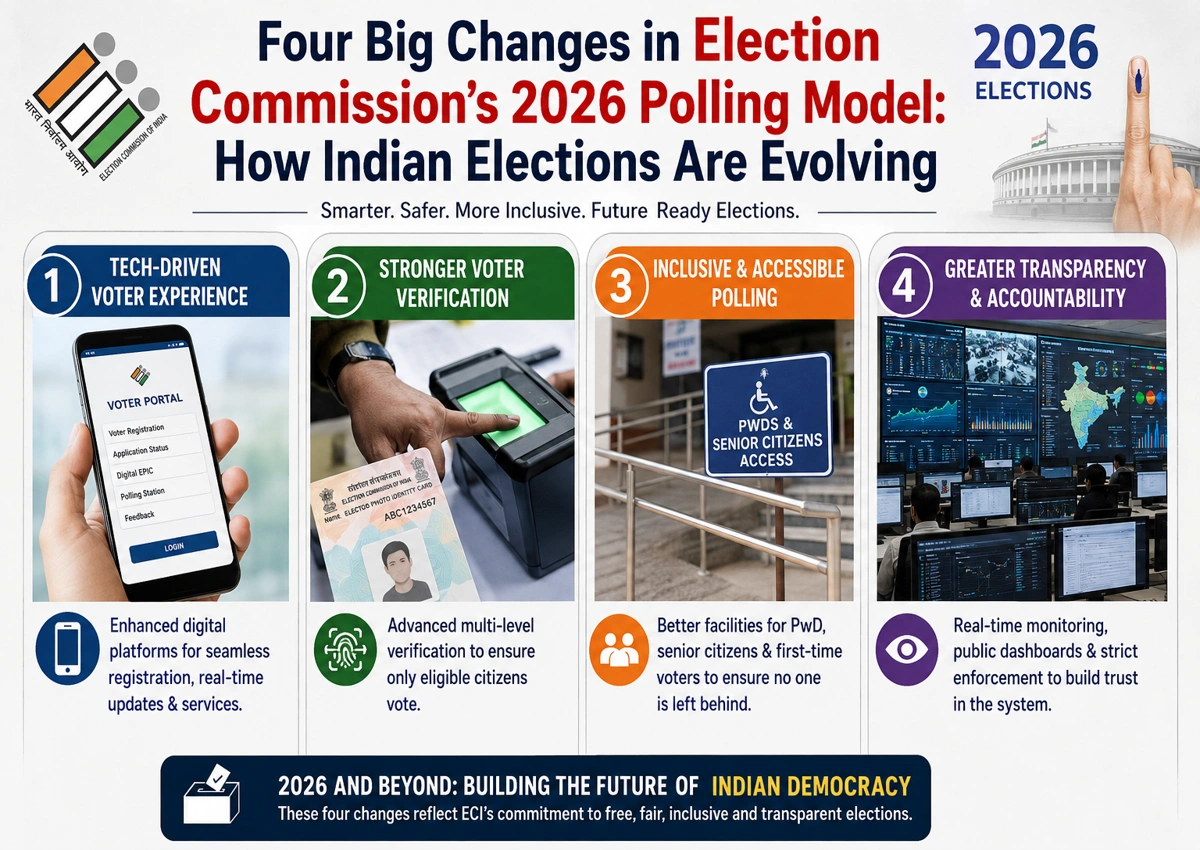
The Assembly Elections 2026 marked an important step in the development of the election system in India. The Election Commission of India (ECI) has implemented various technological, administrative and security measures that have been considered by many analysts as a new way of conducting elections in the country. Besides using AI and drones for election-time surveillance, the commission has also enhanced the voter tracking system and upgraded digital communication to make election management more technology-oriented. All these efforts are made towards checking political volatility, misinformation and security threats as well.
Examples of these changes were most obvious in the recent elections in West Bengal and Tamil Nadu, which relied heavily on digital monitoring and large-scale deployments for the smooth conduct of poll. While proponents argue that these measures are indispensable towards the transparency and efficiency of elections, some express concerns about issues like invasion of privacy, surveillance overload, and the encroaching influence of technology in the functioning of a democracy.
Consequently, the elections of 2026 have evolved beyond merely a political battle to a showdown of how technology and governance can influence democracy.
Shift Towards Tech-Driven Elections
One of the major revisions implemented by the Election Commission in 2026 was significantly ramping up the usage of digital devices and live monitoring mechanisms. Indian elections have predominantly depended on human force, paper workflows, and subnational-level administration.
Nonetheless, the magnitude and intricacy of the present-day elections have compelled the officials to resort to high-end methods. The Commission worked on rapid communication, enhanced surveillance, instant reporting, and closer coordination among polling stations and law enforcement agencies.
These reforms were aimed at making the poll process more transparent, lessening the chances of violence, and enhancing administrative productivity. Especially in politically unstable areas, where clashes, misinformation through propagation of fake news and old-fashioned tensions at the level of the polling booth remained major issues, the deployment of technology was a game changer.
AI-Driven Surveillance and Data Evaluation
The deployment of Artificial Intelligence (AI) technology in electoral monitoring was one of the most popular topics in the 2026 elections. In fact, AI tools were employed to uncover irregularities in voting, oversee crowd movements, and derive insights from live data of polling stations, etc., as per the news.
Besides, the Election Commission also exploited AI-assisted tools for social media monitoring and misinformation detection around election dates, election-related rumours, and counterfeit election materials. Globally, digital misinformation has posed a huge threat to democracies, and India shares the problem.
With the help of AI technologies, they intended to identify the first signs of trouble and take steps to prevent escalation of the issue.
On the other hand, the widespread use of AI for election monitoring raised questions about transparency as well. Some doubted the working of these AI systems, the decision-making process, and also whether the voters are informed enough about how digital surveillance influences the elections.
Nevertheless, incorporating AI in electoral processes is undoubtedly an enormous innovation in India’s electoral management system.
Increasing Security with the Help of Drone Surveillance and Digital Tracking
Security measures for the 2026 elections were among the largest and most comprehensive aimed at individual state polls. Regions considered very sensitive, such as West Bengal, saw the deployment of thousands of Central Armed Police Force personnel, augmented by drone surveillance and digital tracking systems.
In fact, drones were used to keep an eye on the crowds, to see the movement around polling stations, and to discover possible conflict zones, all in real time. Security agencies even went as far as using GPS-enabled coordination systems to enhance the speed of their response and to keep communication going between different ground teams.
Such approaches represented a big departure from the conventional election security methods that were largely reliant on static checkpoints and physical patrols.
The Election Commission justified the implementation of these measures by saying they were the only way to ensure calm and orderly voting and to avert election violence. Moreover, in politically sensitive areas having a record of police action, aerial monitoring in real-time has given the authorities a major advantage in terms of containing the situation with minimum violation of the law and order.
On the other hand, the question of the fine line between security and privacy was also raised. Some civil society organisations wonder if too much surveillance might make voters uneasy or even scared at the time of elections.
Faster Digital Communication With Voters
In 2026, an additional significant transformation in the election model was the creation of a direct digital method of interaction between the Election Commission and the electorate. Apart from SMS services, WhatsApp groups, mobile applications, and social media platforms, alerts about polling dates, booth locations, security advisories, and voter instructions were widely circulated among these channels.
What this way of doing things demonstrates is the fact that communication modes are changing in a society. Since an increasing number of people are getting dependent on their smartphones and digital media, it’s no surprise that election authorities are turning to online platforms more and more for voter engagement.
The merit of such a model is the speed and the range of information dissemination. Essential details can now be shared with a massive number of people very quickly.
On the other side, it also brings about new problems. Incorrect news gets a wide airing online, and controlling digital misinformation becomes as vital as managing physical polling stations.
Greater Emphasis on Sensitive Constituencies
The 2026 elections revealed a new way of identifying and managing “sensitive” groups. The Election Commission is reported to have ramped up micro-level inspections in the neighbourhoods that were more likely to experience violence, intimidation, or political unrest. Special observers, webcasting facilities, additional police, and digital surveillance systems were all used more intensively in those areas. Polling stations categorized as highly sensitive were under closer scrutiny than during the previous elections.
The goal was to enhance voter trust and lessen apprehension among the electorate during voting. This strategy reveals that the Election Commission is gradually embracing data-driven election management, making it less security-centric everywhere.
Though this selective method might yield better results, opponents say that too much classification can lead to political disputes if parties find certain areas being treated differently.
Challenges Ahead
Although the technology has kept advancing, there are still many down-to-earth issues that need to be solved. India, as a country, still grapples with problems such as internet inequality, digital illiteracy, misinformation spreading, and lack of equal access to technology, especially in rural areas.
Meanwhile, not every voter will be equally plugged into the digital systems. Older people, the economically weaker ones, and those living in remote areas may still rely quite a lot on the traditional ways of elections. Cybersecurity, as a matter of fact, is another source of concern.