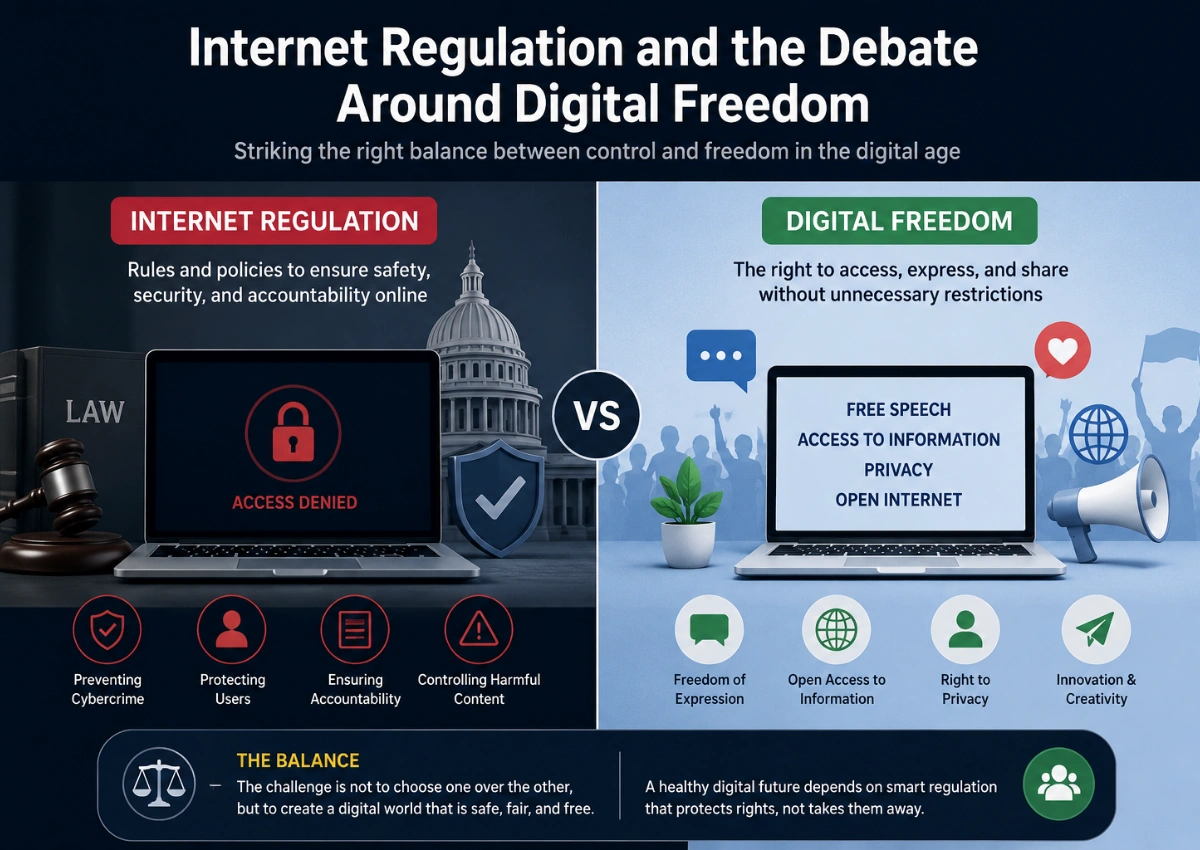
With digital platforms increasingly becoming the main hubs for communication, business education, entertainment, and political debates, governments all over the world are tightening up their internet laws to control users’ behaviour. In India, the ongoing debates on the new IT Amendment Rules 2026 and increasing content-blocking measures have given a new life to the discussion on digital freedom, online safety, and state control of the internet.
Those advocating for tighter internet regulations think that governments should tackle misinformation, cybercrime, hate speech, financial fraud, and harmful content online. On the other hand, opponents of regulation argue that too much control can put freedom of speech, privacy, and independent journalism at risk.
The issue has taken a new turn as the internet is no longer simply a platform for technology; it has become a crucial arena for democratic participation, political debate, social movements, and economic activities. While governments try to put digital spaces under control, the problem is how to ensure public safety without infringing on constitutional rights.
Thus, the present discussion on internet regulation mirrors a broader worldwide conflict between governance and digital freedom.
Growth of the Digital Society
Alongside internet services becoming widely available throughout India during the last ten years, especially in rural areas, millions of people are now relying on digital platforms for performing their banking, shopping, news reading, education, medical counselling, and communication. Social networking sites like Instagram, X, YouTube, Facebook, and WhatsApp have emerged as the primary sources of information and are shaping public opinion.
Besides that, the COVID-19 pandemic further accelerated changes towards digitisation, with online learning, working from home, and digital payments becoming the main necessities of people.
After the usage of the internet rose, simultaneously, worries about fake news, misinformation, cyberbullying, hate speech, financial scams, and data theft surfaced as well. Governments and regulatory bodies started receiving pressure from the public to lay down stringent regulations for digital platforms.
Thus, the spreading of the internet culture has been like a double-edged sword, bringing along both opportunities and threats.
Why Governments Want Stronger Internet Regulation
It’s the position of governments that, without accountability as a principle, digital platforms must not be let off the hook. Following a number of violent riots fueled by fake news and communal misinformation, as well as fraud cases, victims of which were incited via online platforms, several leaks of confidential information and deepfake videos, the issue of enforcing stricter digital laws has become a matter of public concern.
In their view, stronger regulation might be the only way to achieve the following:
- Mitigate the spread of false information during elections and disasters
- Filter out hate speech and violent content from the online environment
- Keep children safe from exposure to harmful digital material
- Prevent cybercrimes and financial fraud
- Safeguard data and ensure the security of the nation
- Make social media platforms accountable for publishing harmful content
The development of Artificial Intelligence and deepfake technologies has presented a whole new level of threats. For instance, altered videos, counterfeit political speeches, and distorted facts can rapidly disseminate on websites, changing people’s minds before police or governmental agencies get chance to react.
The IT Amendment Rules and Latest Developments
Recently there has been a lot of talk about the government formulating IT Amendment Rules 2026. This regulatory framework will give the authorities greater control over social media and other digital platforms. It’s even anticipated that these rules will be imposed on platform-based companies for holding the content posted on their platforms under the scrutiny, rapidly removing the flagged content, and bear bigger obligations toward other technological companies.
The government has reportedly increased content blocks on the internet, with thousands of URLs, posts, and digital accounts restricted or removed under the laws relating to security, public order, or misinformation.
Those in favor claim that the internet can’t remain totally unregulated especially when harmful content spreads very quickly and has a negative impact on public peace.
On the other hand, opposers point out that loose definitions of “harmful content” or “anti-national content” can be used as a pretext for very restrictive censorship and silencing dissent voices. Such a debate is the basis for the digital rights conversation.
Freedom of Expression and Democracy Issues
Among the many concerns raised by reporters, online rights defenders, and non-profit organizations, the possibility of curtailing freedom of speech through regulating the internet has received the most attention.
Modern technology has been a key factor in turning the internet into the main stage for people to voice their criticism, have discussions about politics, do investigative journalism, launch movements, as well as take part in the community. Normally, social networks give the chance to average citizens to speak out the views that generally, don’t get the opportunity in non-digital media.
Many people see that if governments are given stronger powers over the control of internet content they may fear the consequences and refrain themselves from openly discussing their views thus there may be a rise in self-censorship among user, journalists, and content makers.
The matter is far more restrictive when the removal of the content is done rapidly and without a transparent mechanism for review. More often than not, issues are raised about who should decide the content.
The Role of Social Media Companies
Technology companies have become a target of criticism in recent times. For example governments hold the view that big social media companies make huge profits but are still able to evade taking responsibility for the negative consequences of the material hosted on their platforms.
Conversely, some call for keeping private companies from having the final say in what should be public speech. In fact, a lot of the platforms rely on algorithms and moderation systems that control what users discover online.
Thus, a very complicated scenario emerges in which not only governments but also corporations get more and more authority over the digital communication domain.
Consequently, social media companies find themselves in a dilemma and they’re torn between obeying the law, respecting the rights of users, giving in to political pressures and pursuing their business interests.
At the same time, some specialists hold the view that measures to enhance the transparency of the actions of both governments and tech companies have to be implemented without delay.
Internet Shutdowns and Access Restrictions
Internet shutdowns have been one of the problematic topics in the discussion of digital freedom. For instance, India has been singled out globally for shutting down the internet in regions considered sensitive multiple times during protests, elections, or security operations.
On the one hand, authorities justify interruption of the internet as a short-term measure to avert violence, propagation of rumors, or disorderly situations. On the other hand, opponents contend that it isn’t only political activity that’s impacted by this but also everyday life in terms of economic and social aspects.
Those dependent on the internet like small businesses students journalists, and even emergency services suffer the most when access is cut off.
The argument just goes to show that this is a significant aspect of the situation where the internet is no longer being considered a luxury but a fundamental element of public life.
Global Context of the Debate
India isn’t the only country facing this challenge. Nations all over the world are still figuring out how to regulate tech companies and online speech. The EU for instance, has recently announced strict digital legislation through the Digital Services Act whereas the U.S. is still debating platform accountability and the protection of free speech.
Countries vary their approach based on the nature of their political system, the existing legal framework, and security concerns.
India’s moves toward internet regulation therefore have the potential not only to set an example but also to shape the digital governance debate of other emerging democracies.