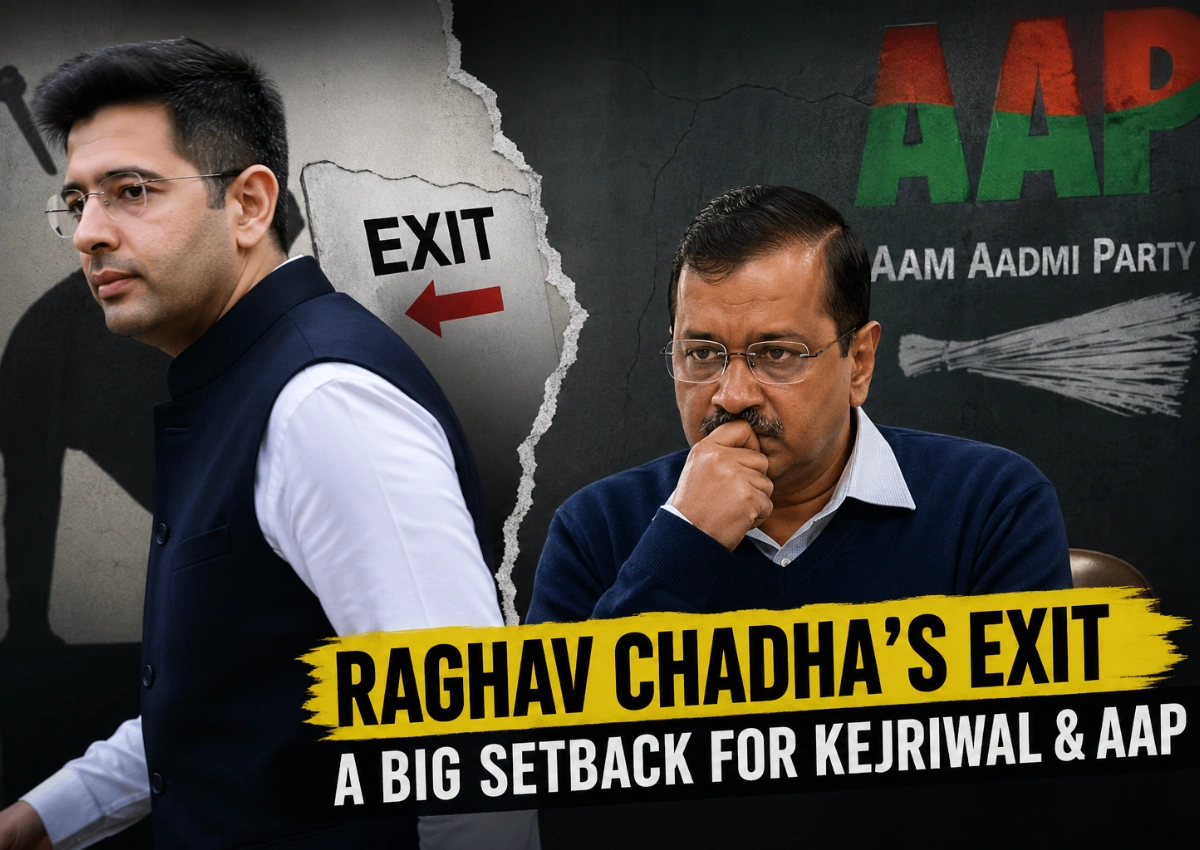
Among the major political developments in April 2026, the highest-ranking member and Rajya Sabha MP, Raghav Chadha, left the Aam Aadmi Party (AAP) and joined the Bharatiya Janata Party (BJP) with six other Rajya Sabha members. The change has been largely interpreted as a heavy blow for AAP and its national convenor, Arvind Kejriwal. The political change has opened up discussions related to party defections, leadership crisis, and AAP’s future role in the national political arena.
Such a big name leaving the party is much more than just an individual’s decision. It is a matter that could change parliamentary equations and public perception. Since Raghav Chadha was considered among the most prominent and eloquent young leaders of AAP, his departure has both a symbolic and strategic meaning.
Raghav Chadha’s Contribution to AAP
Over the last couple of years, Raghav Chadha had become a lead representative of AAP. He was one of the prominent young leaders of the party known for his effective performances in parliamentary debates, media sessions, and election campaigns. His elevation to a prominent position was closely linked with Arvind Kejriwal’s guidance and the growth of AAP beyond Delhi.
Chadha as a Rajya Sabha MP regularly raised his voice on governance, corruption education, and economic policy matters. People recognized him as a leader who was frequently in the limelight and was often seen as AAP’s next leader.
Therefore his leaving the party is not only a political shift but a reflection of the underlying problems of the party to some degree.
The Exit and Political Realignment
Recently it was reported that Raghav Chadha and six other AAP Rajya Sabha MPs resigned and joined BJP. Such a mass resignation majorly decreased AAP’s numbers in the Upper House meanwhile BJP got a stronger position in Parliament. On one hand, the fact that seven out of ten Rajya Sabha MPs changed sides together is a big deal and it also has raised the polemic of the anti-defection law and the legal moves that can be made.
On top of that, the fact that the group decided on this particular moment makes the political weight of the action count for even more. The reality is that AAP is currently battling the fallout of their defeats at the polls, the leadership pressure and the heavy waves of criticism over the governance issues.
BJP was swift to react and they have, among other things, positioned the defection as a sign of the waning confidence in AAP top leadership. Posters and statements from BJP leaders have further accentuated the political symbolism of this defection.
Effect on Arvind Kejriwal’s Leadership
Arvind Kejriwal has been the face of AAP all these years. In fact, the party has given an identity to his leadership and, at the same time, anti-corruption politics. But with the departures of senior leaders there are some sheep being raised about internal democracy, trust, and the political direction of the party in the long run.
Even more so, Raghav Chadha’s switch of sides is an issue because he was thought to be Kejriwal’s right hand and at the same time he was the face of the party’s fresh and modern image. So, when this kind of leader decides to defect, it is almost like the party has its own anti-applause, which can shake up the party workers and the public supporters.
The opposition parties have since then been attacking Kejriwal as they say it is a reflection of his failure to keep senior leaders and that this is a big problem of leaders leaving. For AAP, it is really like everything else that they need to do, in fact, managing how people perceive them has become as big a deal as managing the actual numbers in the Parliament.
Parliamentary and Strategic Consequences
The Rajya Sabha serves as a very vital forum for politicians to influence the country politically at the national level. If the AAP has lesser members in the Upper House, they are going to find it even harder to bring up national issues, influence the debates, and remain the central level.
This is a numerical as well as symbolic gain for the BJP bringing the known opposition leaders into its fold adds to the BJP’s narrative of having a wider political support and weakening its rivals from the regions.
This could have an impact on alliance politics as well. Regional parties generally consider the leader’s ability to govern before they sign the partnership agreement. AAP’s parliamentary presence being weak will reduce its bargaining power in the opposition politics.
Public Reaction and Anna Hazare’s Remarks
The matter was further spotlighted when social activist Anna Hazare spoke on the matter. Reportedly, he stated that AAP was the cause of the leaders leaving as it was internal causes that made the dissatisfaction. He said very little was left for the leadership to blame the system as the people and their movement had to be blamed.
Public responses have been quite diverse. Some see this as the supporter’s political opportunism while a few others feel that it is a case of the party’s structural problems. Social media has played its role in making this issue a topic of national political debate. Anna Hazare’s association with the anti-corruption movement and AAP’s foundation makes her comments stronger in terms of politics.
AAP’s Changing Political Persona
Initially, AAP’s core identity was rooted in the fulfillment of the promise to deliver clean politics, transparency, and a viable alternative to the existing party apparatus. However, as the party grew and became a force to reckon with in mainstream electoral politics, it was also exposed to the temptations of power, alliances, and the whole gamut of internal management which are realities not only of the national parties but of the political system uncertainties generally.
The exit of the senior leaders lends itself to the speculations as to whether the party has really deviated from its primary ethos or these political changes are just a healthy competition among democracies.
In the eyes of many, especially political analysts, the resignation of Raghav Chadha could mark a significant point for rethinking how political movements undergo change when they are turned into establishments of power.
The Road Ahead for AAP
Right now, the first hurdle for AAP is to manage the harm. The party needs to convince its diehards that it is steadfast, seal the cracks in the organisational fabric, and wear the face of a rock-solid and firm entity. The role of leaders’ exchange of communication cannot be overstated in not only fending off exits but also in bringing back the believers among party workers.
Alongside, AAP should work on building up its next line of command and adjusting its national scheme of things. The standing with the voters does not hinge only on the magnetism of the leader but equally on the quickness of the party and the gradual quarterly performance/results/release of governance work/planning/implementation performance of the leaders as an entity.
BJP through this incident, is likely to generate some headlines for political capital, while the opposition camp albeit skeptically can use this as another instance of the changing political scenes as the basis for their arguments against the ruling regime.