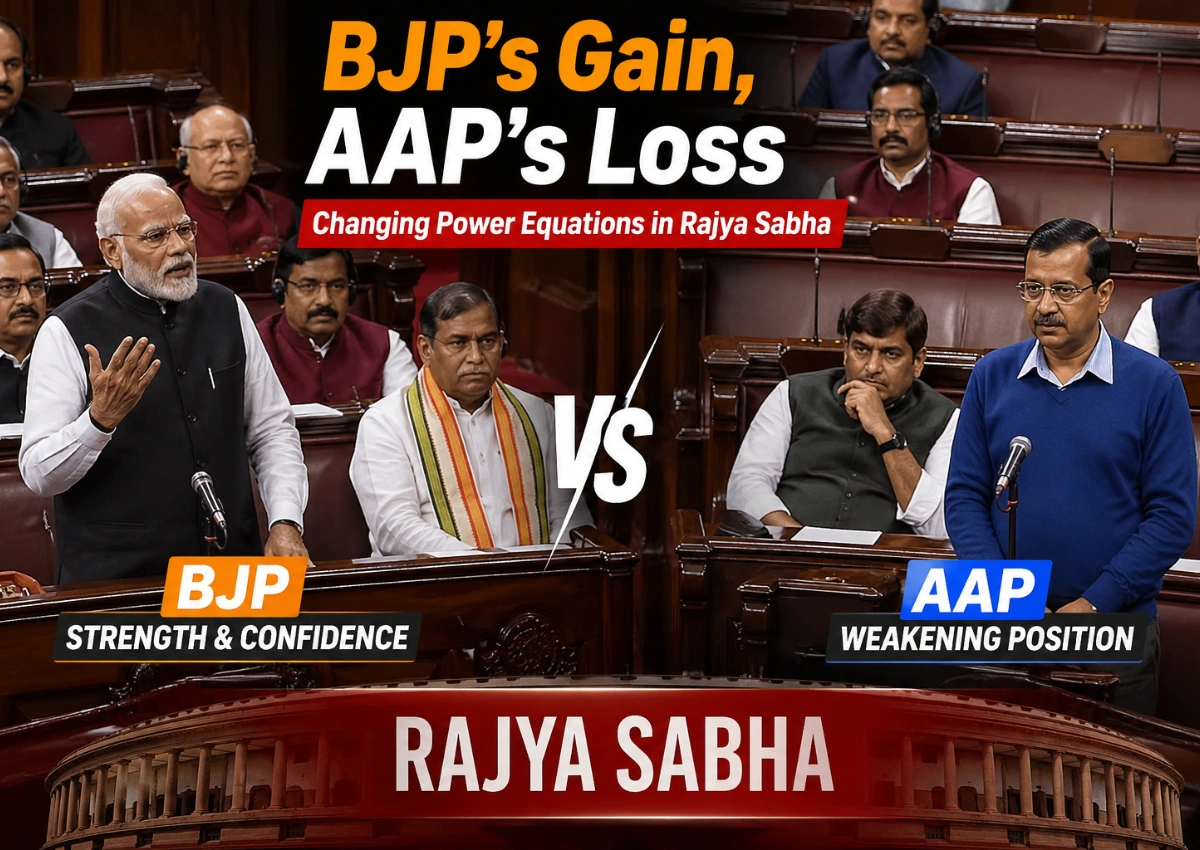
Raghav Chadha and six other Rajya Sabha members recently left the Aam Aadmi Party (AAP) and joined the Bharatiya Janata Party (BJP), which has drastically altered the power equations in the Rajya Sabha. The change in party affiliation of a few members is only the tip of the iceberg as the whole scenario is changing at the level of parliamentary politics, the strength of the opposition, and the political strategy at the national level.
On the one hand, AAP is facing difficulties due to the loss of senior leaders who have not only affected their numbers but also their image in public. On the other hand, the BJP is getting the strength of seasoned opposition leaders, which isn’t only enhancing their political position but also supporting their story of getting wider support at the national level. Therefore, this change has become one of the most talked-about political events of April 2026.
Most importantly, it reveals that the modifications in the Upper House can have a very far-reaching effect on national politics apart from the elementary seat count.
Significance of the Rajya Sabha in Indian Politics
The Rajya Sabha, or the Council of States, is the Upper House of Parliament and is very important in legislative decision-making. Different from the Lok Sabha, it’s a permanent body having members serving fixed terms, and it frequently represents the venue of deeper policy deliberations and long-term political strategic planning.
A strong majority of a party in the Lok Sabha notwithstanding, the Rajya Sabha remains the second most powerful chamber because legislation, constitutional amendments, and policy debates require a strong parliamentary presence there as well.
For regional and smaller national parties like the AAP, having a voice in the Rajya Sabha is crucial because it means getting a national platform, a place for the opposition, and a voice in debates on central governance.
This is the reason why the recent dwindling of AAP’s strength is of political importance.
Raghav Chadha and Six Other MPs Exit
Raghav Chadha was one of the most well-known young leaders of AAP and one of its loudest voices in Parliament. His and the other six Rajya Sabha MPs leaving the party have greatly diminished AAP’s strength in the Upper House.
According to sources, seven out of ten AAP Rajya Sabha members moved in a bloc, which allowed them to cross the two-thirds quorum required by the merger clause of the Anti-Defection Law. This barred them from getting disqualified immediately and made their switching legal and politically effective.
The gesture was more than just a statement. It instantly altered the composition of the Parliament and undermined AAP’s capacity to operate as a powerful opposition voice at the national level.
How BJP Benefits from This Shift
Politically, the BJP gains in multiple ways from this development. The major gain is boosting their numbers minimally in the Rajya Sabha, where each new member translates into greater power over discussions, committee work, and legislative support.
The second way the BJP profits is by hiring important leaders who were affiliated to the opposition party, which adds to the BJP’s political momentum. It suggests that the opposition leaders are losing people’s confidence and that a pro-party alignment of the country is happening, at least from the BJP’s point of view.
The third way is that leaders like Raghav Chadha bring with them the benefits of media presence, parliamentary experience and appeal to the urban constituency, which is a new realm for the BJP. Such leaders work as catalysts for BJP to spread their influence beyond their traditional bases and at the same time, among the younger and urban middle-class voters, and attract some attention.
The political messaging is obvious: the BJP is not only winning the elections but also attracting leaders of the opposing political parties.
Loss in the Parliamentary and Political Sector of AAP
For AAP, the loss is significant both practically and symbolically. The decrease in the number of its MPs in the Rajya Sabha will reduce its speaking time, committee participation, and overall impact on national legislative matters.
The most significant among these issues is how the exit of top leaders portrays the party leadership as unstable. Leaders who depart the party after being recognised as Arvind Kejriwal’s close ones, raise the issue of leadership trust and the party’s strength.
By emphasising clean politics, effective governance, and alternative leadership, AAP has earned much of its national recognition. These kinds of exits at high levels not only hamper the party’s image but also sow doubts among its supporters and possible partners.
Besides, it really brings down the spirits of the party members, especially the youth who regarded people like Raghav Chadha as the party’s future leaders.
Effect on Opposition Politics
This development will also have an impact on the opposition overall. AAP has sometimes seen itself as a major player in the national opposition setup, more so with its presence outside of Delhi. Lesser representation in Parliament will diminish its role as a negotiating partner in alliance politics.
Furthermore, if other regional parties spot turmoil in AAP’s leadership structure, they may even hesitate to commit to long-term partnerships. Essentially, the level of power exerted by a party in the Parliament dictates its decision-making influence even in the coalition politics of parliament.
In fact, for the opposition bloc as a whole, this is yet another indication of the hurdles in achieving unity. Leadership rivalry, differences in ideologies, and strategically timed defections are some of the factors that keep on weakening the combined resistance against the BJP’s nationwide dominance.
Therefore, the Rajya Sabha is more than just a legislative forum; it’s also a centre for perception battles among political parties.
Public Perception and Political Messaging
The public response to this move has been very mixed. Some individuals consider that it’s merely the politicians switching from one side to the other to increase their chances of surviving and becoming powerful. However, others feel that it’s as if AAP is having a hard time holding together internally and ideologically.
Through very hard-hitting political messages, the BJP has successfully highlighted the main event. The visuals in the form of posters, public statements, and media campaigns have used the departures as AAP’s weakness illustration. The broken broom, the party symbol of AAP, was used as a very powerful visual political message.
At the same time, AAP camp sees such changes as part of normal politics and argues that it doesn’t determine the party’s future.
This perception war will be quite a big deal and could be even more significant than the actual number of seats.
Long-Term Political Consequences
What impact do you think this will have on the parties’ politics over the long term? I reckon that the BJP, with this development leading it, will continue to expand its political activities, particularly in urban and state-level areas.
In contrast, AAP needs to gain people’s confidence again, empower its internal leaders, and prove that it can still be politically influential even if some individuals have left. It will definitely be leadership communication and organisational discipline that will be the priority areas in the future months.
This matter could also set the tone for the future of Rajya Sabha politics. Apparently, parties will start to look more at the loyalty of their members, their legal strategies, and their plans for leadership succession.
Thus, one parliamentary change may lead to long-term consequences for the entire national political system.