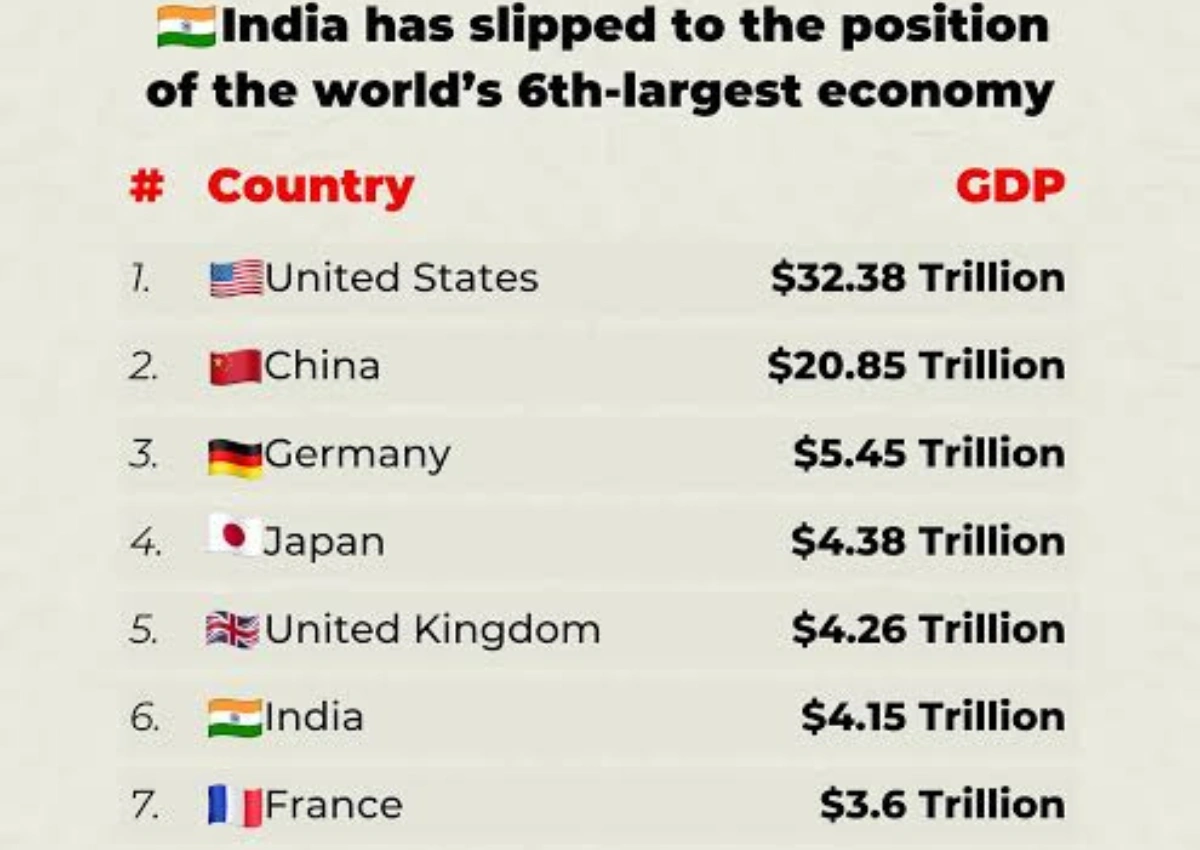
The IMF (International Monetary Fund) gave out its new World Economic Outlook (WEO) on April 14th, 2026. That data has started a new discussion about India’s economic position in the world. The April 2026 forecast reveals India’s nominal GDP for 2026 at around $4.15 trillion, ranking the country as the 6th largest economy in the world.
That’s lower than what was expected at first when India was supposed to be at 4th position or even briefly at 4th. The United Kingdom ($4.26 trillion) and Japan ($4.38 trillion) have overtaken India in nominal terms, while the USA, China, and Germany are still the top three.
There have been different reactions. Some think it’s just a statistical error due to currency changes and methodological variations, while others consider it a signal that nominal rankings do not always reflect the true economic strength. Let’s analyze and understand what the data really show.
Understanding Nominal vs Real GDP Rankings
Two different approaches to measuring an economy’s size need to be explained-
Nominal GDP (expressed in present US dollars) is the one used for global rankings as it shows the actual dollar value of the goods and services produced. Exposure to exchange rates has a major impact on it.
On the other hand, real GDP growth indicates how much economic output has increased in reality after accounting for inflation and is considered a better reflection of the actual momentum.
India has been at the top among major economies in terms of real GDP growth. According to the IMF, India’s real growth is expected to be 6.5% in both 2026 and 2027, which is the highest among big economies. This figure is far above China (about 3.74%), the US (about 2%), or most European countries. Put simply, India is still growing at a quicker pace than nearly anyone else, though its size in terms of dollars may seem smaller when looked at in a paper exercise.
Reasons Why India Dropped in the Rankings
The reason for a slip from an expected 4th or 5th place to 6th is not at all linked to a slowdown in India’s domestic economy. In fact, two main technical factors largely explain the change:
Rupee Weakening Against the US Dollar
Nominal GDP rankings work by converting local currency figures into dollars at current exchange rates. A recent weakening of the Indian rupee has in fact brought down the dollar value of India’s output despite the rupee economy itself is still growing strongly in real terms.
Changing Base Year for India’s GDP
India’s Ministry of Statistics and Programme Implementation recently changed the base year for GDP calculation from 201112 to 202223. This move is considered to result in more accurate measurement as it better reflects the current structure of the economy, including the increasing share of services and the digital sectors. Unfortunately, the revised series has caused a downward revision of nominal GDP figures in dollar terms for 2025 and 2026.
These changes are technical and statistical adjustments rather than signaling the weakening of the economy. Quite the reverse, the IMF revised India’s real growth projections higher for 2025 to 7.6%, a change that shows stronger-than-expected economic performance in recent quarters.
What the Numbers Mean for India’s Global Standing
Nominal GDP rankings mostly grab headlines because they are simple to interpret and have a strong symbolic aspect. A lot of people considered India being the 4th or 5th largest economy as a sign of the country’s increasing global influence. So naturally, the drop to 6th position has caused some media buzz but it should be noted that India is still the fastest-growing major economy by a good margin.
Some people point out that these rankings can change from one IMF data release to the next as a result of currency fluctuations. India is expected by some to surpass the UK and Japan again in the next few years. According to the IMF’s long-term outlook, India might get back to 4th place around 2027-28 as its growth is likely to remain strong.
Besides, nominal GDP size as a factor is far from being the only measure. For example, India’s per capita income is still significantly lower than that of the UK or Japan, which reflects the huge country-scale development challenge India faces. Given a population of more than 1.4 billion even small increases in per capita income will mean very large absolute economic growth.
Growth Projections and Future Outlook
Consistent with its positive tone towards India, the IMF’s April 2026 WEO projects the following key figures-:
- Real GDP growth of 6.5% in both 2026 and 2027.
- India will maintain its top spot among the world’s major economies in terms of growth rate.
- Through infrastructure spending and policy reforms, private investment should receive a significant boost leading to its gradual recovery.
- Inflation is expected to be moderate and the external sector stable, but global risks (e.g. geopolitical tensions in West Asia) have been identified as possible downside factors.
Besides, according to the report, India’s robust domestic demand, digital public infrastructure, and continuous structural reforms serve as a strong base for a continued economic growth. Nonetheless, it warns that global factors, like higher oil prices, trade tensions, and decelerated growth in advanced economies could serve as obstacles.
Policy and Investor Implications
Policymakers will find in the data a strong argument for the kind of structural reforms which enhance productivity, draw foreign investment, and make business operations easier. Manufacturing, exports, and skilling are areas of focus if India is to leverage its high growth rates to achieve higher per capita income and a better global ranking over time.
On the other hand, for investors, the downgrade in nominal ranking is mostly a technical correction rather than a deep change in fundamentals. India’s narrative of growth is still very much at the heart, and several analysts still consider the country among the top long-term investment destinations of major economies.
The Bigger Picture
Moving from being the 10th largest economy in 2010 to the 6th largest currently is a testimony to India’s strong performance over the last 15 years. To top it off, India is still the fastest-growing major economy in the world.
Using nominal GDP rankings to compare countries is helpful. However, they cannot reveal an economy’s strength, resilience, or potential. For instance, India’s large and youthful population, fast-growing digital economy, and ongoing reform efforts all contribute to the country’s growth potential.
In fact, according to the IMF, India is set to be one of the main contributors to global growth in the near future. The update in April 2026 is a nudge that although top rankings catch our eye, the real success is in sustained, inclusive, and quality growth that improves the lives of people across the country.
Whether India can reclaim its position in the nominal rankings and at the same time maintain its strong real growth will be revealed in the upcoming quarters. Currently, the data support the economic consensus: very strong growth potential in India. The same is true in the quote dollar figures occasionally tell a slightly different tale.