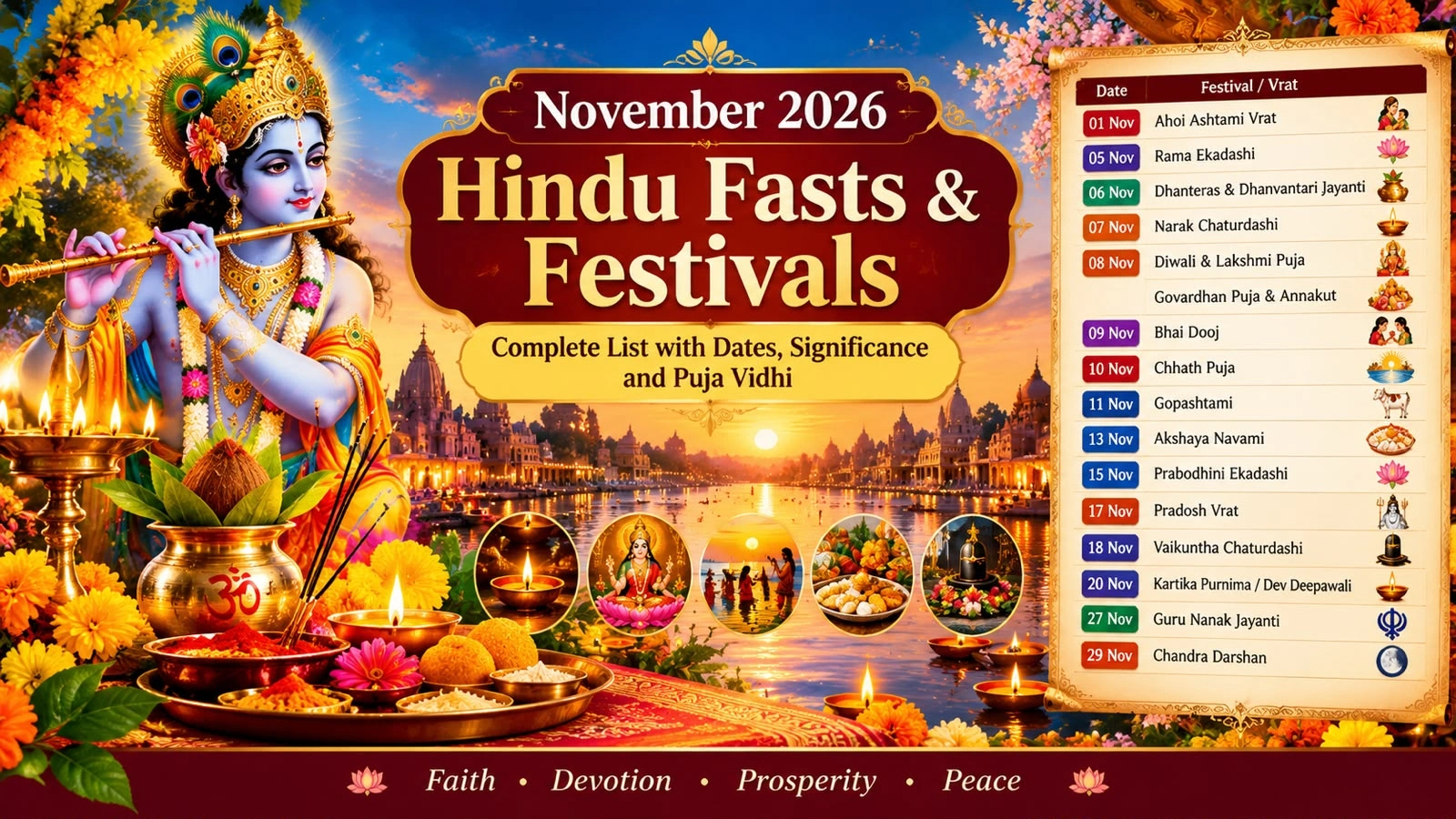
Hindu Festivals in November 2026: Dates for Diwali, Govardhan Puja, Bhai Dooj, Chhath Puja and Other Fasts
A day-by-day guide to the month’s vrats and festivals, with what each observance means and how families usually keep it
Hindu festivals in November 2026 start with Ahoi Ashtami on 1 November, run through the five days of Diwali and the four days of Chhath Puja, and close with Kartik Purnima and Guru Nanak Jayanti on 24 November. The month is full of devotion, family ties, gratitude, charity and seasonal change, and for families who follow a traditional Panchang it helps to know the dates early, so offerings, gatherings and fasts can be planned without a rush.
Hindu Festivals in November 2026: Key Dates at a Glance
| Date | Festival or vrat | Note |
|---|---|---|
| Sun, 1 Nov | Ahoi Ashtami Vrat | |
| Thu, 5 Nov | Rama Ekadashi; Govatsa Dwadashi | Some calendars list Rama Ekadashi on 4 Nov |
| Fri, 6 Nov | Dhanteras and Dhanvantari Jayanti; Pradosh Vrat | First day of the main Diwali period |
| Sat, 7 Nov | Kali Chaudas | Some calendars call this day Narak Chaturdashi |
| Sun, 8 Nov | Narak Chaturdashi; Diwali and Lakshmi Puja | |
| Tue, 10 Nov | Govardhan Puja and Annakut | Some calendars and cities show 9 Nov |
| Wed, 11 Nov | Bhai Dooj | Some calendars and cities show 10 Nov |
| Fri, 13 Nov | Chhath Puja, Day 1 (Nahay Khay) | |
| Sat, 14 Nov | Chhath Puja, Day 2 (Kharna) | |
| Sun, 15 Nov | Chhath Puja, Day 3 (Sandhya Arghya) | Main day, Surya Shashthi |
| Mon, 16 Nov | Chhath Puja, Day 4 (Usha Arghya) | |
| Fri, 20 Nov | Devutthana (Prabodhini) Ekadashi | Ekadashi tithi begins on 20 Nov; some calendars list 21 Nov |
| Sun, 22 Nov | Pradosh Vrat | |
| Mon, 23 Nov | Vaikuntha Chaturdashi | |
| Tue, 24 Nov | Kartik Purnima, Dev Deepawali and Guru Nanak Jayanti |
Why Dates of Hindu Festivals in November 2026 Can Differ
Most Hindu festivals follow the tithi, a lunar day set by the angle between the Sun and the Moon, rather than a fixed date on the Gregorian calendar. A tithi can begin or end at any hour, so a festival may be kept according to sunrise, sunset, moonrise, the pradosh period or the presence of a tithi in a particular ritual window. That is why the dates of Hindu festivals in November 2026 can shift by a day between cities and traditions.
A muhurta, the auspicious window for a ritual, is also tied to place. A time printed for Jaipur cannot simply be used in Delhi, Mumbai or London, because latitude, longitude and local sunrise and sunset change the calculation. When you share or follow an exact time, check the city, date, time zone and source.
Early Hindu Festivals in November 2026: Ahoi Ashtami and Ekadashi
Ahoi Ashtami (1 November) is kept by many mothers who pray for their children’s health and long life. In several North Indian communities devotees fast, worship an image of Ahoi Mata, listen to the vrat katha and pray in the evening. The image may be drawn on a wall or printed, and the time to break the fast is often tied to the stars, so follow your family custom and the Panchang for your city.
Rama Ekadashi (5 November) falls in the dark fortnight of Kartik and is linked to devotion to Lord Vishnu. Devotees may fast, recite Vishnu prayers, chant the divine name and give in charity. Fasting rules vary, from avoiding grains to stricter observances, and a fast should never come at the cost of health, so adapt it to age and medical needs. Govatsa Dwadashi falls the same day in some calendars, and in traditions that keep it, cows and calves are honoured as symbols of nourishment and gentleness.
The Five Days of Diwali (6 to 11 November)
Dhanteras and Dhanvantari Jayanti (6 November) kicks off the main Diwali stretch. Families clean and decorate homes and shops and light lamps, and many buy utensils, gold or silver, or another useful item as a sign of prosperity. The day is also tied to Lord Dhanvantari, remembered in Hindu tradition for his link with Ayurveda and healing. Buying something new is a custom, not a requirement, and nobody should stretch their budget for it. The more lasting idea is gratitude, good health and prosperity that stays within reason.
Narak Chaturdashi (8 November), also known as Choti Diwali, marks the defeat of the demon Narakasura and is read as good overcoming evil. Calendars do not fully agree on the day: Drik Panchang puts Kali Chaudas on 7 November and Narak Chaturdashi on 8 November. Many people bathe early, light lamps and clean the house to get ready for Diwali, and anyone following a traditional oil bath or similar rite should adjust it to their health and safety.
Diwali and Lakshmi Puja (8 November) is the festival of lights. Across communities it stands for light over darkness, knowledge over ignorance and hope over despair. Homes are decked with diyas, rangoli and flowers, sweets are shared, relatives are visited and Lakshmi Puja is performed at home. In some households Lord Ganesha is worshipped too, others recall Lord Rama’s homecoming to Ayodhya, and some regions tell entirely different stories, so Diwali is both a shared festival and a distinct one from place to place.
Lakshmi Puja: Preparing at Home
Most families start by tidying the place of worship, spreading a clean cloth and setting up an image or idol of Lakshmi and Ganesha, with flowers, water, rice, sweets, fruit and lamps nearby. Prayers, a Lakshmi stotra or a family aarti follow. Muhurta windows change by city, so use the one published for yours. A calm, safe puja counts for more than expensive display.
Govardhan Puja and Annakut (10 November) retells how Lord Krishna held up Govardhan Hill to shelter the people of Braj from torrential rain. It is usually taken as a lesson in faith, community care, humility and respect for nature. Devotees may shape a small hill out of food or natural materials, decorate it with flowers, worship Krishna and offer Annakut, a large spread of prepared dishes. Practices differ across Braj, Gujarat, Rajasthan, Maharashtra and elsewhere, and some calendars and cities place the day on 9 November.
Bhai Dooj (11 November) honours the bond between brothers and sisters and goes by names like Bhaiya Dooj, Bhau Beej and Bhai Tika depending on the region. Sisters commonly apply tilak, perform aarti and pray for their brothers’ well-being, while brothers give gifts or promise support. What matters is mutual care, not the price of a present. For many households it closes the main Diwali period, though some calendars and cities show it on 10 November.
Chhath Puja (13 to 16 November)
Chhath Puja is dedicated to the Sun God and Chhathi Maiya and is especially popular in Bihar, Jharkhand and eastern Uttar Pradesh, as well as among communities settled elsewhere. Devotees give thanks to the Sun for life and well-being through days of preparation, fasting and offerings at a river, pond or another clean water body. Seasonal fruit and traditional prasad are offered, and arghya is given while standing in water at sunset and again at sunrise.
The Four Days of Chhath Puja 2026
- 1Nahay Khay: Friday, 13 NovemberA holy bath, cleaning of the home and a single pure meal begin the festival.
- 2Kharna: Saturday, 14 NovemberA fast through the day, usually broken at sunset with kheer and puri.
- 3Sandhya Arghya: Sunday, 15 NovemberThe main day, when devotees offer arghya to the setting Sun, also called Surya Shashthi.
- 4Usha Arghya: Monday, 16 NovemberArghya is offered to the rising Sun at dawn, and the fast is then completed.
The fast is tough on the body, so participants should think about their health and safety, follow family tradition and seek medical advice if needed. At public ghats, keep the water clean and keep an eye on children and older people near it. Arghya time is simply your city’s own sunset and sunrise, so read it from a local Panchang.
Hindu Festivals in November 2026 After Chhath: Gopashtami, Akshaya Navami and Devutthana Ekadashi
Gopashtami, tied to Lord Krishna’s life as a cowherd and to reverence for cows, and Akshaya Navami, seen in several traditions as a day for merit and charity, both fall in the days after Chhath, on the Ashtami and Navami of Kartik’s bright fortnight. Their dates and rituals vary by region, so check the Panchang. Akshaya Navami’s name carries the idea of something enduring, and some communities mark it with worship, charity or visits to sacred places. A respectful modern Gopashtami can mean making sure animals have food and water and avoiding practices that distress them.
Devutthana (Prabodhini) Ekadashi (20 November) is when Lord Vishnu is said to wake after his traditional period of rest, and some communities treat it as the start of the season for weddings and other auspicious ceremonies. Devotees fast, worship Vishnu, sing bhajans and give in charity. The Ekadashi tithi starts on the morning of 20 November, and some calendars list the observance on 21 November.
Late Hindu Festivals in November 2026: Pradosh, Vaikuntha Chaturdashi and Kartik Purnima
Pradosh Vrat honours Lord Shiva around sunset on the Trayodashi tithi, and the month has two, on 6 November and 22 November. Devotees may fast, visit a Shiva temple, offer water at the lingam and perform aarti. The weekday can change the name, such as Som Pradosh on a Monday, and the exact evening window depends on your city.
Vaikuntha Chaturdashi (23 November) is marked in certain traditions with worship linked to both Lord Vishnu and Lord Shiva, and some temples perform special rituals that symbolise harmony between the two. It is not observed uniformly everywhere.
Kartik Purnima (24 November) is the full-moon day of the Kartik month and sacred in several traditions. Varanasi is known for Dev Deepawali, with lamps lining the ghats, though local programmes should be checked each year. The same day is Guru Nanak Jayanti, the birth anniversary of Guru Nanak Dev Ji, founder of Sikhism, which Sikhs commonly mark with prayers, kirtan, community service and langar. The two come from separate religious traditions with their own histories, and each should be described on its own terms.
A Planning Checklist for Hindu Festivals in November 2026
Before You Begin
- Check the date and tithi for your own city on a trusted Panchang.
- Find out whether your ritual is tied to sunrise, moonrise, sunset or a set evening window.
- Arrange puja items early, but keep the observance simple and affordable.
- Put health first when fasting, and get suitable advice for children, older adults, pregnant women and anyone with a medical condition.
- Keep lit lamps away from curtains and decorations, and watch children around diyas and fireworks.
- Protect rivers, ponds and ghats: choose eco-friendly offerings and clear waste properly.
- If you share dates online, name your city and the Panchang you followed.
Whichever of the Hindu festivals in November 2026 your family keeps, the aim is the same: observe with devotion, keep it safe, and share what you know responsibly.
Quick Answers
When is Diwali among the Hindu festivals in November 2026?
Sunday, 8 November 2026, with Dhanteras on Friday, 6 November, per the Drik Panchang for New Delhi.
When are Govardhan Puja and Bhai Dooj?
Tuesday, 10 November and Wednesday, 11 November in New Delhi. Some calendars and cities show them a day earlier.
When is Chhath Puja in 2026?
13 to 16 November, with Sandhya Arghya on Sunday, 15 November and Usha Arghya on Monday, 16 November.
When are Kartik Purnima and Guru Nanak Jayanti?
Both fall on Tuesday, 24 November 2026, along with Dev Deepawali.
Why do festival dates differ between calendars?
Because many festivals depend on a lunar tithi and on rules tied to sunrise, sunset or moonrise, and these change by place and tradition.