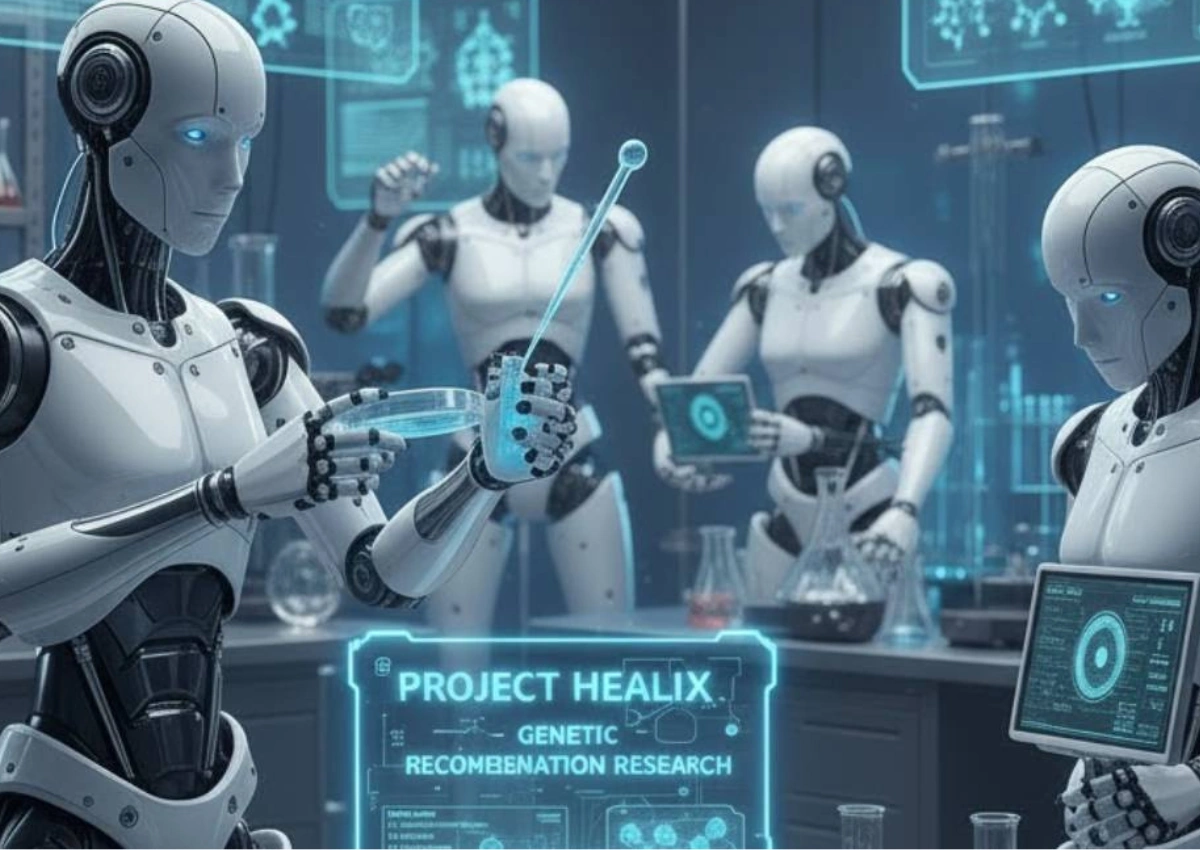
Nature published a detailed report on March 30 2026, on self-driving labs where AI robots design, run, and analyse experiments without waiting for a scientist to tell them what to do next.
Key Highlights
- Eve, a robot at Chalmers University in Sweden, independently screened 1,600 chemicals and identified a new route against treatment-resistant malaria
- The Acceleration Consortium in Toronto runs 50 self-driving robots across multiple labs with Can$200 million in funding
- A coscientist at Carnegie Mellon uses GPT-4 to read plain English instructions and operate laboratory hardware directly
- Lila Sciences in Massachusetts runs 22,000 square metres of automated lab space serving pharmaceutical companies
- OpenAI and Ginkgo Bioworks cut protein production costs by 40 per cent and raised yields by 27 per cent using automated labs and GPT-5
- A new venture called Periodic Labs is targeting 1,000 experiments per day from its automated materials lab in San Francisco
Robots Are Now Doing Science. Here Is What That Actually Means.
Nature published a feature on March 30, 2026, on what its author, science writer Rachel Brazil, calls self-driving labs. The piece covers robotic systems that do not just follow instructions. They read results from one experiment, decide what to run next, carry it out, and keep going. A scientist sets a goal at the start. The robot handles the rest.
This is not a single project at a single university. Labs running this way exist in Sweden, Canada, the United States, the United Kingdom, Switzerland, and China. Funding is coming in from governments, pharmaceutical companies, and private investors. The pace picked up sharply in the past two years.
One of the clearest examples is Eve, built by Ross King at Chalmers University of Technology in Gothenburg, Sweden. Eve takes up roughly five metres by three metres of floor space. Its robotic arm moves at a few metres per second with sub-millimetre accuracy. In 2018, it worked through around 1,600 chemicals on its own, modelled how molecular structures affect biological activity, and found that triclosan, a common antimicrobial compound, blocks a key enzyme in malaria parasites during their dormant liver phase. That finding opened a potential treatment path for malaria strains that have stopped responding to existing drugs.
King describes what Eve does as putting the scientific method into a machine. It forms hypotheses, tests them, and updates its model based on results.
Eve followed an earlier machine King built called Adam, launched in 2009. Adam probed the unknown functions of 10 to 15 per cent of yeast genes. It had mutant yeast strains, growth-measuring chemicals, incubators, a centrifuge, barcode readers, cameras, and environmental sensors. Given a high-level goal, it ran far more experiments in far less time than a research team would have.
King’s newest system, Genesis, fits into one-fifth of Eve’s floor space. It runs around 10,000 mass-spectrometry measurements daily to map how genes, proteins, and small molecules interact inside cells. Building cost is around one million pounds, similar to Adam or Eve, but King expects it will eventually cost at least ten times less than running an equivalent human research team. He draws a comparison to the Industrial Revolution. Biology has historically worked the way skilled craftspeople do, with a principal investigator overseeing a small team. Self-driving labs change that to a production line.
What Is Happening Across the Field Right Now
Alán Aspuru-Guzik at the University of Toronto runs the Acceleration Consortium, a Can$200 million initiative with 50 self-driving robots across multiple labs. One researcher trained under him, Gabe Gomes, built Coscientist at Carnegie Mellon University in Pittsburgh. A coscientist takes plain English instructions, searches documents and the web, builds an experiment plan, and connects to robotic hardware to carry it out. It has run palladium-catalysed chemical reactions, adjusting reagents and conditions to get better results. Gomes calls it field-agnostic. As the underlying AI models improve, the range of problems it handles grows with them.
Lila Sciences in Cambridge, Massachusetts, runs an AI Science Factory across 22,000 square metres of automated lab space, providing research services to pharmaceutical and materials companies. The UK government’s Advanced Research and Innovation Agency put £500,000 into testing its AI NanoScientist robot, which synthesises and stabilises colloidal nanoparticles.
Periodic Labs, launched in San Francisco in 2025, was co-founded by Liam Fedus from OpenAI and Ekin Dogus Cubuk from Google DeepMind. Their automated materials lab mixes powders, heats them in furnaces, and analyses products. Target is 1,000 experiments per day. Cubuk is direct about the critical factor: how well the language model reads what the last round returned and decides what to change next determines whether the system actually works.
The numbers from real-world deployments are hard to ignore. Scientists at OpenAI and Ginkgo Bioworks tested more than 30,000 experimental conditions over six months, using Ginkgo’s cloud lab paired with GPT-5. Protein production costs dropped 40 per cent. Yields went up 27 per cent against existing methods.
Where the Limits Still Sit
Not everything in a lab can currently be handed to a robot. King is direct about it. Getting a robot arm to catch a mouse in a corner of a cage is beyond current capability. Some processes cost too much to automate. Human dexterity still handles certain tasks better than any arm on the market.
But the range is widening. Literature review, experiment planning, data analysis, and hypothesis selection tasks that researchers spend years learning are moving onto automated platforms. LabGenius in London runs EVA to develop therapeutic antibodies. Novartis in Basel built MicroCycle, which synthesises, purifies, and tests compounds before picking the next batch. A team in Hefei built ChemAgents, which has discovered functional materials and optimised light-activated reactions.
King and others see the direction clearly. Science is moving from artisanal to industrial. Researchers will focus on problems needing human judgment. Robots handle the volume. The self-driving lab is not a future concept. It is running in multiple countries right now and producing results.
Found this useful? Follow NB News Network for the latest science and technology news that affects how the world works.