Ayushman Bharat’s Big Healthcare Shake-Up: 112 Treatment Packages May Shift to Government Hospitals From December 1, What It Means for Patients
States will decide whether to apply the change, so it is not a blanket ban on private hospitals
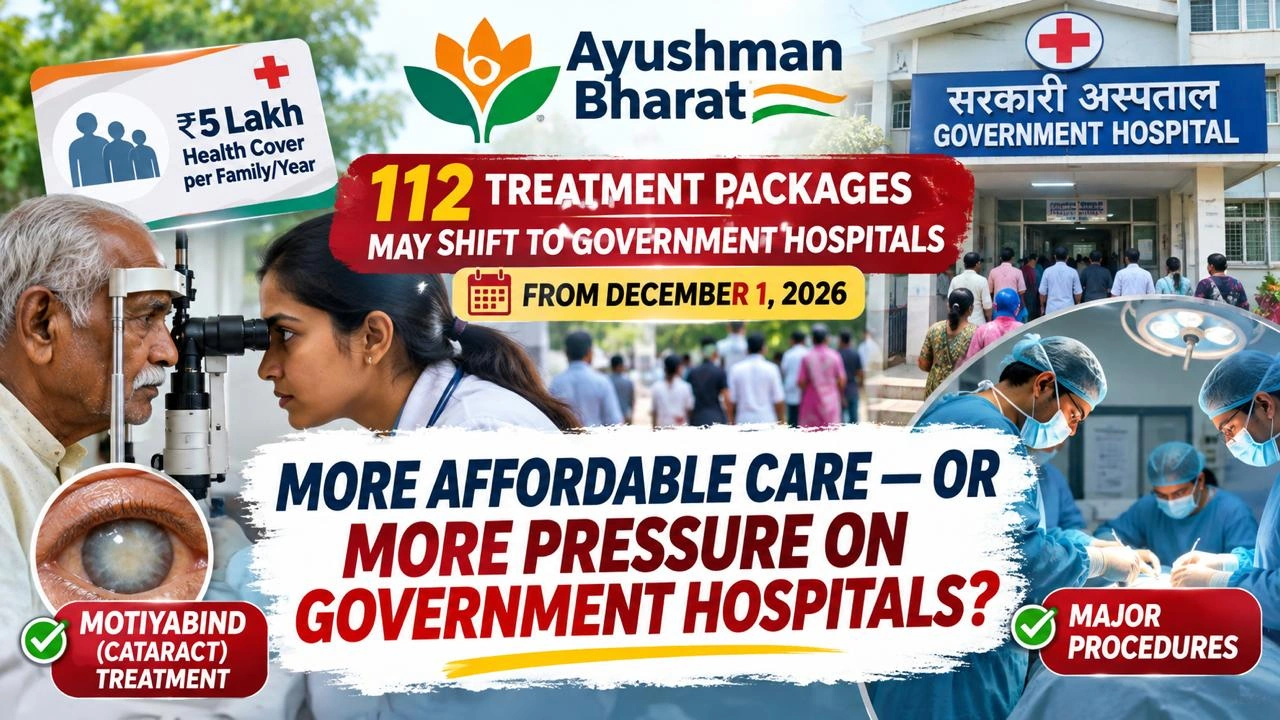
Under a proposed change to the Ayushman Bharat Pradhan Mantri Jan Arogya Yojana (AB-PMJAY), 112 treatment packages are being earmarked for government hospitals, which could limit access to those packages at private hospitals from 1 December 2026 in states that adopt the decision. The Ayushman Bharat 112 packages plan could affect millions of families that rely on cashless treatment, and it raises a question: will it strengthen government hospitals by steering more patients to them, or will it create new problems for patients who have so far used private hospitals under the scheme?
The National Health Authority (NHA) has communicated the proposed changes to state health authorities. According to reports, 23 treatment packages are already reserved for government facilities and 89 more are proposed to be added, and the revised list is scheduled to appear in the scheme’s Transaction Management System (TMS) from 1 December 2026. States, however, keep the discretion to decide whether to remove these packages from private hospitals, so this should not be read as a nationwide ban on private hospitals providing Ayushman Bharat treatment.
What the Ayushman Bharat 112 Packages Plan Changes
Launched in 2018, PM-JAY is one of the world’s largest publicly funded health assurance schemes. It gives eligible families cover of up to ₹5 lakh a year for secondary and tertiary hospitalisation, and beneficiaries can get cashless treatment at empanelled government and private hospitals under the applicable packages and guidelines.
Under the Ayushman Bharat 112 packages proposal, selected packages would be directed to government hospitals in participating states instead of being offered through private providers. A patient who needs one of those treatments may therefore have to go to an eligible government hospital to claim the scheme’s benefit, depending on the state’s final decision. It also helps to know what “112” counts: it refers to treatment packages, not 112 separate diseases. A package can include a defined set of procedures, hospital services and associated care.
Ayushman Bharat 112 Packages: What Is Not Changing
Which Treatments Could Be Affected?
The reported list spans several specialities, including general medicine, surgery, gynaecology, orthopaedics, mental healthcare, ENT and ophthalmology. Reports say it also includes daycare treatments as well as surgeries. Conditions and procedures mentioned in the reported list include the following.
Treatments Mentioned in the Reported List
The range makes the proposal especially relevant for lower-income households, for whom cashless treatment can decide whether care comes on time or gets put off. Beneficiaries should check the final state-wise package list and hospital eligibility before assuming that a particular treatment will be available only in a government facility.
Why the Government May Be Considering It
The aim appears to be to build up public healthcare and direct more of the scheme’s resources towards government hospitals. India has a large network of public facilities, though many face gaps in infrastructure, equipment, specialist availability and patient capacity, while private hospitals have become important providers under publicly funded insurance. Supporters of the idea would point to four possible gains.
These gains depend on how the change is carried out, not on the announcement alone.
Can Government Hospitals Handle the Extra Load?
This is the biggest concern about the Ayushman Bharat 112 packages plan. Government hospitals already serve large populations, and in many cities patients wait long for consultations, tests, surgeries and specialist appointments. If selected treatments are available mainly through them, patient numbers could rise further. A patient who needs a specialised surgery, for example, could face delays if the nearest government hospital lacks a specialist, working equipment or free beds, and for serious illness even a short delay can add medical and financial strain. Districts without advanced diagnostics or specialist departments may find it hardest.
What States Will Need to Ensure
- Enough qualified doctors and specialists.
- Sufficient hospital beds and operation theatres.
- Modern diagnostic equipment and facilities.
- Steady supply of medicines and essential supplies.
- Efficient patient registration and treatment systems.
- Timely treatment without needless administrative delay.
Without those improvements, restricting selected packages at private hospitals could leave a gap between benefits on paper and benefits in practice. Reports say states are currently reviewing staffing levels and surgical capacity before deciding on the December rollout, and several states have already partly put such a system in place.
What Happens to Private Hospitals Under the Ayushman Bharat 112 Packages Plan?
Private hospitals are a major part of the scheme’s delivery network. According to government figures released in March 2026, 36,229 hospitals were empanelled under AB-PMJAY as of 28 February 2026, of which 19,483 were public and 16,746 private, and the national Health Benefit Package covered 1,961 procedures across 27 specialities.
Reserving packages could shift how patients are split between the two sectors. Private hospitals may see fewer scheme patients for treatments that a state chooses to reserve, but they are not being dropped from Ayushman Bharat. They can keep providing other eligible treatments, subject to empanelment and the rules. The wider challenge is to strengthen public hospitals while keeping private providers in the scheme.
What Should Ayushman Cardholders Do?
The key point for beneficiaries is that the benefits are not ending. The ₹5 lakh annual family cover stays, and the proposed change concerns where selected packages can be used. Patients should not assume that every private hospital will stop accepting Ayushman cards on 1 December, because the restriction covers selected packages and depends on each state.
Five Things to Check
- 1Check family eligibilityConfirm that your family is eligible under PM-JAY.
- 2Check the packageVerify that the treatment you need is covered under the applicable package.
- 3Check authorised hospitalsFind out which hospitals in your state can provide that treatment.
- 4Check state reservationSee whether the package has been reserved for government hospitals in your state.
- 5Ask for helpContact the state health authority or the Ayushman Bharat helpline if you face difficulty getting treatment.
A Policy That Will Be Judged on the Ground
The proposal on the Ayushman Bharat 112 packages could strengthen government hospitals, improve the use of public infrastructure and reduce dependence on private providers for selected treatments. It could also add pressure on crowded public hospitals if infrastructure, staffing and treatment capacity are not upgraded at the same time. The real measure will not be how many packages move to government hospitals, but how quickly an ordinary patient can get good treatment without financial hardship.
For millions of families, Ayushman Bharat is a financial safety net against the unpredictable cost of serious illness. As 1 December approaches, states will have to show that strengthening public healthcare does not come at the cost of convenience, timely treatment or choice. The answer will come from patients’ experience on the ground, not from policy documents.
Quick Answers
What is the Ayushman Bharat 112 packages change?
A plan to reserve 112 treatment packages for government hospitals (23 already reserved plus 89 more), with the updated list due on the TMS from 1 December 2026.
Will the Ayushman Bharat 112 packages change stop private hospitals accepting cards?
No. Only selected packages are affected, and states decide whether to remove them from private hospitals.
Does 112 mean 112 diseases?
Not necessarily. A package can include several procedures, services and related care.
What should cardholders do?
Check eligibility, package coverage, authorised hospitals and your state’s decision, and call the helpline if there is a problem.