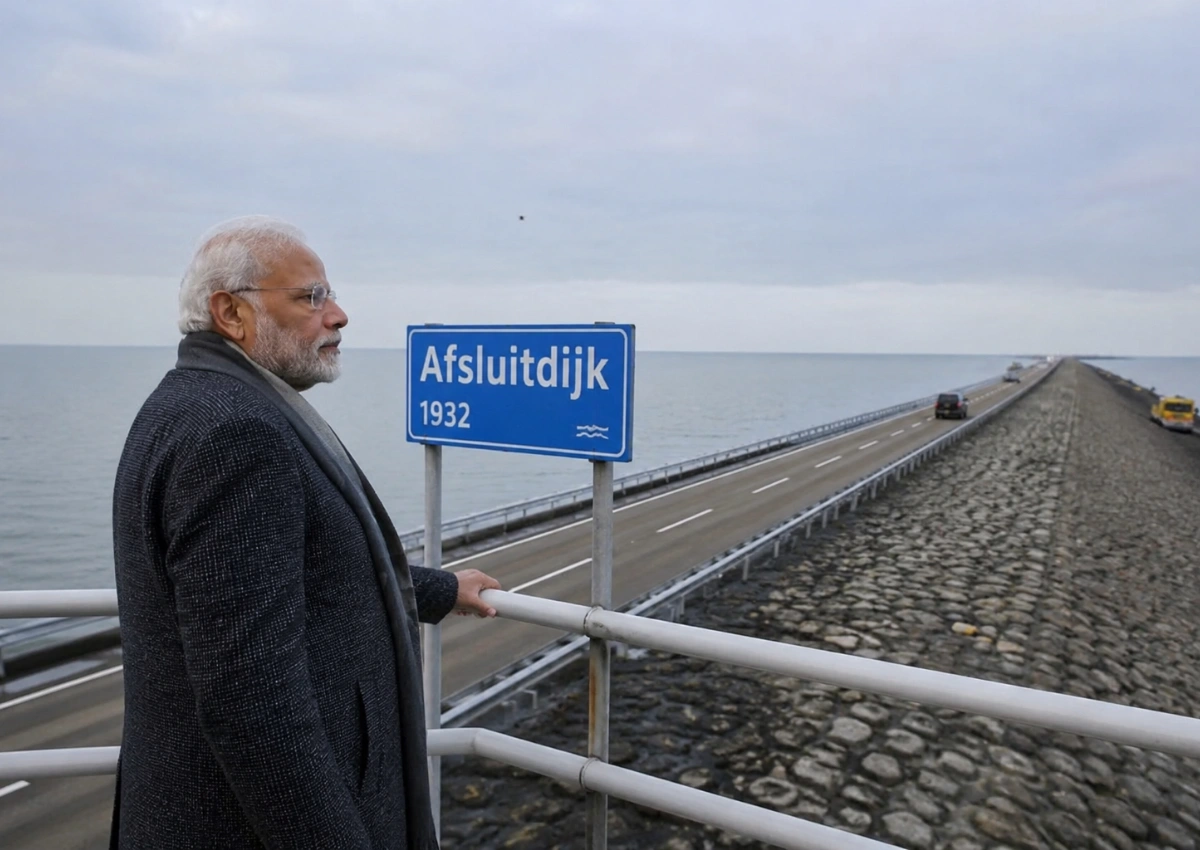
Prime Minister Narendra Modi of India’s visit to the Netherlands, during his global diplomatic visit, drew a lot of interest when he paid a visit to the world-famous Afsluitdijk Dam, considered one of the most iconic engineering feats in the country. The visit wasn’t merely a symbolic gesture for an international long trip but signified the increased significance of climate resilience, water management, sustainable infrastructure and engineering cooperation in today’s global diplomacy. The Afsluitdijk. Though the construction of the Afsluitdijk is regarded as perhaps the greatest engineering project in Dutch history.
When it was constructed nearly a hundred years ago, it revolutionised the Dutch attitude and approach to water and has since been used as a template for flood control and economic/protective structures around the world. Such a visit by PM Modi indicates growing Indian enthusiasm to learn from countries that have effectively managed their climate change and urban infrastructure challenges.
As incidents of severe climatic episodes, increased sea levels and water-related disasters are becoming frequent across the globe, such infrastructure projects are becoming relevant at an international level. The visit also illustrated the continued advancement of collaboration between India and the Netherlands in areas of climate, sustainability, adaptation, and technology transfer.
What’s the Afsluitdijk Dam?
The Afsluitdijk is a monumental dam and causeway in the Netherlands, linking North Holland with the Friesland province. About 32 kilometres long, the dam was finished in 1932 as a component in an extensive Dutch water management program for protecting the Northern Sea from Dutch flooding.
The Netherlands has historically encountered significant problems due to much of the country lying below sea level. Flooding has also been one of the most significant hazards to the Dutch for centuries. This greatly diminished the risk of flooding and helped provide more secure living conditions for millions of residents. It gained international recognition as a marvel in civil engineering and climate adaptation.
Why the Structure Is Considered Special
The Afsluitdijk Still isn’t an ordinary dam. It symbolises the dream of countless generations to survive, to be innovative and to be better prepared.
One of the reasons as to why the structure is so unique is because of the sheer scale of the engineering feat that it was trying to achieve. When being built, it was an extremely bold project to undertake as it was a massive barrier and forever altered the landscape and life of the Netherlands. The dam also led to demonstrating how infrastructure can serve multiple goals.
It has flood prevention, transportation, water management and environmental regulation. Today, the Afsluitdijk is being upgraded to cope with modern problems such as the effects of climate change (e.g. increased sea levels and stronger storms). One reason for the worldwide fame is its longevity, being still relevant nearly 100 years after its erection.
India and the Netherlands: Expanding Cooperation
The inspection visit to the dam by Prime Minister Modi is also an indication of the emerging cooperation between India and the Netherlands in the domain of sustainability, water technology, agriculture and clean energy. The Dutch have already joined hands with India on several projects on water management and urban planning.
Dutch knowledge has been utilised in conversations on port systems, flood control, riverfront development and sustainable urban infrastructure. Looking to the future, India’s rapid urbanisation intensifies the urgency of building new climate-resilient infrastructure.
International collaboration can provide technological knowledge and planning setups to assist with India’s long term development objectives. The visit was Because of this both symbolic and practical. It showed India’s willingness to learn from countries that have managed to achieve sustainable development.
Engineering and National Identity
There is no doubt that engineering, as a global profession, has been affected by this emphasis on national identity. By looking at Britain’s engineering history, I’ll analyse how engineering itself has been used to develop national identity.
The Afsluitdijk is one of the reasons why, for many Dutch people, it has such an emotional significance. The Dutch weren’t solely trying to get away from water, but were exploring the idea that instead of reacting solely to natural disasters, they could manipulate and control water.
Huge public projects became national symbols of survival and unity. Eventually, the Afsluitdijk was more than infrastructure; it was incorporated into the Dutch mind.
Nowadays, many countries around the world regard this kind of project not simply as a technological achievement, but as a demonstration of their long term planning and national approach. In this context, on one hand, PM Modi showed his acknowledgement of the same, and he also tried to place the importance of infrastructure in the shaping of a country’s destiny.
Global Attention on Climate Adaptation
PM Modi’s visit is also indicative of how climate adaptation is becoming a key global policy issue. In the past, adaptation wasn’t a matter of concern in most of the global forum deals with climate reduction. Now the focus has shifted towards adaptation, because the effects of climate change are becoming visible. Flood defences, resilient cities, systems for renewable energy, sustainable transportation and water management are now at the core of international working group debates.
The Afsluitdijk has also, in a larger sense, transcended local engineering by becoming closely intertwined with a broader global discussion about the way societies deal with climatic unpredictability.
Conclusion
The trip to the most renowned water-control structure in the world, the Afsluitdijk Dam in the Netherlands, by the Prime Minister of India, Narendra Modi, underlines the realisation of climate resilience, water security and sustainable infrastructure for global diplomacy.
The structure is still one of the most admired engineering feats in the world because it revolutionised the country’s approach to water and safeguarded millions of lives for hundreds of years.
As we face more and more environmental problems across the world, the knowledge embodied by the Afsluitdijk is becoming more and more applicable.
For India, the visit was a reminder of the nation’s need to engage with the Netherlands, while simultaneously serving as an acknowledgement of planning, climate monitoring and resilient infrastructure as key steps in the future.