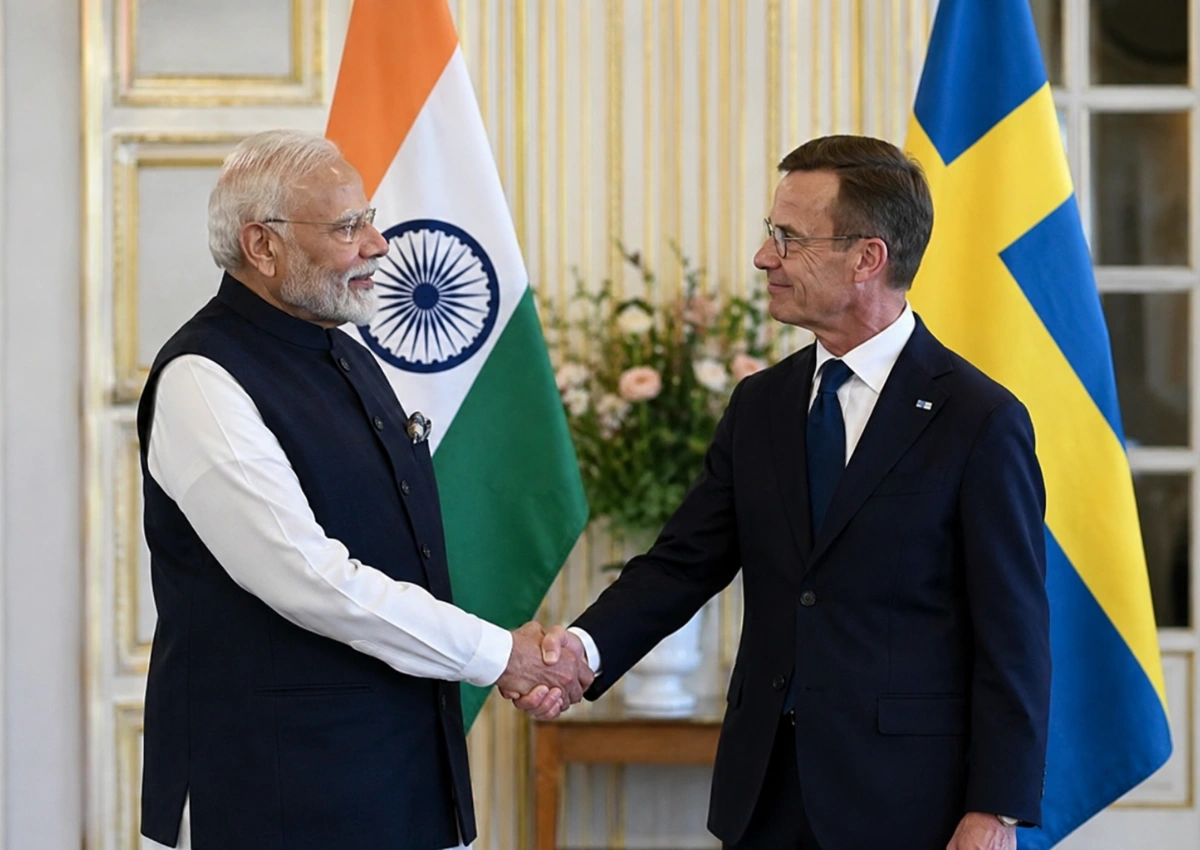
India and Sweden agreed to enhance the relationship to a “Strategic Partnership” during then-Prime Minister Narendra Modi’s visit to Gothenburg. The discussions of the two Prime Ministers focused on AI, defence, clean technology, innovation, and green industrial transition.
As such, it shows a wider trend in Indian foreign policy where relationships are increasingly predicated on future technology, sustainable development and strategic security rather than more conventional trading relationships.
At a time when individual countries have become locked in a race for technological dominance and energy self-sufficiency, the India-Sweden strategic partnership demonstrates how global diplomacy is increasingly intertwined with innovation, climate change and stability in the global system. The new agreements and action plans that were announced during the visit imply that both nations are attempting to forge a continuous partnership in dealing with developing worldwide issues.
A Relationship Expanding Beyond Traditional Diplomacy
Having enjoyed a friendly relationship for decades, the India-Sweden relationship may be moving into a more strategic stage. This was evidenced by the agreements reached at the visit to boost collaboration in high technologies, defence production, green industrial transition, innovation and research. The conversations revealed that countries are moving from viewing diplomatic relations as strictly political alliances. Technology and economic resilience now matter just as much.
Countries seek out collaborations that enable them to stay in the game against other major powers. India finds the strengthening of relations with the more technologically developed Europeans a foreign policy priority. With Sweden, India is one of the world’s most rapidly growing major economies and an important market for innovation, manufacturing and investment eventually.
Artificial Intelligence Becomes a Diplomatic Priority
Perhaps the most significant benefit from this visit was to emphasise cooperation on artificial intelligence. AI continues to be one of the most dominating technologies in the world as it has an impact on most of the major organisations such as healthcare, finance, manufacturing, education, transportation, cyber security and defence. Countries are investing a lot in AI globally.
That’s because the race for technological dominance is becoming crucial to economic and geopolitical power. India has been broadening its AI ecosystem with startups, investments in digital infrastructure, and government schemes around technology innovation.
Sweden is renowned for its research strength, sophisticated engineering systems and innovation-led industries. Based on the concept of technological cooperation, the two parties promoted collaboration in the fields of AI (like research, invention), digital infrastructure, and technology responsibility, which will lead to industrial systems, urbanisation, and digital services. The technical aspects of the discussions surrounding AI are indicative of the increased importance of technology in diplomacy. Nations now consider cooperation in areas of technological expertise as a matter of strategic necessity.
Defence Cooperation and Strategic Security
The visit covered other issues, such as that of Defence co-operation. India, over the last few years, has made extensive modernisation of its defence equipment and is trying to boost domestic manufacturing under the “Make in India” program. Sweden is world-renowned for its leading-edge defence technology. In the field of aerospace engineering, surveillance systems, and radar technology, the country is well ahead of the rest of the world. The country also has the most up-to-date military inventions.
These factors make Sweden an ideal strategic partner for India, considering the latter’s objective of building a self-sufficient arsenal with minimal reliance on defence imports. The discussions are reported to have included defence-industrial cooperation, security collaboration and its plans for long-term military technology cooperation.
Security cooperation and stability in the region, together with the fight against terror, were discussed by the two states. India’s rising defence engagement with European countries also indicates that it’s seeking to diversify its strategic partners rather than remaining overly dependent on a handful of allies.
Economic and Trade Opportunities
The economic relation between India and Sweden is more than just this. Many Swedish companies have already reached out to India, such as telecommunications, industrial systems, transport engineering and renewable energy.
The growing digital economy, population and manufacturing growth bring opportunities for the Swedes to invest in India. Sweden witnesses opportunities not only in the Indian market but also in the developing start-ups, leading to technological advancement.
Meanwhile, India also seeks advanced technology partners and manufactures industrial investments to develop local manufacturing capacity. The talk on the visit is expected to give a solid foundation to boost trade and investment.
Nowadays, economic relationships are more and more tied to technology-sharing. This gives the India-Sweden relationship important strategic value to both countries.
India’s Growing Engagement With Europe
The Sweden visit also underscores the growing Indian push to deepen engagement with European countries in general. Recently, India has increased its diplomatic and economic outreach to numerous European nations in the fields of clean technology, infrastructure, climate cooperation and security.
Lately, the greater significance of Europe for India has opened up as it brings technologically advanced expertise, investment opportunities and industrial collaboration and conversely, European nations regard India as a major state in Asia for political and economic engagement.
The world environment has been transformed recently due to geopolitical tensions, disruption to supply chains and economic uncertainty. As a consequence, nation-states seek to foster strong and resilient international relationships. The growing scope of India’s relations with the continent is indicative of a changing global context where diplomacy is more and more reliant upon resilience, technology and strategic cooperation.
Challenges Ahead
Though both countries might be better off with the solution, there are still some problems to be solved in both countries. It will require long-term policy coordination, investment technology sharing arrangements, and so on, as well as durable political migration to solve. Working in the field of developing artificial intelligence cooperation also brings up several concerns related to data privacy, cybersecurity issues, ethics regulation and digital governance.
Also, green transition projects necessitate heavy investment and a revision of industrial organisation. Yet, ultimately, the survival of the partnership will rely on whether the arrangements that were discussed at the visit will be successfully put into operation eventually. Warm diplomatic notes actually give an illusion, but the benefits achieved in the long term would be based on sustained follow-up and practical co-operation.