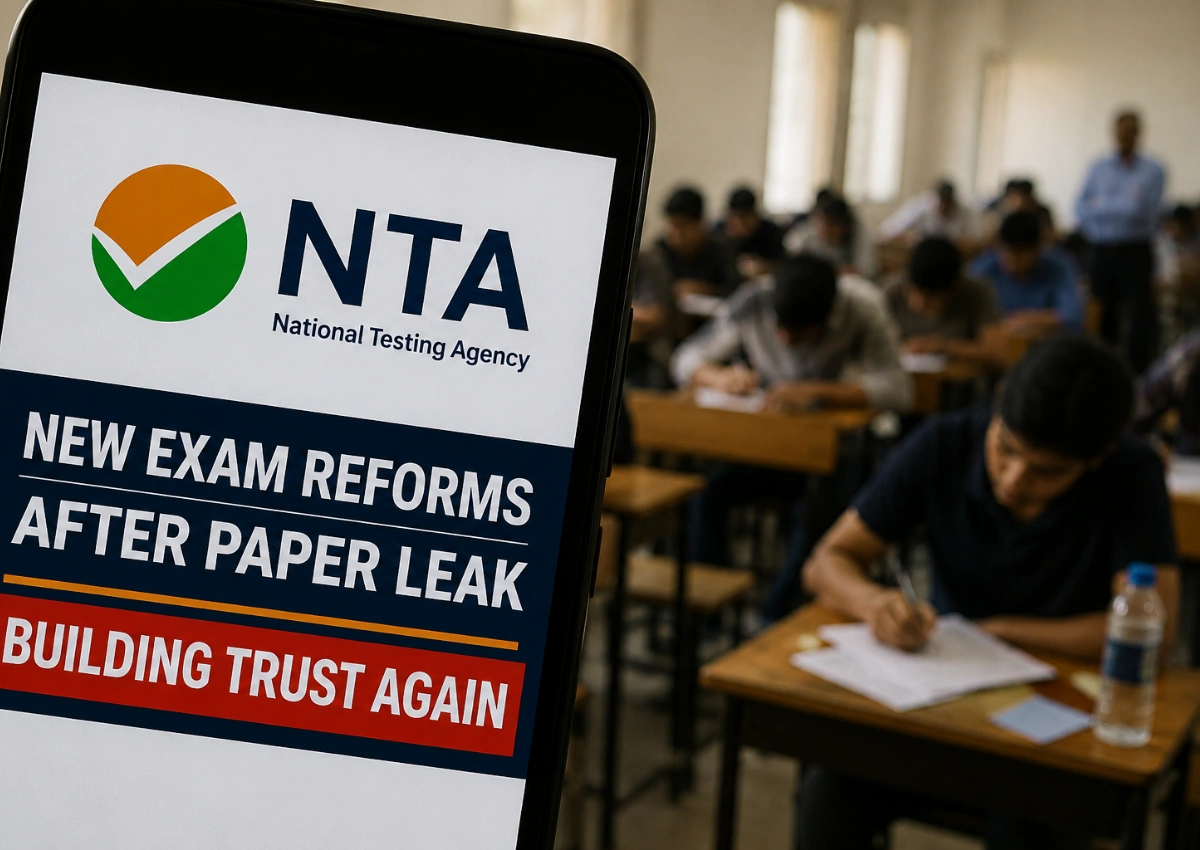
The National Testing Agency (NTA) has introduced a package of significant changes to ensure exam security and win back public trust after the repeated incidents of paper leak, which damaged the image of competitive exams, that were the reasons for these reforms. Publications that show pictures of question papers, influencers, and organizations that promote leaked papers frequently change their criminal tactics, despite strict punishments, making it a constant game of cat and mouse.
Competitive examinations are an inseparable part of our lives now, as is iron and steel. There’s no doubt that school education lays the foundation but has become one of the most important factors determining your future, which is a matter of concern for our whole society i.e. students parents teachers, and all those who are tied to it in any way.
It’s with these objective in mind that NTA has announced major measures. Experts are of the view that the reforms will further bring integrity in the examination system.
Background: The escalating Paper Leak issue
Lots of competitive exams were held in different states which over the years, started receiving allegations of paper leak, cheating through network, impersonation, and irregularities. Many incidents resulted in protests, court cases, cancellation of exams, and demands for investigation.
The problem attracted a lot of attention In particular after the release of modern-day competitive exams with such large-scale that millions of students around the globe make long-term preparation by investing their time, money, and emotions. In addition, due to the rise of coaching centers, private tuition systems, and hard social pressure, the entrance exam isn’t only competitive but also emotionally draining.
The scenario is when exam papers get leaked or irregularities come to light then students invariably feel that they’ve been cheated and many of them have to reappear in the exam after a long delay of few months, which only increases their anger and mental stress.
This escalating crisis brought about a significant decline in public trust and imparted to the officials a need to come up with very stringent measures.
What Changes Has NTA Declared?
Recently, NTA put forward a couple of new reforms mainly focused on enhancing security measures, upgrading monitoring systems, and decreasing avenues of malpractice.
It’s said the reforms are:
- Advance digital surveillance during examination
- Stronger security encryption for paper transmission
- AI-based monitoring systems
- Candidate biometric verification
- Close coordination with the cybercrime department
- Real-time surveillance of examination halls
More thorough background verification for officials involved in exam handling. NTA is also believed to have stepped up its liaison with the state police and intelligence units to root out organized cheating syndicates. The idea isn’t only to check paper leaks but also to restore public confidence in the examination system.
Role of Technology in Securing Exams
The introduction of new reform measures has led to the increased use of technology in exam management which is a huge leap. AI-based surveillance, facial recognition, biometric attendance, and encrypted digital paper delivery are becoming the major tools of modern exam systems.
Officials think that technology could decrease human manipulation and raise responsibility. Digital monitoring enables immediate detection of doubtful conduct and also makes record-keeping more efficient.
Still, the extensive use of technology also throws up practical and moral issues. Technical breakdowns, server failure, Internet difficulties, and system bugs could give rise to new problems, Most of all in huge examinations with millions of candidates.
Scholars contend that technology ought to assist in ensuring justice but at the same time, such systems should be dependable, transparent, and within the reach of students coming from different backgrounds.
Student Trust and Emotional Pressure
Arguably the greatest problem for the NTA today isn’t a matter of technology but one of emotions how to rebuild student trust.
Competitive exams in India are so tightly linked to social and economic aspirations that students can hardly prepare without going through intense pressure, often for years. The joint entrance exams to medicine, engineering, and government jobs are prime examples of this trend.
When exam papers are leaked, students who have studied honestly feel that the system no longer guarantees a level playing ground for competition and this breeds a sense of despair and confusion. Canceling or postponing exams that have been compromised leads to a loss of student trust even more. Besides the psychological distress.
Mental health professionals have urged time and again that repeated examination disputes lead to increase of psychological` pressure in young people, Mainly those preparing for their examinations.
Coaching Culture and Competitive Pressure
Apart from the paper leak, this problem also concerns the bigger coaching culture around competitive exams. Testing for college admissions has become so competitive that entire industries now rely on exam prep. Students frequently relocate, invest heavily in coaching, and commit several years to study. In such a competitive scenario, even minor misconducts provoke immense outrage, as the stakes are very high.
The critics point out that the over-reliance on only one high-stakes exam has resulted in a system that isn’t only unfair but also very stressful where performance in one day can decide the entire life of a student.
These developments have resulted in these discussions:
- Examination reform
- Multiple assessment systems
- Continuous evaluation models
- Reducing extreme competition pressure
So the paper leaks are just the surface of the problem and the debate is actually about the structure of the examination system.
Challenges in Implementing Reforms
Although the new policies may be strong on paper, the lion’s share of the challenge is in the execution.
India runs some of the largest exams in the world, with:
- Multi-million candidates
- Thousands of exam venues
- Huge digital infrastructure
- Many languages and areas
The task of managing such large-scale operations without any technical or administrative failure is almost impossible. Internet connectivity in rural areas, lack of uniform infrastructure, power cuts, and low digital literacy can create problems for the implementation of highly technological systems.
With the increasing use of biometric and AI-based systems, there’s growing concern about data privacy and surveillance. The professionals are of the opinion that the reforms, if introduced, should be supported by strong training, transparency, and accountability structures.
Broader Impact on Education and Employment
Competitive examinations can decide the fate of students not only in acquiring education but also in deciding their future jobs and social status. For many students, Mainly from middle-class and rural backgrounds, entrance exams are viewed as means for economic stability and social upliftment. If trust in examinations diminishes, it will result in loss of confidence in systems that are based on merit.
This is the reason why exam integrity goes beyond just the matter of administrationit is connected with social justice, equality and equal opportunities. Only a transparent and dependable examination system can keep the public trust in educational and recruitment institutions going.
Need for Long Term Reform
Experts in the field of education lament that simply stopping paper leaks won’t accomplish much. Long-term reform is linked to extensive changes in education and assessment systems.
Some reform ideas:
- Completely eliminating the reliance on single entrance exams
- Offering university assessments more flexibility
- Making higher education of good quality accessible to more people
- Raising the overall standard of school education
- Enhancing the career guidance systems
If major educational pressures leading to exams aren’t removed, then stress related to exams and cases of malpractices Linked to them may continue. Because of this the matter calls for reform both in security and education.