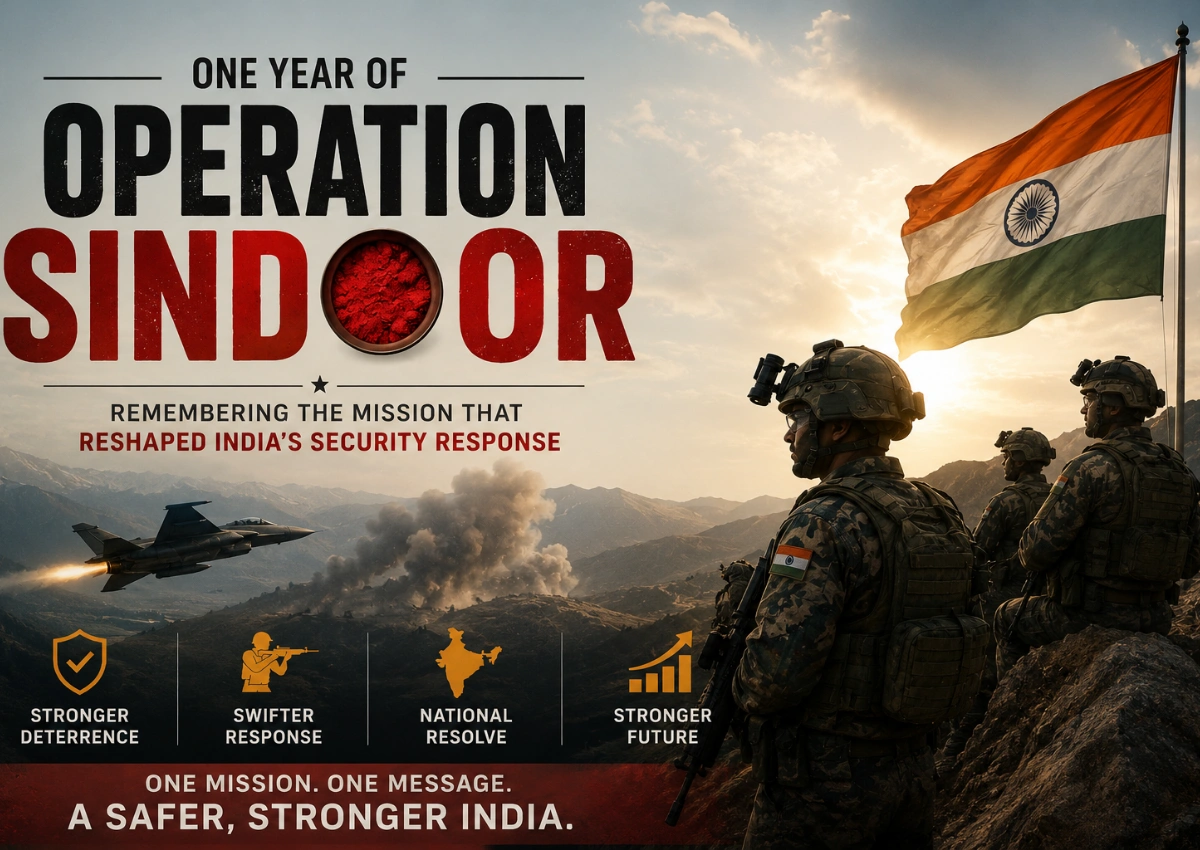
It has been a whole year since India launched “Operation Sindoor,” a major military and anti-terrorism operation. The operation was launched on 7 May 2026, right after the horrific Pahalgam attack, which left dozens dead in Jammu and Kashmir, and it changed India’s strategy for national security and dealing with terror across the borders in a big way.
The main focus of the operation was the terror camps that are situated in Pakistan and Pakistan-occupied Kashmir (PoK), which not only stirred political and diplomatic debates but also military discussions inside the country and outside. Initially, the exercise was just a security measure, but later it significantly shaped India’s strategic and political landscape.
While the nation is commemorating the first year of Operation Sindoor, the conversation has shifted from just the military actions to their ripple effects on the national security policy, India-Pakistan relations, internal preparedness, media coverage, and public perception. This day is a reminder for us to think about how deeply the operation has influenced the country throughout the year.
Background: The Pahalgam Terror Attack
Operation Sindoor was initiated in response to the Pahalgam terror attack that not only caused shock among the populace but also drastic indignation and calls for the government to act firmly. The assault, which took the lives of both civilians and security forces in Jammu and Kashmir, once again underscored the persistent dangers posed by militancy and cross-border terrorist networks.
Political leaders from all sides condemned the brutal act, while security forces geared up for an extensive investigation and better intelligence sharing. The mood of the people was in favour of a strong reaction. Social media platforms, televised debates, and political discussions were clear signs of mounting pressure on the government to deliver a firm blow to the terror infrastructures across the border. In this climate of tense anticipation and mourning on a national scale, the authorities decided to initiate Operation Sindoor.
Launch of Operation Sindoor
India formally launched Operation Sindoor in May 2026, attacking several terror camps in Pakistan and Pakistan-occupied Kashmir through coordinated missile and precision strike operations. The authorities termed the mission a “limited and exact counter-terror operation” that focused on killing only terrorist infrastructure while sparing civilian or military establishments.
Official sources have said that the operation sought to disband the camps of those groups that are believed to be behind the planning of attacks against India. Immediately, the operation made headlines all over the world. International media closely followed the situation, while major world players called for restraint and regional harmony, but for India, the operation was seen as a show of its strategic power and political determination.
Public Response and National Sentiment
The public’s reaction to Operation Sindoor was very strong and emotional. Throughout the nation, there was great support for the military forces, accompanied by a solid nationalist spirit. Public assemblies, candlelight marches, and social media campaigns showing support for the security forces were widespread during that time. Many considered the operation a strong signal that terrorist attacks would be met with retaliation. Politicians also praised the military, and this action soon entered the national political dialogue.
However, some voices called for a more thoughtful approach and diplomatic balancing. A few specialists pointed out that a military confrontation between two nuclear-armed countries poses great dangers and should therefore be handled very cautiously. This fusion of patriotic feelings, security worries, and international political tensions colored the public discussions for the following weeks after the operation.
International Diplomatic and Regional Reactions
Operation Sindoor not only attracted local attention but also major international focus. Several countries requested that India and Pakistan show restraint, and at the same time, they appreciated India’s concern about terrorism. World bodies and foreign governments kept a close eye on the situation in India-Pakistan relations, as any upsurge in the two countries’ conflict was feared by many. India explained that the operation was a perfectly lawful act of self-defence geared at countering terrorism, and the Indian side stressed the point that the operation was very narrowly targeted and totally limited in its nature.
As a result of the operation, talk about international cooperation to combat terrorism and the need for states to take responsibility for not allowing terror networks to operate within their territories also intensified.
Operation Sindoor and India-Pakistan Relations
Even after one year of the Operation Sindoor, it is continuing to have a bearing on the India-Pakistan relations. Initially, the immediate post-strike period saw a sharp increase in the diplomatic tensions between the two countries, and besides that, the two countries’ communication was at a very low level for several months.
Additional border fencing, more frequent patrolling, and, in many locations, security alerts remained at the highest levels near the Line of Control. Despite the fact that neither side was willing or ready to endure a full-fledged military conflict, the operation served as a point of deepening the political distrust between the two countries, especially. Besides that, experts argue that it has culminated in a more aggressive counter-terror doctrine becoming a quasi-corporative element of India’s security policy. While the sequence of events leading to such a turn of events might not be very clear, terrorist issues remain a stumbling block in any serious dialogue or interaction between the two neighbouring countries.
Security Changes After the Operation
Internal security preparedness has been one of the most significant long-term consequences of Operation Sindoor. The implementation of various mock drills, upgrades in airport security, and enhancements of surveillance and emergency preparedness exercises have been taking place in different parts of the country during the last year. Pushing in monitoring of sensitive areas, refining intelligence coordination, and fortifying cybersecurity systems were some of the steps taken by the authorities in response to the emerging threats of misinformation and hybrid threats.
Besides these, the operation has brought out the issue of defence modernisation, drone surveillance, AI-based monitoring systems, and border infrastructure development, among other things. In their opinion, security experts relate human changes in military policy that operations brought about with the overall adjustment of a nation’s approach towards preparedness and crisis management.
Media Coverage and the Role of Social Media
Operation Sindoor was the major media news event of the year. TV channels, digital media platforms and also social media users shared news images, discussions and patriotic messages during the event. On the other hand, the disastrous effects of misinformation in national security situations were proved by this event. Fake videos, unverified claims, edited footage and rumour-based reporting were some of the items that were being rapidly spread online. That gave rise to the reconsideration of topics such as responsible journalism, fact-checking and digital regulations during security emergencies. Both the government and the media organisations were put under pressure to find a balance between transparency and national security concerns. The operation showed that modern wars are waged not only on borders, but also in digital information spaces.
Remembering the Human Cost
Operation Sindoor might be framed as a military-political operation in most discussions but the anniversary is also a reminder of the human cost of terrorism and conflict. For example, the families of the victims of the Pahalgam attack, the border residents living in a constant security environment, and security personnel patrolling the high-risk regions are emotionally and psychologically challenged.
It is vital to keep alive the memories of these human aspects. Aside from strategic talk and political stories, national security issues touch the lives of common people so deeply that they suffer changes and setbacks in their lives. Hence, the anniversary is not only a commemoration of a military success but a time for contemplation, a show of strength in hardship, and a marking of the memory of those who have been lost.