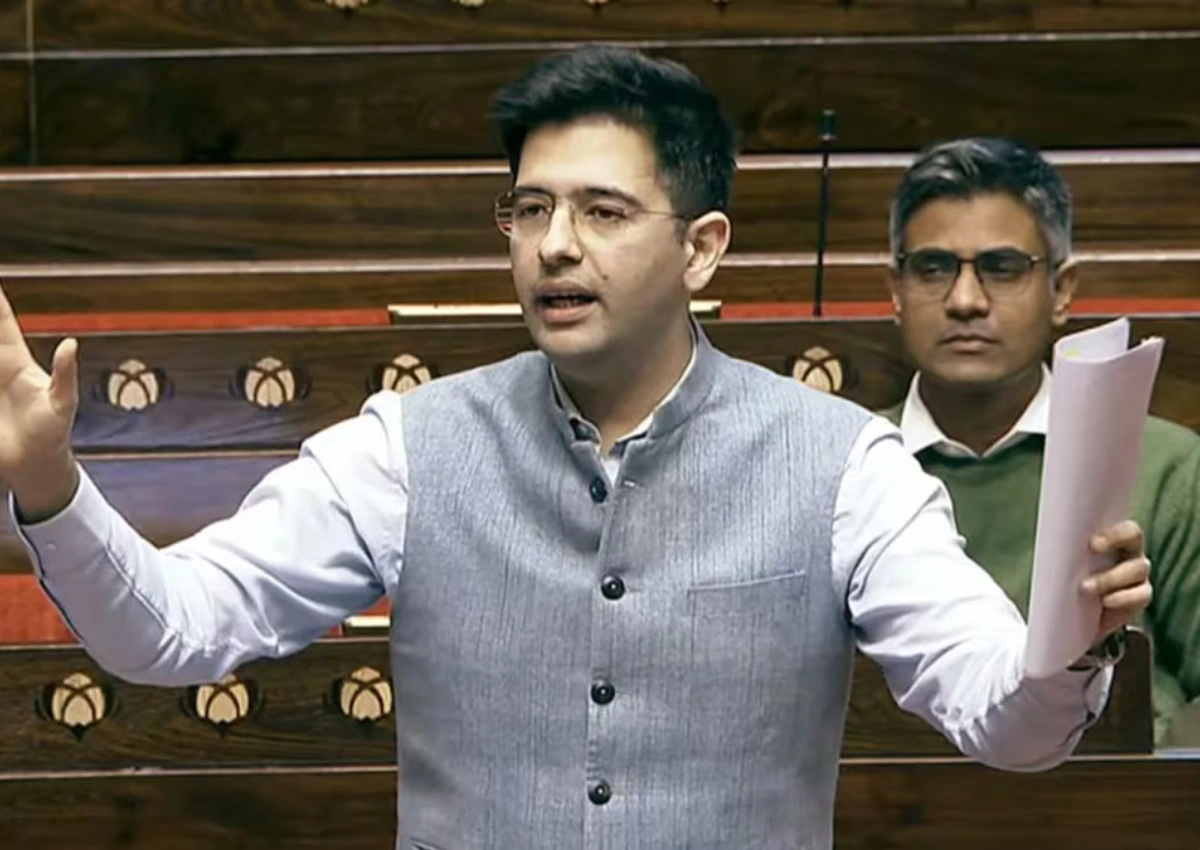
In Indian politics, the top leaders’ reshuffle in parties generally doesn’t stay secret for long. When the Aam Aadmi Party (AAP) at the beginning of April 2026 decided that Raghav Chadha would no longer be the Deputy Leader of the party in the Rajya Sabha, the decision soon became public, resulting in a very unusual and very sharp public exchange of words within the party.
A few years ago, Chadha was considered to be one of the most trusted lieutenants of Arvind Kejriwal and the face of AAP in Parliament. Now, his removal from the position has become a point of departure to look at the issues of loyalty, parliamentary strategy, and going too far while expressing one’s individual views within a tightly-knit organisation. This case study analyses the actions taken at each step, the views of the parties involved, and their reflection on this incident of the time.
Who he was and what he did
Raghav Chadha, after his accounting qualifications, became a member of AAP during the period when it was fighting against corruption, and he didn’t remain a newcomer for very long. He finally got elected to the Rajya Sabha representing Punjab in 2022, since then he has been known for his well-spoken and reasoned speeches on the economy, policies, and local government issues. He was the one who brought to the Upper House of Parliament a kind of voice that was both mature and based on data. His being in the core group and close to Kejriwal was enough to be given big tasks, which was a common perception.
Deputy Leader’s removal from office occurred on April 2-3, 2026, when AAP officially sent a letter to the Rajya Sabha Secretariat requesting that Punjab MP Ashok Mittal be appointed in his place. The party did not stop there and also wrote to the Secretariat asking them not to provide Chadha with speaking time from AAP’s quota. Initially, party sources labelled the change as a “routine organisational readjustment.” However, the public statements by the senior leaders made it clear that there were deeper issues behind this move.
The Trigger and AAP’s Perspective
Many AAP leaders justified the step as a reply to Chadha’s parliamentary focus. In recent times, they argue, he has concentrated primarily on issues that are regarded as “soft” or “PR-friendly” such as gig workers’ rights, food adulteration, toll fees, airport canteen prices, and concerns of digital content creators. Although these are all legitimate matters of public interest, the dissenters within the party indicated that these subjects purposely avoided confrontations with the central government and did not sufficiently bring to light Punjab-related grievances, like dues from the Rural Development Fund or flood relief.
Punjab Finance Minister Harpal Singh Cheema and other state leaders claimed that Chadha had “betrayed” Punjab’s interests. Delhi Minister Saurabh Bharadwaj asked publicly why Chadha had neither taken part in major opposition walkouts nor signed any motions. AAP leader Atishi went to the extent of saying that some leaders get “scared” of the BJP and stop raising difficult issues. Chief Minister Bhagwant Mann reportedly, in private conversations, termed Chadha as “compromised” and these statements later cropped up in news reports.
The party’s stand was very clear: our parliamentary representatives should be working in tandem with the collective strategy. The AAP is such a highly disciplined organisation where the communication is mostly centralised that even an act by a member or a group, which may look like deviation, would be seen as undermining the bigger fight.
Chadha’s Response: “Silenced, Not Defeated”
Chadha didn’t stay quiet. Just a few hours after his demotion, he shared on X (formerly Twitter) a carefully penned down video saying, “Ghayal hoon, isiliye ghatak hoon” “I am wounded, that is why I am lethal.” Later, he posted another longer compilation video of his speeches in Rajya Sabha on issues like gig workers’ low wages and no social security, amendments to the Copyright Act for digital creators, healthcare reforms, and food adulteration.
In a long reply, Chadha rejected the charges as “baseless, maliciously motivated and totally false.” He referred to official parliamentary documents to refute the accusations that he had missed opposition protests or had refused to sign important motions. He maintained that his top priority has always been issues that directly impact the common people rather than confrontational theatrics. “It is not wrong to raise one’s voice for the public, ” he pointed out, describing the incident as a move to silence a dissenting voice rather than a genuine organisational change.
However, Chadha did not even accuse the party leaders directly, nor did he mention any plans of quitting the party. In fact, he is currently a Rajya Sabha MP from Punjab and neither has he been suspended nor expelled.
Underlying Factors and Broader Context
A public dispute of this nature cannot be seen as a sudden development. Some secretly noticed a slight change in the relationship between the two since March 2024, when Kejriwal was arrested in the excise policy case. Even then, Chadha gave a proper public statement on the matter, and the difference was quite visible as Kount and trends implied that these differences in tone got sharper when certain senior leaders kept responding to the Kejriwal case in quite an aggressive manner. Gradually, over the two years, differences in styles became clearer to the public. While Chadha was in favour of deep policies and talking to other parties, the party was more into a sharp and confrontational approach.
The move of AAP to exclude Chadha from the list of star campaigners for the upcoming assembly elections led to more rumours. Some commentators believe that this is just AAP’s way of showing a more unified and centrally controlled parliamentary face before the next elections. Others think that it is part of a bigger pattern that when the leaders who have developed independent profiles get reined in.
On top of that, the controversy resulted in the party members receiving backlash even from outsiders. The BJP leaders who spoke out in favour of Chadha’s right to voice his opinion also managed to stoke the flames of rumours – nevertheless, there is no concrete evidence that there has been any change in his political leaning.
What the Episode Unveils
Among its many insights, the incident reveals the inherent tussle between individual drive and collective discipline within a party led by a few top leaders.
Historically, the Aam Aadmi Party has positioned itself as a breath of fresh air in politics, being a transparent party, non-dynastic, and governance-oriented rather than power-oriented. However, the Chadha incident demonstrates that even AAP has the same troubles of ambition management, different work styles, and public image in a hierarchy like the other. For the party, it might be unfortunate that at the same time when it is trying to recover after the 2025 Delhi Assembly election and is busy with other state elections, this episode may give an impression of internal conflict. On the other hand, for Chadha, the incident might be a turning point to some extent: does he remain a marginalised parliamentarian or does this realignment bring him more things?
At the moment (early April 2026), the matter is uncertain. Chadha is still a member of the Rajya Sabha, and the party has not meted out any further punishment. None of them has reached a complete rupture so far. Whether this will only lead to a party reorganisation or, on the contrary, deep divisions will be revealed, only time will tell.